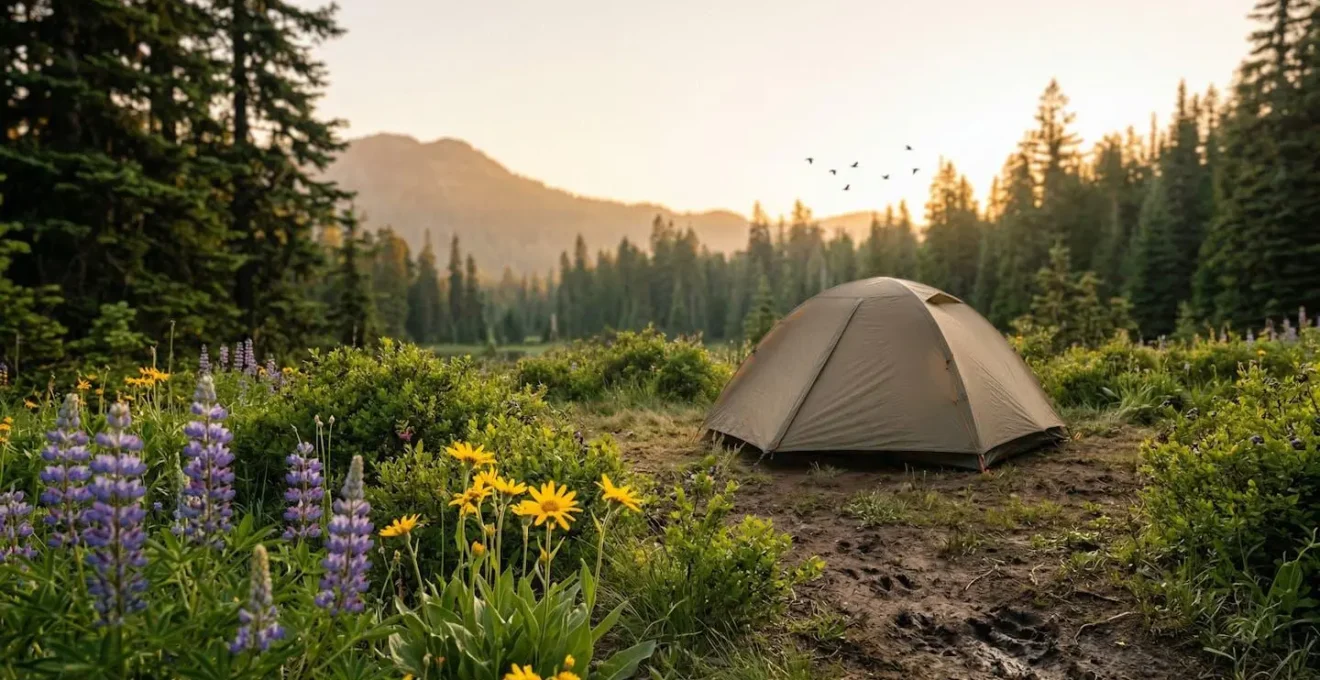
Contrary to popular belief, feeding wildlife is not a harmless act of kindness; it’s a death sentence that triggers an ecological breakdown and often ends with a “management” kill.
- Habituating an animal to human food corrupts its natural foraging behavior, leading to aggressive encounters and property damage.
- Even indirect actions, like not cleaning your boots, spread invasive species that dismantle native ecosystems from the ground up.
Recommendation: Shift from seeking interaction to practicing respectful distance and observation. Your goal is to leave the wilderness and its inhabitants completely unaltered by your presence.
It’s a scene played out in parks and on trails worldwide: a nature lover, heart full of good intentions, tosses a piece of their sandwich to a curious squirrel or an inquisitive bird. It feels like a moment of connection, an act of kindness. The common wisdom is that this is mostly harmless, or at worst, it might make the animal a little “dependent.” This comforting assumption is dangerously wrong. As a wildlife biologist, I can tell you that this single act is often the first link in a chain of events that leads directly to that animal’s death and contributes to the degradation of the very ecosystem you came to enjoy.
The problem goes far beyond simple dependency or giving an animal an unhealthy snack. When you feed a wild animal, you are actively teaching it a fatal lesson: humans are a reliable and easy food source. This is the start of what we call ecological corruption. The animal’s finely tuned, instinctual behaviors—honed over millennia for survival—are short-circuited. It stops performing its natural role, whether that’s seed dispersal, insect control, or being part of the prey-predator balance. Instead, it becomes a beggar, and soon, a thief.
This article will dismantle the myth of harmless feeding. We will not just repeat the rules; we will explore the brutal ecological math behind them. We’ll start with the stark reality of why “a fed bear is a dead bear,” then expand to the invisible damage caused by invasive seeds hitchhiking on your gear. Finally, we will equip you with the skills to become a truly ethical observer—one who can appreciate wildlife intimately without signing its death warrant. It’s time to replace ignorant “kindness” with informed respect.
This guide will provide a clear framework for understanding the profound impact of human presence on wildlife. Each section is designed to build on the last, moving from the most critical rules to the nuanced skills of an expert observer, ensuring you leave the wild exactly as you found it.
Summary: A Biologist’s Guide to Ethical Wildlife Viewing and Ecosystem Protection
- The “Fed Bear is a Dead Bear” Rule: What It Really Means for Your Safety?
- How to Clean Your Boots to Stop Invasive Seeds from Hitchhiking?
- Binoculars or Zoom Lens: How to Get “Close” Without Stressing the Animal?
- Freezing vs Relaxing: How to Tell if an Animal Wants You to Leave?
- Bear Canister or Hang Bag: Which Method Actually Stops Rodents?
- The 100-Yard Rule: How to Enjoy the Sighting Without Altering Behavior?
- Upwind vs Downwind: How to Approach Wildlife Without Being Smelled?
- Tracking Endemic Wildlife: How to Spot Rare Species Without Disturbing Habits?
The “Fed Bear is a Dead Bear” Rule: What It Really Means for Your Safety?
The phrase “a fed bear is a dead bear” isn’t a catchy slogan; it’s a blunt statement of cause and effect. It describes a tragic, predictable sequence that begins with a single human feeding and ends with wildlife managers being forced to euthanize an otherwise healthy animal. This isn’t about punishment; it’s about public safety. Once a bear associates humans with food—a process called food-conditioning—it loses its natural wariness. This is the start of a dangerous behavioral cascade. The bear no longer avoids campsites; it approaches them. It no longer flees from human voices; it investigates them, seeking a calorie-rich reward. In Vermont alone, wildlife officials respond to hundreds of bear conflict calls each year, many stemming directly from access to human food.
This progression was tragically illustrated in Glacier National Park, where a four-year-old black bear was euthanized after becoming food-conditioned. It brazenly snatched food from an open car while visitors were nearby. The bear was healthy, but its behavior was irreversibly corrupted. Relocation is not an option for these animals; they either return to their original territory or, more likely, become a problem in a new community. The “problem” isn’t the bear; it’s the behavior that humans taught it. A food-conditioned bear will tear into a tent, break into a car, or approach a child with the same food-seeking drive it once used to turn over logs for grubs. At that point, it has crossed a line and become a significant threat to human safety, leaving managers with no responsible choice but management euthanasia.
Every time you leave food unsecured or intentionally offer a handout, you are pushing an animal one step closer to this grim fate. Your momentary act of “kindness” is, in reality, the first step in signing that animal’s death warrant.
How to Clean Your Boots to Stop Invasive Seeds from Hitchhiking?
While the danger of feeding large predators is obvious, one of the most significant ways we destroy local ecosystems is microscopic and unintentional. Every step you take on a trail has the potential to transport non-native, invasive plant seeds to new areas. These hitchhikers can outcompete and eliminate native flora, which in turn devastates the local insects, birds, and mammals that depend on it for food and shelter. The scale of this problem is staggering. When studying visitors to Antarctica, one of the world’s most protected environments, researchers found over 70,000 seeds from dozens of plant families, with nearly half clinging to visitors’ footwear. This isn’t just littering; it’s a form of biological warfare waged by our dirty boots.
Preventing this form of ecological destruction requires a conscious and diligent routine. It’s not enough to simply “stay on the trail.” You must actively decontaminate your gear before and after every single outing. This simple act is one of the most effective conservation efforts any hiker can undertake.
Your Post-Hike Decontamination Protocol
Action Plan: Preventing the Spread of Invasive Species
- Arrive Clean: Start your hike with clean shoes, clothing, and gear. Use boot brush stations at trailheads to scrub any seeds or soil from your boot treads before entering the ecosystem.
- Scrub and Inspect: After your hike, use a stiff brush to remove all visible mud, seeds, and organic debris from your boots, paying special attention to the laces and tread grooves.
- Clean All Gear: Don’t stop at your boots. Brush off your backpack, tent, and even check your pet’s fur for hitchhikers. Invasive seeds are notoriously good at clinging to any surface.
- Stay on Marked Trails: Venturing off-trail not only causes erosion but is the primary way seeds are picked up and dropped in pristine areas. Marked trails are corridors; stay within them.
- Report What You See: Use citizen science apps like iNaturalist or EDDMapS to photograph and report suspected invasive plants. This data helps land managers track and control outbreaks.
Choosing Seed-Resistant Gear
You can also fight the spread of invasives through smart gear choices. Smooth-surfaced materials like nylon and other synthetics are far less hospitable to seeds than fleece, exposed socks, or Velcro. Wearing gaiters over your boots creates a physical barrier that prevents seeds from lodging in your laces or the top of your shoes. Simple, pocketless pants without cuffs further reduce the number of places a seed can snag a ride. By dressing for prevention, you turn your gear into a first line of defense.
By adopting this mindset, you move from being a potential vector of destruction to an active steward of the trails you love.
Binoculars or Zoom Lens: How to Get “Close” Without Stressing the Animal?
In the age of social media, the desire to capture a stunning wildlife photo can override good judgment. The impulse to get “just a little closer” for the perfect shot is a powerful one, but it’s a selfish act that prioritizes digital validation over animal welfare. The critical difference between ethical observation and harmful harassment lies in your choice of tool: binoculars or a zoom lens. Binoculars are a tool for appreciation; they bring the animal to you without you invading its space. A camera, especially when used to chase a better angle, often becomes a tool for pursuit. This pursuit, even if subtle, causes immense stress to an animal, forcing it to expend precious energy fleeing and potentially abandoning a nest, a meal, or its young.
The ethical failure is compounded when these photos are posted online. A study of Appalachian Trail hikers revealed that most visitors were completely unaware of how they contribute to environmental problems, a blindness that extends to digital behavior. A major issue is geotagging—embedding the exact GPS coordinates of a sighting in a photo. Posting a geotagged image of a rare orchid, a nesting bird, or a reclusive predator acts as a digital beacon, leading crowds of followers to the same sensitive location. This can lead to trampling, repeated disturbances, and even poaching. The fleeting glory of an Instagram post is not worth the long-term harm to a vulnerable species or its habitat.
True wildlife appreciation means accepting that you don’t have a right to a close-up photo. Your goal is to observe the animal in its natural state, behaving naturally. This requires patience and the right equipment. A quality pair of binoculars or a spotting scope allows for breathtakingly intimate views from a safe, respectful distance. It allows you to witness the animal on its terms, not yours. If you choose to use a camera, it must be paired with a powerful zoom lens that allows you to remain far outside the animal’s zone of awareness.
The best wildlife encounter is one the animal never even knew happened. Leave your ego at home and pack your binoculars.
Freezing vs Relaxing: How to Tell if an Animal Wants You to Leave?
One of the most dangerous misconceptions among nature lovers is misinterpreting an animal’s stillness for comfort. You see a deer in a meadow, and it stops chewing to look at you. You think, “How wonderful, it’s calm and letting me watch.” The reality is the exact opposite. That “freeze” is a high-alert stress signal. The animal has stopped all other activity to devote 100% of its sensory awareness to you, the potential threat. It’s assessing your intent, calculating an escape route, and its cortisol levels are spiking. What you perceive as a peaceful moment is, for the animal, a tense standoff where it is deciding if it needs to flee for its life.
The U.S. National Park Service provides the clearest guideline for this situation. In their wildlife safety rules, they state:
If your presence causes the bear to change its behavior (stops feeding, changes its travel direction, watches you, etc.) you are too close.
– U.S. National Park Service, Save A Bear’s Life wildlife safety guidelines
This principle applies to nearly all wildlife. Any deviation from what the animal was doing before it noticed you is a sign that you have breached its personal space, or what biologists call its Flight Initiation Distance (FID). Key signs of stress include:
- Stopping an activity: A bird that stops preening, a fox that stops foraging, or a moose that stops grazing.
- A change in posture: The animal becomes rigid, lowers its head, or raises its hackles.
- Direct, sustained eye contact: It is no longer casually aware of you; it is actively monitoring a perceived threat.
- Ear orientation: Ears swiveling and locking in your direction are like radar dishes acquiring a target.
A truly relaxed animal is one that largely ignores you. It might glance at you and then immediately return to feeding or grooming. That is the sign that you are at a safe and respectful distance. The moment its behavior is dictated by your presence, you have failed as an ethical observer. The correct response is not to take a photo, but to immediately and slowly back away until the animal resumes its natural behavior.
Treat any change in behavior as a clear, unambiguous request for you to leave. Respect it and back off.
Bear Canister or Hang Bag: Which Method Actually Stops Rodents?
Most backcountry campers focus their food-protection strategy on bears, meticulously planning their bear bag hang or investing in a bear-resistant canister. This focus is important, but it often misses the more persistent and insidious threat: rodents. As professional backpacking guide Andrew Skurka notes, these “mini-bears” are often the bigger issue. He points out:
Mini-bears are probably going to be a bigger issue on the PCT…rodents around the most heavily impacted campsites are pretty comfortable around smell thru-hikers nowadays.
– Andrew Skurka, Tutorial on food storage and protection methods
Mice, squirrels, chipmunks, and marmots are relentless in their quest for high-calorie hiker food. They can chew through expensive backpacks and stuff sacks in minutes, and a poorly hung “bear bag” is little more than a piñata for them.
The critical failure of many food storage systems is that they are not rodent-proof. While a properly executed bear hang can keep a bear from your food, it does almost nothing to stop a mouse from scurrying down the rope or a squirrel from leaping from a nearby branch. These small animals become habituated to human food sources far more quickly and in much greater numbers than bears. A campsite infested with food-conditioned rodents becomes a constant source of unintentional baiting for larger predators. A bear that smells the remnants of a rodent-raided food cache is drawn into the campsite, accelerating the cycle of habituation.
This is where hard-sided bear canisters prove their superiority. A bear canister is not just bear-resistant; it is also completely rodent-proof. Its rigid, slick-sided construction offers no purchase for chewing or climbing. When combined with an odor-proof inner liner, it creates a nearly impenetrable fortress for your food. While a bear hang is a skill that can fail if done improperly (wrong branch height, wrong distance from the trunk), a canister’s effectiveness is simple: just seal it and place it on the ground 100 feet away from your tent. It is the most reliable method for ensuring that no animal—large or small—gets a taste of human food.
Investing in a bear canister isn’t just about following park rules; it’s about taking responsibility for the entire food web, from the smallest mouse to the largest bear.
The 100-Yard Rule: How to Enjoy the Sighting Without Altering Behavior?
Park regulations often post simple distance rules: stay 100 yards from bears and wolves, and 25 yards from bison and other animals. These are excellent, easy-to-remember starting points, but a biologist will tell you they are dangerously oversimplified. The true “safe distance” is not a fixed number; it is a fluid concept determined by the animal’s perception of threat. This is known as Flight Initiation Distance (FID), the invisible boundary that, when crossed by a perceived threat, triggers an animal’s flight response. This distance is not universal. It varies dramatically based on the species, the individual animal’s experience, whether it’s with its young, and the directness of your approach.
A direct, head-on approach is far more threatening than moving tangentially. An animal accustomed to seeing humans on a road may have a much smaller FID than a reclusive individual in the deep backcountry. Prey species are particularly sensitive. While a predator like a bear might tolerate a 100-yard presence, many prey animals will bolt at much greater distances, wasting vital energy. For example, research on 760 approaches to Australian shorebirds demonstrated that their FID varied from a mere 18 meters to over 126 meters depending on the species and context. Applying a single “25-yard rule” to this group would be catastrophic for the more sensitive species.
Therefore, the 100-yard rule should be treated as an absolute minimum for predators, not a goal to be reached. The real rule is to observe the animal’s behavior. If you have a zoom lens or binoculars, you can enjoy a spectacular view from 200, 300, or even 400 yards away, with zero impact on the animal. The goal is not to see how close you can get, but to enjoy the most natural sighting possible. This means staying far enough away that the animal continues its natural behaviors—foraging, resting, or playing—completely unaware of your presence. A quality sighting is measured by the naturalness of the behavior you witness, not by your proximity to the subject.
Use the posted distances as the starting point, not the finish line. Observe from afar, watch for stress signals, and always be prepared to back away.
Upwind vs Downwind: How to Approach Wildlife Without Being Smelled?
Humans are profoundly visual creatures. We perceive the world primarily through our eyes, and we assume other animals do the same. This is a critical error. For most mammals, the world is not a series of images, but an incredibly detailed map of scents. Their sense of smell is so acute it’s almost a form of sight. When you walk through the woods, you are not just a visual object; you are broadcasting a massive plume of scent that travels for hundreds of yards, announcing your presence long before you are seen or heard. Understanding how to manage your scent is one of the most advanced, yet fundamental, skills of ethical wildlife observation.
The key is to always be aware of the wind direction. If you are “upwind” of an animal, the wind is blowing from your back towards the animal. You are effectively sending your scent signature directly to its nose. To an animal like a deer or an elk, your scent is an unambiguous alarm bell. Even if it can’t see you, its brain is screaming “PREDATOR!” and it will either flee immediately or become highly stressed. The only ethical way to observe scent-sensitive animals is to be “downwind,” meaning the wind is blowing from the animal towards you. This carries its scent to you while carrying your scent away from it, allowing you to remain undetected within its sensory bubble.
How can you tell the wind direction? It’s simpler than you think. You can feel it on your face. You can watch the direction grass or leaves are blowing. A classic tracker’s trick is to pull a tiny fluff from a milkweed or cottonwood and see which way it drifts. By constantly monitoring the wind and adjusting your position to stay downwind, you can slip through the landscape without triggering alarms. This is the secret to seeing animals behave in a completely natural, unguarded way. It requires more thought and effort than simply stomping through the woods, but the reward is an authentic glimpse into an animal’s world.
Before you take another step towards an animal, stop and ask yourself: which way is the wind blowing? The answer will determine whether your encounter is respectful or stressful.
Key Takeaways
- A single act of feeding a wild animal directly leads to behavioral changes that make it a danger to humans, often resulting in its euthanasia by wildlife managers.
- Your impact is not just direct; you are an ecosystem-wide vector. Uncleaned boots and gear spread invasive seeds that destroy native habitats from the ground up.
- Ethical observation is defined by distance and detachment. Use optics like binoculars to get “close,” and never geotag your photos of sensitive species.
Tracking Endemic Wildlife: How to Spot Rare Species Without Disturbing Habits?
The ultimate expression of respect for wildlife is to shift your goal from seeing the animal itself to understanding its life through the signs it leaves behind. This is the mindset of a tracker and a naturalist. Instead of striving for a close encounter that inevitably causes stress, you can learn to read the story of the forest in its tracks, scat, and feeding signs. This approach offers a profoundly deep connection to the ecosystem without ever disturbing its inhabitants. A fresh track tells you not only what passed by, but when, how fast it was moving, and where it was going. It’s an intimate look into the animal’s life that is entirely non-invasive.
Furthermore, you can turn this passive observation into active, valuable conservation work. The rise of citizen science has empowered every hiker with a smartphone to become a field researcher. By documenting and reporting your findings, you contribute to massive databases that scientists and land managers use to monitor species populations, track migration patterns, and identify conservation hotspots. This transforms a simple hike into a mission. Instead of just “seeing” a rare bird, you can document its presence, contributing to its long-term protection. This is the most ethical form of “trophy hunting”—where the trophy is a data point that helps save a species.
Here are the key steps to becoming a citizen scientist:
- Download the Tools: Before your trip, install trusted citizen science apps like iNaturalist (for all species), eBird (for birds), or EDDMapS (for invasive species).
- Document the Signs: Focus on photographing tracks, scat, browse lines on trees, or nests from a distance. These signs are often as valuable as a photo of the animal itself.
- Contribute Your Data: Use the apps to identify what you’ve found and log the location and time. Your single observation, when combined with thousands of others, creates a powerful picture of ecosystem health.
- Practice Covert Conservation: If you are lucky enough to find a rare or nesting animal, the most ethical action is to quietly retreat, refrain from photographing it, and never share its specific location on social media. Protect it by keeping its secret.
The next time you go into the wild, challenge yourself to have the quietest, most invisible, and most scientifically valuable presence possible. That is the true mark of an expert nature lover.