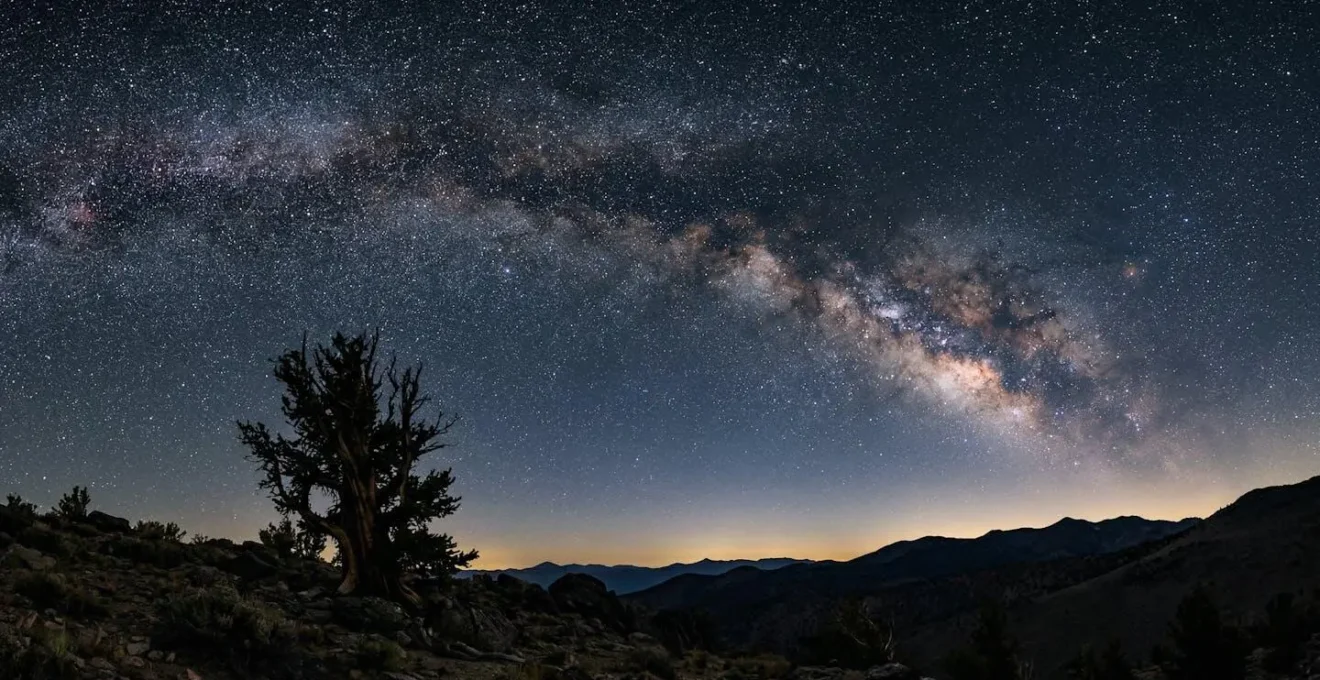
Finding truly dark skies is more than just picking a remote spot on a map. It’s a holistic discipline of managing light across all spectrums—from the glow of distant cities and the sun’s own cycles to the red light in your camp and the photons hitting your camera sensor. This guide reveals the technical, biological, and astronomical strategies needed to achieve pristine darkness and capture breathtaking images of the cosmos.
For the urban stargazer or amateur photographer, the night sky is a ghost of its former self. You invest in equipment, plan your shots, but the final image is a battle against a pervasive orange haze—the signature of light pollution. This invasive glow, or skyglow, washes out the faint nebulae and the delicate dust lanes of the Milky Way, reducing the cosmos to a handful of its brightest stars. The common advice is to simply “get away from the city” and “use a light pollution map,” but this guidance barely scratches the surface of a much deeper practice.
The quest for darkness is a multi-faceted challenge. It involves understanding not just where to go, but when. It requires a form of light discipline that extends to your own campsite and even your internal biology. The difference between a good photo and an awe-inspiring one lies in mastering this entire ecosystem of light. It’s about recognizing that the quality of starlight, or what we might call photon purity, is affected by everything from atmospheric moisture to the 11-year cycle of the sun.
But what if the key wasn’t just escaping artificial light, but actively managing your relationship with all light? This guide goes beyond the basics. We will explore the technical nuances of camera sensors, the biological impact of a single stray streetlight, and the advanced strategies for timing and location that separate the novice from the master astrophotographer. We will transform your approach from one of escape to one of mastery, enabling you to find and preserve the profound darkness our planet still offers.
This article provides a comprehensive roadmap for your journey into the dark. From celestial navigation to advanced image processing, each section builds upon the last to create a complete system for dark-sky mastery.
Summary: Escaping Invasive Light Pollution: Where to Find True Dark Skies for Astrophotography?
- Bortle Scale 1 vs 3:Navigating Ancient Boreal Forests: How to Find Your Way When GPS Fails?
- How to Set Up Camp Lighting Without Ruining Your Night Vision?
- Why Sleeping Under Streetlights Disrupts Your Circadian Rhythm Even in a Tent?
- New Moon vs Milky Way Season: When to Book Your Dark Sky Trip?
- Solar Cycles: Why Booking in 2025 Might Be Better Than 2028?
- The Light Pollution Map Mistake: Why Some “Dark” Zones Are Still Hazy?
- ISO 1600 vs 6400: Is Your Camera Sensor ISO Invariant?
- Mastering Astrophotography: How to Eliminate Noise in High ISO Night Shots?
Bortle Scale 1 vs 3:Navigating Ancient Boreal Forests: How to Find Your Way When GPS Fails?
The first step in any deep-sky journey is severing reliance on the very technology that contributes to a brighter world. Before you can capture the stars, you must learn to read them. In a true Bortle 1 zone—a sky so dark the Milky Way casts a faint shadow—getting lost is a real possibility, and a dead GPS is more than an inconvenience. Celestial navigation is not just a romantic throwback; it’s a foundational skill for the dark-sky purist. It re-establishes a direct, functional relationship with the cosmos. Your primary tool is Polaris, the North Star, a steadfast beacon in the Northern Hemisphere.
Learning to find Polaris is simple. The Big Dipper constellation serves as your celestial signpost. By locating the two “pointer stars” at the end of the Dipper’s bowl (Merak and Dubhe), you can trace a line between them and extend it about five times that distance to find the surprisingly unassuming Polaris. It isn’t the brightest star in the sky, but it is the most important for direction, as it sits almost directly above the Earth’s North Pole. Once you’ve located it, the point on the horizon directly beneath it marks true north. This ancient technique is your most reliable compass.
This skill offers more than just direction. It can also help you determine your position on the globe. In fact, a fundamental principle of celestial navigation shows that the angular height of Polaris above the horizon directly corresponds to your latitude. An astrolabe or even a simple protractor can give you a rough estimate of your latitude, a powerful piece of information when you’re truly off the grid. Mastering this connection transforms the sky from a beautiful backdrop into a functional map.
This knowledge grounds your entire astrophotography experience, connecting you to generations of travelers who looked to the same stars for guidance.
How to Set Up Camp Lighting Without Ruining Your Night Vision?
You’ve traveled hours to reach a pristine dark-sky location. The stars are blazing with an intensity you’ve only dreamed of. Then, your campmate turns on a brilliant white LED lantern, and in a fraction of a second, the magic is gone. Your eyes, which took 30 minutes to fully adapt to the dark, are now bleached and useless. This is the core principle of light discipline: the darkness you travel to find is a fragile resource that you must actively protect, starting with your own campsite. The goal is to illuminate your immediate surroundings without destroying your scotopic (night) vision.
The solution lies in understanding the physiology of the human eye. Your retina contains two types of photoreceptor cells: cones (for color vision in bright light) and rods (for monochrome vision in low light). Rods are incredibly sensitive but are easily overwhelmed by bright light, especially blue and white wavelengths. However, they are almost blind to specific shades of red. Because of this, scientific research on human eye physiology demonstrates that red light above a 650nm wavelength does not affect scotopic (rod) vision, allowing you to see your gear without resetting your dark adaptation.
This is why every serious astronomer and astrophotographer uses a red headlamp. When setting up your camp, declare it a red-light-only zone. Cover your car’s dome light with red film, switch your phone screen to its reddest setting, and ensure any lanterns have a dedicated red-light mode. Even a brief flash from a standard flashlight or a phone notification can set your night vision back by 20-30 minutes, a critical loss of time when you’re trying to frame a galaxy or fine-tune your focus.
Action Plan: Campsite Light Contamination Audit
- Source Identification: Methodically list every potential light source at your campsite, from headlamps and phone screens to vehicle lights and watch faces.
- Gear Inventory: Collect all light-emitting devices and document their specifications—do they have a dedicated red mode? What is their lowest brightness setting?
- Coherence Check: Confront your gear with your primary goal. Does your brilliant white lantern align with the value of preserving night vision, or does it work against it?
- Experience Design: Assess your setup. Is it merely functional, or does it enhance the dark-sky experience? A “red-only” zone feels immersive, not restrictive.
- Integration Plan: Create a prioritized list of actions to fill the gaps—replace a white-only headlamp, purchase red gel filters, or download an app to force a red screen on your phone.
By controlling your personal light bubble, you maintain your connection to the faint starlight you came to witness.
Why Sleeping Under Streetlights Disrupts Your Circadian Rhythm Even in a Tent?
Your commitment to light discipline cannot end when you zip up your tent. The insidious nature of modern light pollution means that even in a designated campsite, you may not be free from its influence. A distant streetlight, a neighboring RVer’s “security” light, or the glow from a nearby town can easily penetrate standard tent fabric. This isn’t just an annoyance; it’s a biological attack on your body’s internal clock, the circadian rhythm. This 24-hour cycle governs everything from hormone production to sleep patterns, and its primary regulator is light—specifically, the absence of it.
The key culprit is melatonin, the “hormone of darkness.” As evening falls, your brain’s pineal gland begins to produce it, signaling your body to prepare for sleep. However, exposure to light, especially blue-rich light from LEDs and screens, powerfully suppresses melatonin production. Even the thin walls of a tent may not be enough to stop this. A 2025 peer-reviewed study published in Life journal found that after two hours, blue light kept melatonin levels suppressed at 7.5 pg/mL, while subjects exposed to red light saw their levels recover to a healthy 26.0 pg/mL. This shows that even low levels of the wrong kind of light can trick your brain into thinking it’s still daytime, leading to restless sleep and daytime fatigue—hardly ideal for a night of complex astrophotography.
Protecting your sleep in an imperfect campsite is a form of visual ecology, where you actively manage your environment for biological health. If you can’t control the light outside, you must control what reaches your eyes. This is where bio-hacking strategies become essential for the dedicated stargazer:
- Strategy 1: Use a high-quality contoured sleep mask that blocks 100% of light, especially effective against blue-rich LED wavelengths (460-500nm) that suppress melatonin.
- Strategy 2: Time your last meal 2-3 hours before sleep to align with your body’s natural circadian clock and support melatonin production.
- Strategy 3: Implement a strict ‘digital sunset’ by avoiding all phone, tablet, and backlit screens at least 60 minutes before sleep, as these emit powerful blue light even when dimmed.
- Strategy 4: If light pollution is unavoidable, consider wearing blue-light blocking glasses (with transmission cutoff below 480nm) during evening camp activities.
A well-rested photographer is a more patient, focused, and successful one. Protecting your sleep is as important as protecting your dark-sky site.
New Moon vs Milky Way Season: When to Book Your Dark Sky Trip?
Finding a dark location is only half the battle; arriving at the right time is the other. The night sky is a dynamic theater, and its two main actors are the Moon and the Milky Way. Your primary goal is to schedule your performance when the main character—the galactic core—is on stage and the disruptive character—the Moon—is not. The single most important factor for deep-sky photography is the phase of the Moon. A full moon can be over 1,000 times brighter than the surrounding stars, acting as a giant celestial lightbulb that washes out all but the brightest objects. It essentially creates a Bortle 8 or 9 sky, even in the most remote desert.
Therefore, all deep-sky astrophotography must be planned around the New Moon, when the moon is invisible in the sky. However, the window of opportunity is wider than just a single night. As a general rule, expert astrophotographers recommend that the five days before and after the New Moon are the best times to shoot dark skies. During this ten-day period, the moon is either absent or a razor-thin crescent that sets early or rises late, leaving you with hours of pristine darkness. But the moon isn’t your only consideration. A faint crescent moon can actually be an asset for landscape astrophotography, providing just enough soft, natural light to illuminate a foreground of mountains or trees, creating a more dynamic composition.
The following table outlines how to strategize around the moon’s phases for different photographic goals:
| Moon Phase | Illumination % | Best For | Photographic Advantage |
|---|---|---|---|
| New Moon | 0-5% | Faint deep-sky objects, nebulae | Maximum sky darkness, no moon interference |
| Thin Crescent (5-15%) | 5-15% | Landscape astrophotography with foreground | Natural low-angle light source for illuminating terrain |
| Rising/Setting Full Moon | 95-100% | Dramatic horizon compositions | Creates separation between land and sky, dramatic lighting |
| Overhead Full Moon | 100% | Avoid for deep-sky work | Drowns out Milky Way galactic core visibility |
Finally, you must align your new moon window with the “Milky Way season.” For the Northern Hemisphere, the bright, dramatic galactic core is only visible above the horizon during the spring, summer, and early autumn months (roughly March through October). A new moon in December is great for some constellations, but you won’t capture that iconic shot of the galactic center. The ideal time is a new moon from June to August, when the core is highest in the sky for the longest duration.
Aligning these celestial schedules ensures that when you arrive at your dark site, the cosmos is ready for its close-up.
Solar Cycles: Why Booking in 2025 Might Be Better Than 2028?
While the monthly dance of the Moon dictates your immediate schedule, a much grander, slower rhythm also impacts the quality of the night sky: the solar cycle. The Sun goes through an approximately 11-year cycle of activity, swinging between a “solar maximum” (high activity, many sunspots) and a “solar minimum” (low activity, few sunspots). Counterintuitively, this long-term planning can have a significant effect on your astrophotography, and choosing the right year for a major trip can be as important as choosing the right night. We are currently approaching a solar maximum, predicted to peak around 2025.
During a solar maximum, the Sun ejects more charged particles into space. When these particles interact with Earth’s magnetic field, they create more frequent and intense auroras (borealis and australis). For photographers at mid-latitudes—like the northern US, the UK, or central Europe—the solar maximum of 2025 presents a rare opportunity to capture auroral displays far south of their usual arctic domain. However, there is a trade-off. This heightened solar activity also increases “natural airglow,” a faint, diffuse light in the upper atmosphere that can slightly reduce the contrast of faint deep-sky objects like galaxies and nebulae.
Conversely, a solar minimum, expected around 2028, offers the opposite conditions. With minimal solar activity, aurora opportunities will be scarce even in the far north. The significant advantage, however, is a darker, more stable, and more transparent background sky. This is the ideal time for the purist hunting for the faintest, most distant deep-sky objects. The reduced airglow provides a canvas of pure black, allowing the subtle details of distant galaxies to be captured with greater clarity. Understanding this cycle allows you to align your photographic goals with the Sun’s behavior.
| Solar Cycle Phase | Peak Year | Primary Advantage | Best Photography Target | Trade-off |
|---|---|---|---|---|
| Solar Maximum | ~2025 | Heightened aurora activity at mid-latitudes | Aurora borealis/australis visible in Northern US, UK, Central Europe | Increased natural airglow can reduce deep-sky contrast |
| Solar Minimum | ~2028 | Darker, more stable background sky | Faint galaxies, distant nebulae, Milky Way detail | Minimal aurora opportunities, even at high latitudes |
| Solar Max Side Effect | 2025-2026 | Increased satellite orbital drag | Fewer Starlink trail disruptions in long exposures | Unpredictable satellite brightness variations |
This is the essence of a signal-to-noise philosophy: optimizing every variable, even those that play out over a decade.
The Light Pollution Map Mistake: Why Some “Dark” Zones Are Still Hazy?
The light pollution map is the astrophotographer’s first planning tool. Pointing your browser to a color-coded map showing pristine “grey” or “black” zones (Bortle 1 or 2) feels like a definitive solution. You pick a spot, drive for hours, and arrive to find… a disappointing haze on the horizon. This is the light pollution map mistake: trusting that a dark spot on a satellite-derived map guarantees a truly dark sky on the ground. These maps are brilliant tools, but they have a critical limitation: they primarily measure skyglow, the light scattered vertically into space. They often fail to account for horizontal light travel and low-level atmospheric conditions.
The primary issue is the light dome. Even if you are 100 miles from a major city, its collective glow can be projected vast distances, creating a dome of faint light that hovers over the horizon and contaminates the lower portion of your sky. This is especially true in humid or hazy climates where more particles are in the air to scatter the light. In fact, research on light pollution propagation shows that the glow from a large city can be detected up to 100 km (62 miles) away or more, ruining long-exposure shots aimed in that direction.
So how do you overcome this? The secret weapon is elevation. A strategy of vertical escape can be more effective than simply driving further away. By climbing a few thousand feet, you can literally lift yourself above the thick, hazy layer of atmosphere that scatters the most light. A mountain peak in a “blue” Bortle 4 zone can offer a far superior viewing experience than a valley in a “green” Bortle 3 zone for this very reason. To truly vet a location, you must supplement the light pollution map with other tools:
- Principle: Climbing 1,000-2,000 feet in elevation can lift you above ground-level haze and the worst effects of distant light domes.
- Application: A mountain site in a Bortle 4 zone can offer superior sky quality compared to a valley in a Bortle 3 zone due to reduced atmospheric scattering.
- Verification: Use real-time ‘seeing’ forecasts (available on sites like Meteoblue.com which also provides seeing and transparency data) in addition to static light pollution maps to assess atmospheric stability.
- Distinction: Understand ‘Transparency’ (darkness) versus ‘Seeing’ (stability)—a dark sky can have poor seeing, resulting in blurry stars.
True darkness isn’t just found; it’s scouted with a multi-layered understanding of geography, meteorology, and the physics of light.
ISO 1600 vs 6400: Is Your Camera Sensor ISO Invariant?
You’ve found the perfect dark sky. You’ve preserved your night vision. Now, the final frontier is technical: capturing the faint light of the cosmos with maximum fidelity. This is where a deep understanding of your camera’s sensor becomes paramount. One of the most critical, and often misunderstood, concepts in astrophotography is ISO invariance. For decades, the rule was simple: in the dark, crank up the ISO to make the sensor more “sensitive.” But for many modern cameras, this is not only unnecessary but detrimental.
A sensor that is “ISO invariant” (or close to it) means that there is little to no penalty for shooting at a lower ISO and brightening the image in post-processing, versus shooting at a high ISO in-camera. The amount of noise will be virtually identical. This is because the “read noise”—the electronic noise introduced by the camera when it reads the data from the sensor—is extremely low on these modern sensors. For these cameras, raising the ISO in-camera is just a digital gain applied to the data *after* it’s been captured, which is the same thing your computer does when you move the exposure slider. The advantage of shooting at a lower ISO (e.g., 800 or 1600) is that you preserve significantly more dynamic range. This prevents the brightest stars in your frame from “clipping” to pure white, retaining their color and detail.
Case Study: ISO Invariance Impact on Astrophotography Strategy
Modern sensors (particularly Sony, Nikon Z-series, and recent Canon mirrorless) exhibit high ISO invariance. For invariant sensors, astrophotographers achieve superior results by shooting at lower ISOs (800-1600) to preserve dynamic range and prevent star clipping, then raising exposure in post-processing software. This technique overcomes the camera’s ‘read noise’ electronically. Conversely, non-invariant sensors (older Canon DSLRs) require higher in-camera ISOs (3200-6400) to overcome read noise at the capture stage, as post-processing amplification introduces unacceptable noise. Understanding your specific sensor’s behavior fundamentally changes your night-shooting workflow.
You don’t need a lab to figure this out. You can perform a simple test at home to determine your camera’s characteristics. This knowledge will fundamentally change your shooting strategy and is a key step in adopting a true signal-to-noise philosophy.
This technical insight is a major leap toward professional-quality images, allowing you to capture the full range of light the dark sky offers.
Key takeaways
- True darkness is a discipline: it requires managing light from the sun’s cycles to your headlamp and camera sensor.
- Prioritize red light (650nm+) at your campsite to preserve your dark-adapted scotopic vision, a process that can take over 30 minutes.
- Go beyond maps: use elevation (“vertical escape”) to get above atmospheric haze and distant light domes for superior sky quality.
- Master your tools: understanding if your sensor is ISO invariant allows you to shoot at lower ISOs to maximize dynamic range and avoid clipped stars.
- Stacking is non-negotiable: it mathematically reduces random noise, dramatically improving your signal-to-noise ratio for clean, detailed images.
Mastering Astrophotography: How to Eliminate Noise in High ISO Night Shots?
Even with a perfect location, impeccable light discipline, and an ISO-invariant camera, a single long exposure of the night sky will always contain a degree of unwanted “noise.” This random, grainy pattern is the natural enemy of astrophotography, obscuring fine details and muddying the rich colors of nebulae. The ultimate technique to defeat it is not a filter or a camera setting, but a powerful post-processing method known as image stacking. This is the final and most crucial step in the signal-to-noise philosophy.
The concept is based on a simple mathematical principle. The “signal” (the light from the stars and galaxies) is constant and appears in the same place in every photo you take. The “noise,” however, is random in each frame. By taking multiple identical exposures (called “light frames”) and then averaging them together using specialized software, the consistent signal is reinforced while the random noise is averaged out and effectively cancelled. The improvement is dramatic; the mathematical principle of image stacking demonstrates that stacking 10 images improves the signal-to-noise ratio by the square root of 10 (an approximately 3.16x reduction in random noise). Stacking 100 images would yield a 10x improvement.
This process transforms a series of noisy, mediocre images into a single, clean, and detail-rich master file that can withstand aggressive editing. For professional-grade results, the process is enhanced with “calibration frames” (darks, flats, and bias frames), which remove sensor-specific noise patterns like hot pixels and vignetting. The workflow is methodical but essential:
- Step 1: Capture 10-30 identical ‘light frames’ of your target (e.g., 10 x 30-second exposures at ISO 3200).
- Step 2: Immediately after your imaging session, capture ‘calibration frames’: Dark frames (lens cap on, same ISO/exposure), Flat frames (evenly lit white surface), and Bias frames (shortest exposure, lens cap on).
- Step 3: Import all frames into stacking software (DeepSkyStacker, PixInsight, Sequator—all support calibration frames).
- Step 4: The software will align and average your light frames mathematically, improving signal-to-noise ratio.
- Step 5: Apply calibration frames to remove sensor-specific noise patterns for professional-grade results.
- Step 6: Export the stacked master file and perform final adjustments, working on a much cleaner base image.
By embracing this complete system—from celestial navigation to light discipline and technical mastery—you are no longer just a photographer. You become a true guardian and artist of the dark, capturing the universe not just as it appears, but as it truly is: profound, silent, and luminous.