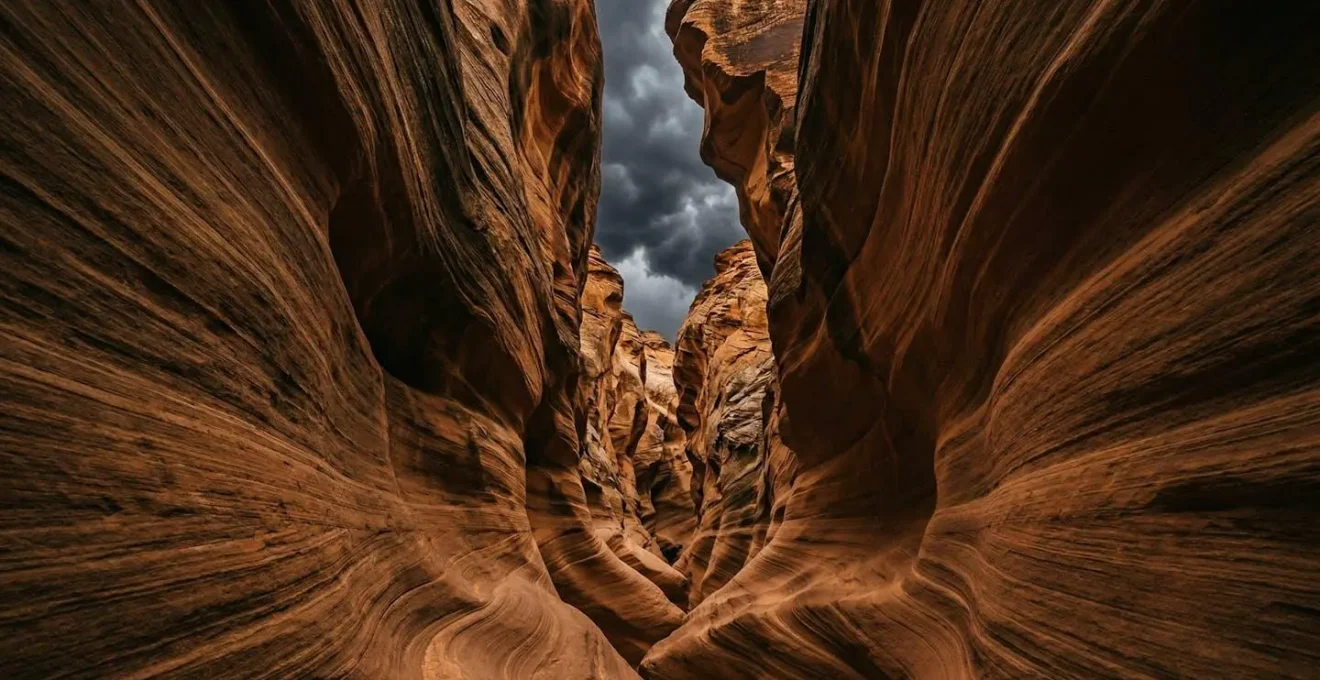
A clear blue sky above a slot canyon is a deceptive killer; the real threat comes from a storm system you cannot see, miles away in the canyon’s watershed.
- Flash floods are not caused by local rain, but by the accumulation of water across a vast drainage basin that funnels into the narrow gorge.
- Survival depends on pre-entry risk assessment—identifying inescapable “trap points” and understanding the specific physics of canyon hydraulics.
Recommendation: Before entering any slot canyon, your primary safety check must be to analyze the full weather forecast for the entire upstream watershed, not just your immediate location.
The image is seductive: a narrow, sculpted sandstone corridor with a sliver of perfect blue sky overhead. For an adventurer heading into the iconic slot canyons of Utah or Arizona, this is the prize. Yet, this idyllic scene hides a lethal paradox. The most terrifying risk in these environments—drowning in a sudden, violent torrent of water—often arrives under that same clear sky. Many canyoneers believe that checking the local weather forecast is sufficient diligence. This is a fundamental, and often fatal, misunderstanding of canyon hydrology.
The conventional wisdom to “look for high ground” or “not enter if rain is predicted” is dangerously incomplete. These platitudes fail to address the core mechanism of a slot canyon flash flood. The true danger isn’t the storm directly overhead; it’s a thunderstorm that occurred an hour ago, 50 miles away, dumping its payload into the vast, interconnected network of washes and tributaries that all feed into the single, narrow channel you are about to enter. This is the concept of the watershed—a drainage basin that acts as a massive funnel.
This guide abandons generic advice. It is built on the principles of systemic risk management used by canyoneering experts and rescue teams. We will not focus on what to do when it starts raining; we will focus on the predictive judgments you must make before you even take your first step into the gorge. We will dissect the landscape for threats, analyze group dynamics as a safety system, and detail the counter-intuitive physics required to survive an encounter with moving water in a confined space. Understanding this system is the only reliable way to mitigate the risk of a tragedy that begins miles away and minutes before you ever see a cloud.
This article provides a structured framework for that understanding. Each section addresses a critical component of slot canyon safety, from environmental assessment to technical maneuvering, designed to build the expert-level judgment required to explore these magnificent and dangerous places.
Summary: A Guide to Flash Flood Prediction and Canyon Maneuvering
- Why a Storm 50 Miles Away Can Flood Your Canyon in 15 Minutes?
- Stemming and Bridging: How to Move Through Canyons Without Exhausting Your Core?
- The Trap Point: Identifying Sections with No Higher Ground Before You Enter
- Dry Bag Failures: The Error That Ruins Electronics in Waist-Deep Water
- Lead or Sweep: Who Should Be Where During a Technical Canyon Descent?
- The Ditch Kit: What Must Be Attached to Your Body, Not the Boat?
- The Horizon Line: How to Spot Hazards You Can’t See from the Boat?
- White Water Rafting Safety: How to Swim Out of a Hydraulic Hole?
Why a Storm 50 Miles Away Can Flood Your Canyon in 15 Minutes?
The most critical concept in slot canyon safety is watershed awareness. A slot canyon is the drain at the bottom of a massive funnel. This drainage basin, or watershed, can span hundreds of square miles of high-desert terrain. A thunderstorm miles away unleashes a tremendous volume of water onto this hard, non-absorbent ground. The water doesn’t soak in; it sheets across the landscape, collecting in small gullies, which feed into larger washes, which ultimately converge on the single, narrow entrance to the slot canyon.
This process creates a terrifying multiplier effect. A moderate amount of rain spread over a large area is concentrated into a violent, debris-filled torrent. This wall of water moves with incredible speed and force. It is not an exaggeration that a storm can occur dozens of miles away, completely out of your sight and hearing. In fact, documented canyon flooding patterns show floods originating up to 50 miles from the storm source. The time from the initial rainfall to the flood’s arrival can be alarmingly short, sometimes as little as 15 minutes, giving anyone inside the canyon virtually no time to react. This is why a clear sky overhead is a dangerously unreliable safety indicator.
Case Study: The 1997 Lower Antelope Canyon Tragedy
On August 12, 1997, a flash flood killed eleven tourists inside Lower Antelope Canyon. On that day, very little rain fell at the canyon site itself, giving the group a false sense of security. However, an intense thunderstorm had occurred seven miles upstream. The runoff from this distant storm funneled into the canyon system, creating a sudden, powerful flood wave that swept through the narrow passages. This tragedy serves as the ultimate, stark reminder that safety depends on monitoring weather conditions across the entire watershed, not just the immediate vicinity of the canyon.
Therefore, your pre-trip planning must involve a thorough analysis of weather radar and forecasts for the entire drainage area upstream of your intended canyon. If there is any significant chance of precipitation anywhere in that basin, the trip must be canceled. No canyon is worth the risk.
Stemming and Bridging: How to Move Through Canyons Without Exhausting Your Core?
Once inside a canyon, your greatest asset after judgment is your energy. Many novices approach narrow sections with brute force, pulling with their arms and tensing their core, leading to rapid exhaustion. The key to efficient and safe movement is energy economy, achieved through techniques like stemming and bridging. These methods rely on oppositional force and skeletal structure, not muscular power, to traverse sections where the floor is non-existent or undesirable to walk on (e.g., deep, cold water or mud).
Stemming is a technique used in narrow passages, where you place your back and feet, or hands and feet, on opposite walls. By pushing outwards, you create a stable, locked-in position. Bridging is similar but involves a more horizontal body position across a wider gap. The goal is to use your legs—the strongest muscles in your body—to do the majority of the work, while your arms are used primarily for balance and stability. This minimizes strain on your core and upper body, preserving precious energy for the long day ahead.
As the illustration demonstrates, effective stemming relies on body geometry. The canyoneer creates an “X” shape, pressing into the walls with straight or slightly bent limbs. This transfers the load to their skeleton, allowing muscles to relax. Mastering this is not just about efficiency; it’s a safety imperative. An exhausted canyoneer makes poor decisions, moves slowly, and is more susceptible to hypothermia and accidents. Practicing these movements in a safe environment before a major trip is crucial.
Your Action Plan: Mastering Energy-Efficient Movement
- Start with proper body positioning: Keep knees slightly bent and weight centered over your feet to maximize friction and minimize muscular effort.
- Use skeletal structure, not muscle power: Press with straight arms and legs in opposition to engage bones rather than relying on arm and core strength.
- Master the rest stance: Find stable mid-maneuver positions where you can pause, shake out limbs one at a time, and allow blood flow to return to large leg muscles.
- Practice the movement vocabulary: Experiment with chimneying (back against one wall, feet on other), stemming (hands and feet on opposite walls), and bridging (horizontal body position) to find the least taxing technique for each section.
- Keep heels low when smearing: This maximizes friction and minimizes calf fatigue during extended stemming sequences.
The Trap Point: Identifying Sections with No Higher Ground Before You Enter
The generic advice to “seek high ground” during a flash flood is meaningless if there is no high ground to be found. The most dangerous slot canyons contain sections where the walls are perfectly vertical or even overhanging for significant distances. Once you enter such a section, you are committed. There is no escape upwards. This is the Trap Point, or commitment point, and identifying it *before* you descend into it is a non-negotiable survival skill.
As the Travel Curious Canyon Safety Guide notes, this concept of commitment is central to canyon topography:
Consider that canyons are typically divided up into different sections, entering a certain section may make you committed to completing that section before you will again have access to a safe spot.
– Travel Curious Canyon Safety Guide, How To Explore Slot Canyons Safely
A Trap Point is not always obvious from above. It might be a beautiful, sculpted hallway that slowly narrows, or a series of short rappels that drop you deeper into the gorge. Before every rappel and at every major bend in the canyon, your team must pause and scout ahead. Ask the critical question: “From the bottom of this drop, can we see a viable escape route within a reasonable distance?” A viable escape route is not a desperate 5.12 climb; it’s a crack system, a sloping ledge, or a debris pile that a panicked, wet, and cold person could realistically ascend.
Look for high water marks on the canyon walls—lines of debris, mud, or discoloration. These marks show you the height of previous flash floods. If you are in a narrow section where the high water marks are 30 feet up and the walls are sheer, you are in a death trap. The decision to not enter a section is just as important as the skill to navigate it. If your team cannot identify a clear escape from a section, you must find an alternate route or turn back. Pride has no place in a slot canyon; a safe retreat is a mark of expert judgment.
Dry Bag Failures: The Error That Ruins Electronics in Waist-Deep Water
In a slot canyon, it’s not a question of *if* you will get wet, but *when* and *how wet*. Protecting critical electronics like your phone, GPS, or camera requires a reliable dry bag. However, a common and costly error leads to catastrophic failure: improper sealing. Most canyoneers use roll-top style dry bags, but they fail to understand that the waterproof guarantee depends entirely on a minimum of three tight, clean rolls before clipping the buckle. Anything less, and the seal is compromised.
The mistake happens in a rush. You quickly make one or two loose folds, clip the bag, and assume it’s safe. But when submerged, especially under the pressure of moving water or while swimming, water will work its way through a loose seal. The fabric strips must be clean of sand or grit, aligned perfectly, and rolled down tightly upon themselves to create a compressive, watertight barrier. A single grain of sand can create a micro-channel for water to enter.
Furthermore, not all dry bags are created equal. The difference between a lightweight bag and a heavy-duty vinyl or PVC bag is significant. While a lightweight bag may be fine for splashes, it’s not designed for prolonged submersion. As gear laboratory submersion testing shows, lightweight bags may only remain waterproof for a few hours at most, while heavy-duty bags can withstand submersion for 24 hours or more. For critical items like a satellite messenger or primary navigation device, a secondary layer of protection (e.g., a smaller waterproof pouch inside the main dry bag) is a professional standard. Never trust a single point of failure for life-saving equipment.
Lead or Sweep: Who Should Be Where During a Technical Canyon Descent?
A common recreational mindset is that the “best” person goes first. In technical canyoneering, this is a dangerous oversimplification. Group management is a dynamic system of risk control, and the roles of Lead and Sweep are distinct and equally critical. Placing the right people with the right skills in these positions is fundamental to team safety.
The Lead is the point person, responsible for forward risk. This is typically the most experienced route-finder. Their job is to read the canyon, assess the quality of anchors for rappels, identify hazards beyond the next corner, and make go/no-go decisions. They are the eyes of the group, preventing the team from walking into an unforeseen problem.
The Sweep is the last person in the line, responsible for trailing risk. This position requires an equally, if not more, experienced and calm individual. Their job is to manage ropes during retrieval, assist any struggling group members, spot dropped gear, and ensure the last person is safely through each obstacle. The Sweep is the shepherd of the group, ensuring no one is left behind and that all systems are cleaned up properly. Placing an inexperienced person at the back is a recipe for disaster, as they may be unable to solve a stuck rope or help a panicked teammate.
Effective group management follows a clear framework for positioning and communication:
- Lead Position: Assign your most experienced route-finder to manage forward risk—identifying anchor quality, spotting unseen hazards, and making critical rigging decisions.
- Sweep Position: Place an equally experienced person at the back to manage trailing risk—assisting stuck members, recovering gear, and ensuring proper rope management.
- Float Position: Position a competent middle person who can move in either direction to provide assistance, manage group spacing, and act as a communication link when sight is lost.
- Dynamic Repositioning Protocol: Establish clear signals so the most experienced person (often Sweep) can move to the front for complex problems without creating confusion.
- Safe Zone Management: Move the group from one safe zone to the next as a cohesive unit, preventing members from being stranded in exposed positions.
The Ditch Kit: What Must Be Attached to Your Body, Not the Boat?
In a worst-case scenario—a violent flash flood or a fall—you can be forcibly separated from your backpack and all your carefully packed gear. The gear in your pack is for the planned trip; the gear on your body is for an unplanned survival situation. This is your Ditch Kit, a small collection of essential items securely attached to your person, typically on your harness or Personal Flotation Device (PFD).
The philosophy is simple: if you are swept away, tumble down a drop, or lose your pack, what do you have left to save your own life? Waiting for rescue is not a viable plan. According to Bureau of Land Management rescue data from remote incidents, operations can take 8+ hours, if a rescue is even possible. During that time, you are on your own. Hypothermia, injury, and disorientation are your primary enemies. Your Ditch Kit is your only defense.
This is not a theoretical exercise. It’s a brutally practical one. Every item must be compact, robust, and secured in a way that it will not be torn off in turbulent water. This kit is your last line of defense when everything else has failed.
- Fire: A waterproof lighter or ferro rod in a sealed container attached to a harness loop. The ability to make fire is the single most important factor for preventing death from hypothermia.
- Shelter: A compact emergency blanket or bivy sack secured to your PFD or harness. If swept away, you need immediate protection from the cold.
- Signal: A loud whistle clipped to a chest strap and a signal mirror in a secure pocket. These are essential for attracting rescue if you are separated from the group and your electronic devices are gone.
- Trauma: A tourniquet and hemostatic (clotting) gauze on your harness. This is for immediate control of severe bleeding from a traumatic injury.
- Navigation: A small, reliable backup compass attached to your body. GPS devices can be lost or broken, but a simple compass ensures you can orient yourself if stranded.
The Horizon Line: How to Spot Hazards You Can’t See from the Boat?
In a canyon, the point where the floor disappears from view ahead is called the horizon line. This is one of the most dangerous and information-rich features you will encounter. It could conceal a simple five-foot drop, or it could hide a 100-foot waterfall into a deadly, recirculating hydraulic. Approaching a horizon line without a strict protocol is like driving blindfolded. You must learn to read the subtle clues that signal what lies beyond.
Your ears are often more valuable than your eyes. Listen before you look. The sound of the canyon is a constant source of information. A low, distant roar indicates a large waterfall. A sudden, eerie silence can be even more dangerous, potentially signaling a “keeper pothole”—a deep, water-filled hole that traps sound and swimmers alike. If the ambient noise of moving water suddenly changes, stop and assess.
Visual clues are equally important. As you approach a horizon line, watch the water itself. Is it smooth and placid, or is there a “V” shape on the surface pointing downstream? This “V” is a classic river-reading sign indicating the main channel and a safe passage. Does the water suddenly change from clear to muddy? This is a primary indicator of a flash flood beginning upstream, beyond your sight. Debris, even small twigs, appearing in the flow is another red flag that conditions are changing.
Never commit your group over a blind drop. The correct procedure is to use a “scout’s stance.”
- Listen Before You See: A roar indicates a big drop; sudden silence can mean a dangerous keeper pothole that dampens sound.
- Scout’s Stance Technique: Set a temporary, retrievable anchor a safe distance from the edge, allowing a team member to securely look over the horizon line before the group commits.
- Establish Non-Verbal Signals: Define clear hand signals for “Big Drop,” “Deep Pool,” “Keeper Hydraulic,” and “All Clear” for when water noise makes verbal commands impossible.
- Monitor Water Quality Changes: If water suddenly changes from clear to muddy, or debris appears, this signals a flood developing upstream.
- Use Auditory Clues for Distance: Rushing water sound carries far in slot canyons; if you start to hear it, get to higher ground before visual confirmation.
Key Takeaways
- The primary threat is not local weather but the entire upstream watershed; a storm 50 miles away can create a deadly flood.
- Efficient movement through canyons relies on energy economy (stemming, bridging) using skeletal structure, not brute muscular force.
- Your last line of defense is a “Ditch Kit” of essential survival items attached directly to your body, not stored in your backpack.
White Water Rafting Safety: How to Swim Out of a Hydraulic Hole?
While the term “hydraulic” is common in whitewater rafting, its presence in a slot canyon transforms it into an exponentially more lethal trap. A hydraulic, or “keeper hole,” forms at the base of a waterfall or ledge where the falling water creates a powerful, recirculating current. In an open river, a swimmer can often be flushed out to the side. In a confined canyon, with sheer rock walls on either side, there is no lateral escape. The hydraulic becomes a perfect, inescapable washing machine.
Fighting against the current and struggling for the surface is a natural instinct, and it is a fatal one. The surface water is flowing *back* towards the waterfall, holding you in place until you are exhausted and drown. The only way out is to execute a counter-intuitive maneuver: dive down. The outflowing current, the part that continues downstream, is located at the bottom of the hydraulic. You must curl into a tight ball (to protect yourself from impact with rocks), and actively swim or push yourself down towards the riverbed.
Once you feel the downstream current grab you, swim aggressively in that direction, staying low until you are well clear of the recirculation zone. This requires immense composure in a terrifying situation. For this reason, the only truly safe strategy is prevention through identification. Using the horizon line scouting techniques discussed previously, you must learn to spot the tell-tale signs of a keeper hydraulic—a churning, foamy pile of water at the base of a drop with no clear downstream flow—and never, ever enter it.
Checklist: Escaping a Confined Keeper Hydraulic
- Recognize the exponential danger: Understand that a hydraulic in a slot canyon is far more dangerous than in an open river due to lack of escape routes and confined space amplifying the force.
- Execute the “Down and Out”: Do NOT fight for the surface. Curl into a compact ball to protect your body and actively dive deep towards the bottom where the outflowing current is located.
- Swim aggressively downstream: Once you feel the outflow current at the bottom, swim hard in that direction to exit the recirculation zone before attempting to surface.
- Prevention through identification: The best escape is avoidance. Scout for keeper hydraulics (churning, recirculating water, foam pile) from above before committing to a drop.
- Recognize waterfall hazards: Assume every significant waterfall creates a hydraulic at its base. In a slot canyon, this offers no escape routes. Prevention is the only viable strategy.
The stakes are absolute. Flash floods are a leading cause of weather-related deaths in the United States. An analysis of flash flood mortality data shows nearly 2,000 deaths between 1995 and 2021, a stark reminder of the power of moving water. Your preparation must match this threat.
Do not enter a slot canyon until you have mastered these principles. Your life depends not on luck, but on your preparation, judgment, and skill. Begin your next trip planning by reassessing the entire watershed, not just the sky above.