In summary:
- Predator safety is not about reacting to aggression, but about proactively reading subtle environmental and behavioral cues.
- Understand an animal’s “behavioral baseline” in a relaxed state to instantly spot deviations that signal stress or intent.
- Your own movement communicates vulnerability or confidence; move deliberately to project yourself as a “hard target.”
- The most critical rule: if an animal changes its behavior because of you, you are already too close and must create distance.
The air in predator country has a weight to it. For a photographer or tracker on foot, every snapped twig, every shift in the wind, carries meaning. The common advice—to watch for bared teeth or listen for a growl—is dangerously simplistic. These are the final, desperate warnings. True safety lies not in reacting to an animal’s anger, but in understanding its thoughts long before they turn to aggression. It requires a shift from passive observation to a state of active, pre-conscious tracking.
Most guides focus on the obvious, the loud, the dramatic. They create checklists of attack signs that, by the time you see them, mean you have already failed. But what if the real key wasn’t in identifying a threat, but in never being perceived as a viable target in the first place? This is the core of a master tracker’s mindset. It’s about interpreting the sensory landscape of scent, the subtle language of posture, and the invisible lines of an animal’s territory. It’s a deep, psychological understanding of the predator’s energy calculus—why it chooses to engage or ignore you.
This guide will walk you through the essential layers of this deep awareness. We will move from the invisible world of scent to the nuanced signals of body language and movement. You will learn to decipher the signs an animal leaves behind, understand the critical concept of alert distance, and master your own presence to move through the wild not as an intruder, but as a silent, respected observer. This is how you ensure that a once-in-a-lifetime encounter remains a memory, not a confrontation.
To navigate the complexities of predator behavior, we will explore the essential skills a tracker must master. This guide is structured to build your awareness layer by layer, from understanding the environment to interpreting an animal’s most subtle signals.
Summary: A Tracker’s Guide to Predator Language and Safety
- Upwind vs Downwind: How to Approach Wildlife Without Being Smelled?
- Binocular Stability: How to Spot Movement Without Eye Fatigue?
- Scratch Posts and Spray: How to Know if You Are in a Core Territory?
- Vehicle Angles: How to Park for the Best View Without Startling the Herd?
- The Alert Distance: How to Tell When an Animal Is About to Run?
- The Fox Walk: How to Move Silently to Avoid Spooking Skittish Animals?
- Freezing vs Relaxing: How to Tell if an Animal Wants You to Leave?
- Photography Under Dense Canopy: How to Capture Sharp Images with ISO Limits?
Upwind vs Downwind: How to Approach Wildlife Without Being Smelled?
The first rule of tracking is to acknowledge the senses you lack. A predator’s world is painted in scent, an invisible landscape that dictates movement and awareness. Approaching an animal is not a simple matter of staying “downwind.” The common understanding of wind is a straight, predictable line, but this is a profound misconception. You must instead think in terms of a “scent plume,” a chaotic and unpredictable cloud of information about your presence.
Scientific observation reveals a crucial insight: an animal’s strategy for tracking odors is far from simple. Research into how various animals follow their nose shows that odor plumes are almost always turbulent, not linear. This means that a predator might detect your scent even if you believe you are perfectly positioned. A slight change in terrain, a thermal updraft, or a swirl of wind around a rock outcropping can carry your scent in unexpected directions. Mammals like bears and big cats compound this by constantly alternating between sniffing the ground, where scents linger, and the air, where new information arrives.
Therefore, your strategy cannot be static. You must constantly assess the micro-terrain and its effect on airflow. Use a pinch of dust or fine powder to visualize these micro-currents. Pay attention to how vegetation moves at different heights. The wind near the ground can behave differently from the wind three feet higher. Acknowledging this sensory chaos is the first step in moving from a bumbling intruder to a ghost in the landscape. Your goal is to remain a blank spot on the animal’s olfactory map for as long as possible.
Binocular Stability: How to Spot Movement Without Eye Fatigue?
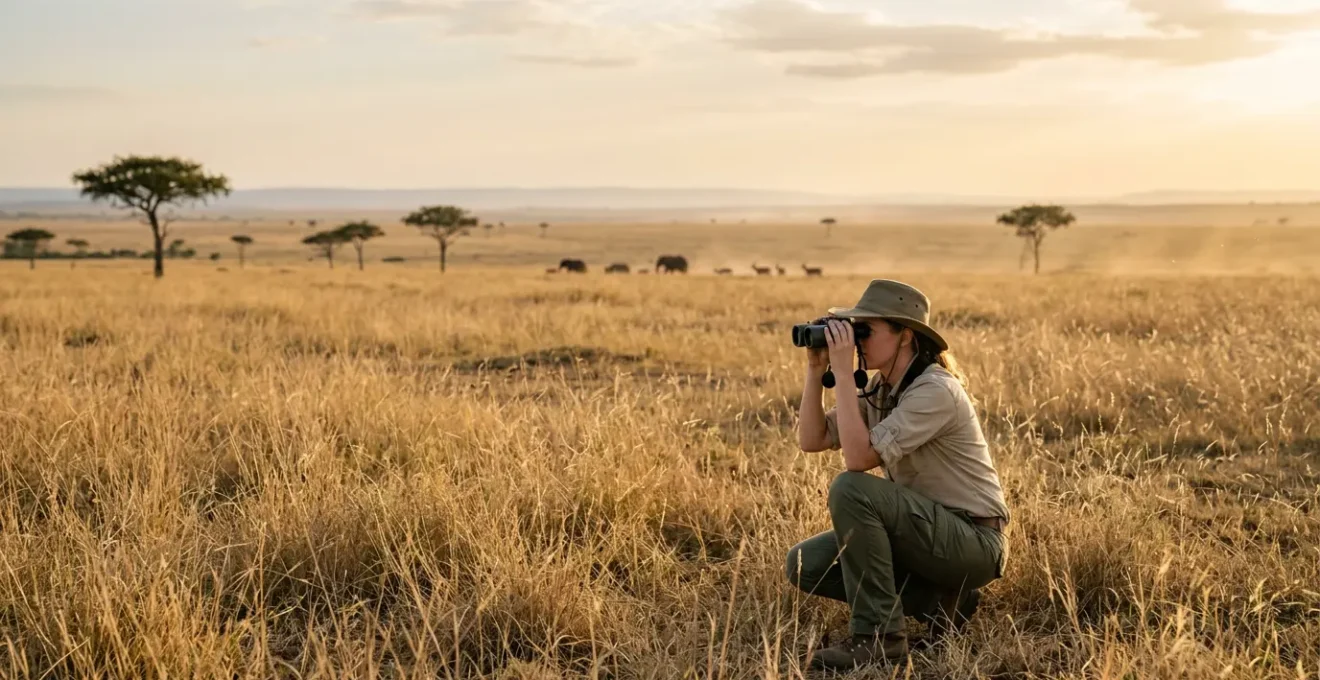
Once you’ve managed your scent, your eyes become your primary tool for interpreting the landscape ahead. However, simply looking is not enough. A tracker or photographer must learn to see. This means developing a systematic way of scanning that combats eye fatigue and picks up the minute details that signal a predator’s presence or a prey animal’s unease. Randomly sweeping your binoculars across a vista is inefficient and exhausting; you will miss the flicker of an ear or the twitch of a tail that tells the whole story.
The key is to replace random searching with a deliberate, structured method. The “grid scan” technique transforms a vast, overwhelming landscape into a series of manageable zones. By mentally overlaying a grid on your field of view, you can scan each section methodically, ensuring no area is missed. You prioritize high-probability zones first: the edges where forest meets meadow, water sources, and game trails. This disciplined approach keeps your eyes focused and your mind engaged, allowing you to establish a behavioral baseline for the area. You’re not just looking for an animal; you’re looking for anything that is out of place.
This stability isn’t just physical—bracing your elbows on your knees or against a tree—it’s mental. By controlling your search pattern, you conserve mental energy, which is crucial for the long hours of observation required in the field. This prevents the “tunnel vision” that can set in with fatigue, where your brain starts to filter out peripheral information. A calm, systematic scan is your best defense against surprise.
Your Action Plan: Systematic Landscape Observation
- Divide your viewing area into a mental grid of zones before scanning.
- Focus on high-probability zones first—edges, water sources, and transition areas between different terrain types.
- Scan systematically zone by zone rather than randomly searching the landscape.
- Analyze the area around any spotted animal for contextual clues, such as hidden young, nearby carcasses, or other animals’ alert postures.
- Take regular breaks every 15-20 minutes to prevent the eye fatigue that can cause you to miss critical pre-attack signals like muscle twitches or ear flicks.
Scratch Posts and Spray: How to Know if You Are in a Core Territory?
Long before you see a predator, you will encounter the language it writes upon the landscape. The forest is a manuscript of territorial claims, and learning to read it is essential for understanding whose home you are walking through. Scratch marks on a tree, a pile of scat on a prominent rock, or the pungent smell of urine are not random occurrences; they are deliberate, strategically placed signposts. These markers are a predator’s way of communicating its presence, status, and ownership to rivals and potential mates.
Understanding the difference between a casual trail and a core territory is a matter of life and death. A predator is most defensive and least tolerant of intrusion within its core territory—the area where it rests, raises its young, and feels most secure. These areas are marked with a higher density and freshness of signs. As one expert source on leopard behavior explains, predators use strategic scent-marking at boundaries and high-traffic crossroads. The pheromones in these marks convey complex messages about identity and reproductive status that last far longer than a vocalization like a roar.
The physical evidence can be remarkably precise. For instance, detailed field research in Iran’s Bamu National Park documented that 48 leopard scrapes averaged 39.3cm in length and 22.7cm in width. Finding markings of this nature, especially when fresh, is a clear indication you are no longer in a shared corridor but in a private domain. This is your cue to heighten your awareness, slow your movement, and prepare to give way. You are a guest, and the host is a master of its own land.
Vehicle Angles: How to Park for the Best View Without Startling the Herd?
For many photographers, a vehicle serves as a mobile hide—a tool that allows for closer proximity than would ever be possible on foot. However, this advantage is easily lost through careless positioning and movement. Wildlife, particularly prey animals, have learned to tolerate the general shape and sound of a vehicle. It becomes part of the familiar landscape. This tolerance, however, is fragile and based on one critical illusion: that the vehicle is an inanimate object.
The moment you break that illusion, you transform from a harmless lump into a collection of potential threats. As marine biologist and shark expert Ocean Ramsey notes in a different context that applies universally:
Animals often tolerate a vehicle’s shape but react to a human silhouette.
– Ocean Ramsey, The Inertia – Guide to Sharks and Safety
This is the central principle of vehicle-based observation. Any part of the human form—an arm resting on the window, a head popping out of the sunroof, a long camera lens breaking the vehicle’s profile—shatters the illusion. To maintain your cover, you must adhere to a strict protocol:
- Never block an escape route. The most fundamental error is to position your vehicle in a way that makes an animal or herd feel trapped. A cornered animal is an unpredictable one. Always leave them a clear, wide path to retreat.
- Kill the engine. Once you are in position, cut the engine. The sudden silence is less disturbing than a constant, low-frequency rumble, which can mask the sound of an approaching predator and put prey on edge.
- Stay inside the silhouette. All body parts, camera lenses, and equipment must remain within the vehicle’s profile. You must become part of the machine.
- Minimize all internal movement. Quick, sudden movements inside the vehicle can be perceived through the windows, breaking the inanimate object illusion and signaling a live threat.
By respecting the vehicle’s profile as an inviolable boundary, you can observe natural behavior up close. The moment the herd’s heads snap up in unison to stare at you, you have failed. You have crossed the threshold of tolerance.
The Alert Distance: How to Tell When an Animal Is About to Run?
Every animal possesses an invisible, shifting boundary around it—a “flight zone” or threshold of tolerance. As a tracker on foot, your entire practice revolves around understanding and respecting this space. It is not a fixed radius but a dynamic calculation the animal is constantly making based on its perception of you. Crossing this threshold is what triggers a flight-or-fight response. The challenge is to recognize you are approaching it long before you breach it.
The first sign is the “alert distance.” This is the point at which the animal stops its current behavior—grazing, resting, grooming—and focuses its full attention on you. Its head comes up, its ears pivot to lock onto your position, and its body tenses. It has detected you and is now actively assessing your intent. This is not yet alarm; it is a question. And your next movements are the answer.
The size of this flight zone is influenced by numerous factors. Research into the flight decisions of prey like deer provides critical insights for any tracker. A study on Columbian black-tailed deer found that prey animals flee at greater distances when predators approach more quickly and directly. A slow, meandering, indirect approach is perceived as less threatening than a direct, fast-paced march. Your gaze is also a factor; staring directly at a predator is often interpreted as a challenge. Use your peripheral vision and observe from the corner of your eye.
This is the moment of truth. If you continue to advance once an animal is on alert, you are communicating a threat. The correct response is to stop, avert your gaze, and perhaps even take a small step back or to the side, signaling that you have heard its non-verbal communication and respect its space. It’s a silent conversation, and showing you can listen is paramount to your safety.
The Fox Walk: How to Move Silently to Avoid Spooking Skittish Animals?
How you move through the landscape communicates more about your intent and capability than any other signal you send. Predators are masters at reading body language, not just of their prey, but of other potential threats in their environment—including you. They can distinguish between a confident, capable creature and a nervous, vulnerable one in a matter of seconds. Your movement patterns are an open book, and you must learn to write a story of calm competence.
The concept of a “hard target” versus a “soft target” is crucial here. As research has shown, predators assess vulnerability based on basic movements like stride length, posture, and arm swing. A person shuffling their feet, taking unnaturally short or long strides, or holding their arms stiffly signals anxiety and weakness. This is the body language of prey. It is an invitation for unwanted attention because it suggests an easy, low-energy target.
To avoid this, you must adopt a deliberate and silent way of moving, often called the “Fox Walk.” This technique involves placing your foot down consciously, rolling from the outside of the foot to the inside, feeling the ground before committing your full weight. This allows you to test for noisy twigs or loose rocks before they can betray your position. Keep your strides even and your posture upright but relaxed. Let your arms swing naturally. This is the posture of a creature that belongs in its environment—aware, efficient, and not a threat. You are not trying to be invisible; you are trying to be inconsequential.
This silent, deliberate movement does more than just prevent you from spooking skittish animals. It fundamentally changes your mindset. It forces you into a state of heightened awareness, where every step is a conscious decision. This is the physical manifestation of pre-conscious tracking. By controlling your body, you control the message you send.
Freezing vs Relaxing: How to Tell if an Animal Wants You to Leave?
You have made your approach. You have managed your scent, moved with intention, and respected the animal’s alert distance. Now comes the most subtle and important phase of the encounter: reading the animal’s decision about your presence. The line between tolerance and stress is incredibly fine, and the signals can be missed in a blink. The master tracker’s golden rule, as articulated by wildlife photographer Paolo Sartori, is absolute:
When an animal changes its behavior because of you, you’re too close.
– Paolo Sartori, Ethical Wildlife Photography Guidelines
This is the cornerstone of all safe and ethical wildlife interaction. If the deer stops grazing, if the bear looks up from foraging, if the flock of birds falls silent—you are the cause. The behavioral baseline has been broken. The most common initial reaction is freezing. The animal becomes perfectly still, its muscles tense, its entire being focused on you. This is the final moment of assessment. It is weighing its options: is it safer to flee, to ignore you, or to neutralize the perceived threat?
Conversely, signs of relaxation indicate acceptance. Look for the micro-expressions: a soft jaw, a casual ear flick, a skin-twitching shake as if to dislodge a fly. If the animal resumes its previous activity, like grazing, while giving you only occasional, casual glances, it has deemed you non-threatening. But be aware of “displacement behaviors.” These are out-of-context actions, like sudden, frantic grooming or mock-foraging, which indicate the animal is under stress from your presence and is trying to self-soothe. These are not signs of comfort; they are signs that your presence is a burden, and you should retreat immediately.
Understanding this language is your responsibility. An animal that freezes is asking you to leave. An animal that displays displacement behaviors is screaming for you to leave. An animal that resumes normal activity has granted you a temporary pass. Do not abuse it.
Key takeaways
- Scent and sound are as important as sight. Approach wildlife by considering how the terrain affects the chaotic flow of your scent plume.
- Your movement signals intent. A deliberate, confident stride projects you as a non-vulnerable “hard target,” while hesitant or erratic movement can be perceived as prey behavior.
- The ultimate sign you are too close is a change in the animal’s behavior. Freezing, staring, or sudden grooming are all indicators of stress that require you to immediately create distance.
Photography Under Dense Canopy: How to Capture Sharp Images with ISO Limits?
The final layer of a tracker’s discipline comes into play when a camera is in hand. The goal of wildlife photography can sometimes conflict with the principles of safety and ethical interaction, especially in challenging lighting conditions like a dense forest canopy. The desire for a sharp, well-lit image can tempt a photographer to get closer, to use a flash, or to manipulate the environment—all of which violate the core tenets of safe tracking.
Under a dense canopy, light is scarce. The technical solution is to use a wider aperture, a slower shutter speed, or a higher ISO. However, a slow shutter risks motion blur, and a high ISO introduces noise. This is where the temptation to use a flash arises. This must be resisted at all costs. The use of artificial light, especially on nocturnal or crepuscular animals, can be devastating. A powerful flash can temporarily blind an animal whose eyes are adapted for low light, compromising its ability to hunt, navigate, or spot other threats. In a predator, it can provoke a defensive, aggressive response.
The ethical and safe solution lies in equipment and patience. The first priority is a telephoto lens. This is your primary tool for maintaining a respectful and safe distance. Secondly, a lens with a wide maximum aperture (e.g., f/2.8 or f/4) is invaluable for gathering as much natural light as possible. Finally, invest in a modern camera body with good high-ISO performance. A grainy photo is infinitely better than no photo and a dangerous encounter. Ethical guidelines for photographers emphasize that the animal’s welfare always comes first. This includes not interrupting natural behaviors and using camouflage to blend in rather than altering the habitat for a better shot.
The ultimate skill is knowing when not to take the picture. If the shot requires you to cross the animal’s threshold of tolerance or to use tools that will cause it distress, you must lower the camera. Your role as a tracker and an observer is to witness, not to interfere. That principle is the foundation of long-term safety and respect in the wild.
Integrate these principles into every outing. Your next step is not just to see the wild, but to understand it. Practice this awareness to move from a visitor to a silent and informed observer, ensuring every encounter is safe for both you and the wildlife you revere.