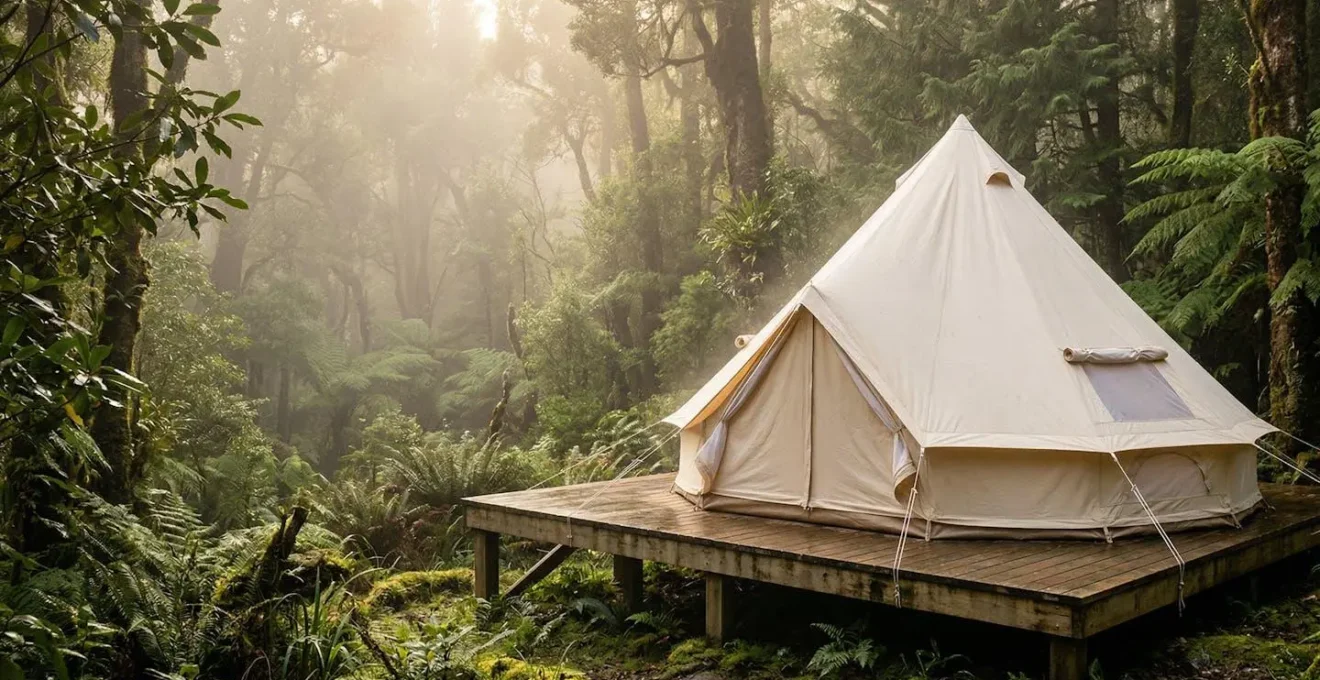
The greatest threat to your canvas tent’s longevity is not a single storm, but the slow, silent creep of mold thriving on trapped moisture.
- Preventing rot requires a systems approach, starting with a multi-cycle seasoning process to waterproof the cotton weave itself.
- The most critical step for a long-term setup is elevating the tent on a wooden deck to create an air gap, physically separating it from ground moisture.
- Effective storage is a science: the canvas must be 100% “bone-dry” and stored in an environment with under 60% relative humidity.
Recommendation: Treat your canvas tent like a long-term investment, not disposable gear. Proactive, system-wide maintenance, starting with a proper foundation and ending with controlled storage, is the only way to ensure multi-season durability and prevent catastrophic mold damage.
The dream of a semi-permanent canvas bell tent, nestled in a favorite landscape, often collides with a damp reality: the musty smell of mildew, the first sign of a battle being lost. For any landowner or long-term camper who has invested in high-quality canvas, the fear of rot is constant. Standard advice often feels inadequate. You’re told to “air it out” or “store it dry,” but these platitudes fail to address the complex physics of moisture management in a structure designed to breathe.
This isn’t just about avoiding a few dark spots. It’s about preserving a significant investment and ensuring a healthy living space. The common solutions are only part of the story. But what if the key wasn’t just reacting to dampness, but proactively engineering a complete, mold-resistant setup from the ground up? What if you could adopt the mindset of a manufacturer, focusing on a holistic “canvas ecosystem” rather than isolated tips?
This is the professional approach. It means understanding the material science of cotton, the dynamics of airflow, and the critical failure points that allow moisture to gain a foothold. This guide abandons simplistic advice and instead provides a technical, preventative framework. We will dissect the entire lifecycle of your canvas tent—from the initial seasoning process to the science of long-term storage—to empower you to defeat mold before it ever has a chance to begin.
This article provides a comprehensive, experience-based roadmap to ensure your canvas shelter remains a sanctuary, not a science experiment. Explore the sections below to master each critical stage of canvas tent preservation.
Summary: A Technical Manual for Canvas Tent Longevity
- Seasoning the Canvas: Why Your New Tent Leaks and How to Fix It?
- Deck vs Ground Sheet: Which Platform Extends Your Tent’s Lifespan by 5 Years?
- Cutting the Canvas: How to Install a Stove Jack Without Ruining the Roof?
- The Fold and Roll: How to Store a 60lb Tent Without Creating Permanent Creases?
- Guy Line Geometry: How to Anchor Your Tent to Survive a 50mph Storm?
- Slider Failure: How to Fix a Separated Zipper in the Field?
- DWR Wash-In vs Spray-On: Which Revives Beading Best?
- Selecting Expedition Gear: How to Identify Failure Points in Your Equipment?
Seasoning the Canvas: Why Your New Tent Leaks and How to Fix It?
A brand-new canvas tent will leak. This is not a defect; it is a feature of the material’s organic design. The process that corrects this is called “seasoning,” and it is the single most important foundational step in creating a waterproof shelter. Unlike synthetic materials, canvas waterproofing relies on the physical properties of its threads. When wet, the cotton fibers swell and contract, closing microscopic gaps between the threads that were created during the weaving and stitching process. This initial, controlled swelling creates a permanent, watertight seal that cannot be replicated by chemical coatings alone.
Skipping this step is a critical error that leaves the tent vulnerable. A single heavy rain on an unseasoned tent can force water through seams and pinholes, saturating the interior and creating the perfect breeding ground for mold from day one. To properly prepare your canvas ecosystem, a multi-cycle process is required, especially for heavier-grade canvas (360gsm and up).
Follow this procedure with precision before your first use:
- Setup: Pitch your tent in a sunny, dry location with all doors and windows fully closed to create tension.
- Saturate: Using a hose with a spray nozzle, wet the entire tent with cold water until it is completely saturated. This can take 5-20 minutes depending on the tent’s size. Pay extremely close attention to all seams, ensuring they are thoroughly soaked.
- Inspect: While it’s wet, step inside. You may see tiny pinpricks of light through the weave and seams. This is normal; these are the very holes that will be sealed as the fibers swell.
- Dry Completely: Allow the tent to dry 100% in the sun. This is non-negotiable and can take a full day or longer in humid conditions. The canvas must be “bone-dry.”
- Repeat: Repeat this full wet/dry cycle two to three times. Each cycle strengthens the seal, further tightening the weave and closing any remaining gaps.
Only after this rigorous seasoning process is your canvas truly ready for the elements. It’s a one-time investment of time that pays dividends for the entire life of the tent.
Deck vs Ground Sheet: Which Platform Extends Your Tent’s Lifespan by 5 Years?
Your tent’s greatest enemy is not rain from the sky, but moisture from the ground. A simple groundsheet or tarp is a basic barrier, but for a long-term setup, it’s an inadequate solution that can actually trap condensation. The professional standard for preventing floor rot and systemic dampness is to physically decouple the tent from the earth by building an elevated wooden deck. This single upgrade is the most significant factor in extending a canvas tent’s lifespan.
The principle is simple: ground moisture constantly wicks upwards. When a tent floor is in direct contact with a groundsheet on damp earth, this moisture gets trapped. With no airflow, it creates a perpetually humid microclimate under your floor—the ideal environment for mold and mildew to flourish and degrade the expensive floor material. An elevated deck with 6-12 inches of airflow space underneath completely interrupts this process, allowing air to circulate freely and keep the underside of the tent floor dry.
As confirmed by experienced glamping operators who rely on their equipment, this elevation not only stops moisture but also protects the floor from abrasion by rocks and sticks, dramatically reducing wear and tear.
The construction of the deck itself is important. Using planks with a quarter-inch gap between them maximizes ventilation. This platform becomes the foundation of your entire canvas ecosystem, creating a stable, dry, and durable base that a simple groundsheet can never match. While it requires an initial investment of labor and materials, a deck is not a luxury; it is a necessity for anyone serious about long-term canvas living.
Cutting the Canvas: How to Install a Stove Jack Without Ruining the Roof?
Installing a wood stove is more than a creature comfort; it’s a strategic move to actively manage your tent’s internal climate. A wood-burning stove is a powerful dehumidifier. Through thermal convection, it heats the air, causing it to expand and hold more moisture, which is then vented out through natural air exchange. This process is highly effective at combating the damp, humid conditions that allow mold to thrive. However, installing the stove jack—the high-temperature port through which the chimney pipe exits—requires cutting a permanent hole in your canvas roof. This step must be approached with meticulous planning to avoid compromising the tent’s integrity.
The placement of the stove jack is a critical decision that impacts safety, performance, and longevity. A poorly placed jack can lead to backdrafts of smoke, inefficient heating, or even damage to the tent itself from contact with the hot flue pipe. Before making the first cut, you must work through a system of critical questions to map out the entire installation.
Consider this pre-cut checklist as a mandatory planning phase:
- Wind Direction: Where is the prevailing wind at your site? Position the stove jack to minimize the chance of wind blowing smoke back down the chimney.
- Internal Layout: How will your furniture placement affect airflow around the stove? Ensure there’s a clear, safe perimeter and that you’re not creating a fire hazard or blocking convective heat flow.
- External Rigging: Is the planned flue path completely clear of all guy lines and rigging? A chimney pipe resting against a nylon guy line is a recipe for disaster.
- Maintenance Plan: The silicone or fiberglass flashing of a stove jack is not immune to the elements. Have you factored annual inspection for UV degradation and embrittlement into your maintenance schedule?
By treating the stove as a piece of technical equipment and planning its integration accordingly, you transform it from a simple heater into a core component of your moisture management system.
The Fold and Roll: How to Store a 60lb Tent Without Creating Permanent Creases?
The most catastrophic mold damage often occurs not in the field, but in the garage. Improper storage is the Achilles’ heel of canvas ownership. Even a microscopic amount of moisture, pollen, or organic debris packed away with the tent can blossom into a full-blown mold colony during the off-season. The single most important rule of storage is that the canvas must be 100% bone-dry before it is folded.
Beyond being dry, the storage environment itself is a critical factor. Canvas should be stored in a cool, dry, and ventilated area, off the ground. A concrete garage floor, for example, can transmit dampness. As a technical target, storage experts recommend maintaining humidity below a 50-60% relative humidity threshold. Investing in a simple digital hygrometer for your storage space is a wise and inexpensive way to monitor this.
However, field conditions don’t always cooperate. Packing down in the rain is sometimes unavoidable. In this emergency scenario, you must initiate a strict protocol to prevent disaster. Do not leave the damp tent packed for more than 48 hours.
- Hour 0-4 (The Pack-Down): Pack the tent loosely, ideally in a breathable mesh bag. Avoid plastic bags at all costs, as they trap moisture and accelerate mold growth.
- Hour 4-24 (The Unfurl): As soon as you get home, partially unfurl the tent in a garage, covered porch, or basement. Use fans to create aggressive air circulation.
- Hour 24-48 (The Pitch): Fully pitch the tent or hang it by its loop in a well-ventilated space. Even on a cloudy day, the canvas will dry relatively quickly once it can breathe.
- Final Inspection: Before the final fold, inspect every inch—seams, corners, and the floor—to ensure it is completely dry. As a final step, vacuuming the dry canvas with a soft brush attachment can remove microscopic organic matter that feeds mold.
Finally, when folding, vary the fold lines each time to prevent permanent creasing, which can weaken the canvas fibers over time. Rolling the tent tightly after folding is preferable to stuffing, as it minimizes hard creases.
Guy Line Geometry: How to Anchor Your Tent to Survive a 50mph Storm?
A bell tent’s stability is not derived from its center pole alone, but from the balanced tension of its guy lines. Proper anchoring is a crucial failure point. A single stake pulling loose in high winds can trigger a cascading failure, leading to a collapsed tent. A collapsed tent in a rainstorm is a guaranteed saturation event, setting the stage for a severe mold outbreak. Therefore, mastering guy line geometry and stake selection is a core component of preventative maintenance.
The type of stake you use is not a matter of preference; it’s a technical choice dictated by the soil conditions at your site. Using the wrong stake in the wrong soil is like using the wrong tire for the terrain—it’s destined to fail under pressure. A 12-inch V-stake that holds firm in loamy soil will pull out of loose sand with minimal force. An 18-inch spiral stake that provides excellent grip in sand might be impossible to drive into rocky ground. Matching your anchoring hardware to the specific geological challenge is essential for storm-proofing your setup.
This soil-to-stake matching guide provides a professional framework for selecting the right equipment. The following table, based on information from canvas tent anchoring experts, outlines the correct approach for various conditions.
| Soil Type | Characteristics | Recommended Stake Type | Anchoring Technique |
|---|---|---|---|
| Sandy Soil | Loose, low cohesion, poor holding power | Spiral stakes (18+ inches) | Drive at 45-degree angle away from tent; use two stakes per guy line in X formation |
| Loamy Soil | Well-balanced, moderate density, good drainage | V-shaped or Y-stakes (12-16 inches) | Standard 45-degree angle; single stake sufficient for most conditions |
| Rocky/Hard Soil | High density, difficult penetration, excellent hold once set | Heavy-duty nail stakes or rock anchors | May require pre-drilling or finding natural rock anchors; check guy line tension frequently |
| Saturated/Muddy Soil | Waterlogged, low friction, prone to stake pullout | Deadman anchor (buried log or stake bag) | Bury anchor 18-24 inches deep; use wider surface area for friction |
Beyond stake selection, always drive stakes at a 45-degree angle away from the tent to maximize resistance against the pull of the guy line. Regularly walk your perimeter to check and adjust tension, especially after rain or significant temperature changes, which can cause the canvas and lines to shrink or stretch.
Slider Failure: How to Fix a Separated Zipper in the Field?
While we focus on catastrophic failures like mold and storm damage, the integrity of a canvas tent ecosystem also depends on its smallest components. A failed zipper on a main door or window is more than an inconvenience; it’s a breach in your shelter’s armor. It compromises the seal against insects, wind, and—most importantly—driving rain. A zipper that has separated or won’t close properly can turn a waterproof sanctuary into a wet mess in minutes, introducing the moisture that fuels mold growth.
The primary cause of zipper failure is not manufacturing defects, but accumulated dirt and excessive tension. The heavy-duty #10 YKK zippers used on quality bell tents are robust, but sand, dirt, and grit act as an abrasive, wearing down the teeth and the internal mechanism of the slider. Over-tightening the tent during setup puts immense lateral stress on the zipper, forcing the slider to spread and lose its grip on the teeth.
Preventative care is 90% of the solution. Integrating a simple zipper care regimen into your regular maintenance schedule can prevent almost all common failures. This micro-maintenance is a hallmark of an experienced owner.
- Post-Trip Cleaning: After every trip, use a soft toothbrush and a little water to gently scrub the zipper teeth, removing all embedded sand and debris.
- Quarterly Lubrication: Apply a silicone-based zipper lubricant to keep the slider moving smoothly. Avoid petroleum-based products like WD-40, which can attract more dirt and damage the canvas.
- Seasonal Inspection: During a deep clean, inspect the full length of the zipper for any misaligned teeth, fabric bunching near the track, or visible wear on the slider. Address these issues immediately.
- Field Repair Kit: The most essential items in your repair kit should be a pair of needle-nose pliers and replacement sliders (like ZlideOn clips). Pliers can often be used to gently squeeze a spread slider back into shape for a temporary fix, while a replacement slider can bring a completely separated zipper back to life in minutes.
Treating your zippers with the same care as the canvas itself is a small but critical part of maintaining a fully functional, weatherproof shelter.
DWR Wash-In vs Spray-On: Which Revives Beading Best?
Over time, even the best-seasoned canvas will see its water repellency diminish due to UV exposure, abrasion, and dirt. The “beading” effect—where water forms distinct droplets and rolls off—is the first line of defense. When you notice water starting to “wet out” or darken the canvas surface instead of beading, it’s time to reapply a Durable Water Repellent (DWR) treatment. However, not all DWR treatments are created equal, and choosing the wrong one can compromise your tent’s most important feature: breathability.
Canvas works because it is breathable. It allows water vapor from cooking, breathing, and drying gear to escape, preventing the clammy internal condensation common in synthetic tents. A DWR treatment that seals the canvas pores, while creating impressive water beading, will turn your breathable tent into a plastic bag, trapping moisture inside and ironically increasing your risk of mold. This trade-off between beading and breathability is the central consideration when choosing a DWR product.
The application method and chemical base determine the product’s performance. The choice depends heavily on your primary climate and use case. Some studies on tent waterproofing show that the right application can do more than just repel water; it can also protect against fabric-degrading UV rays, effectively doubling the life of the equipment.
| Treatment Type | Application Method | Breathability Impact | Water Beading Performance | Best Use Case |
|---|---|---|---|---|
| Silicone-Based Spray | Aerosol or pump spray on dry canvas | Can seal canvas pores, reducing breathability and increasing internal condensation risk | Superior beading; water rolls off immediately | Arid climates with infrequent intense rain (Southwest monsoon season) |
| Fluoropolymer Wash-In | Diluted solution applied to wet fabric with sponge/roller | Preserves canvas breathability; allows moisture vapor to escape | Good beading; effective protection without pore sealing | Pacific Northwest winters (high rain, high humidity environments) |
| Water-Based Concentrates (Nikwax type) | Mix with water, apply to clean wet fabric | Excellent breathability retention; environmentally friendly | Reliable beading with UV protection bonus | All-season use; doubles equipment life by protecting against UV damage |
For most long-term, multi-season users, a water-based, wash-in concentrate that preserves breathability is the superior technical choice. While the initial beading from a silicone spray might look more dramatic, maintaining the canvas’s ability to manage water vapor is far more critical for long-term health and mold prevention.
Key Takeaways
- Seasoning is a mandatory, one-time process: Properly swelling the cotton fibers through 2-3 wet/dry cycles is what makes the canvas weave itself permanently waterproof.
- Elevate for Airflow: A wooden deck is the single most effective investment for tent longevity, creating a critical air gap that stops ground moisture and prevents floor rot.
- Storage is a science, not an afterthought: Canvas must be 100% bone-dry and stored in an environment below 60% relative humidity; a digital hygrometer is an essential tool for any serious owner.
Selecting Expedition Gear: How to Identify Failure Points in Your Equipment?
The battle against mold and premature failure is won or lost before you ever pitch the tent. It begins with your selection process. An experienced user doesn’t just look at a tent’s size or color; they perform a technical audit, identifying potential failure points at the point of purchase. Understanding what to look for separates a multi-decade investment from a tent that will fail in its second season. The most robust mold-prevention strategy is useless if applied to a poorly constructed tent.
From a manufacturer’s perspective, quality is measurable. It’s in the weight of the canvas, the brand of the zippers, and the number of stitches per inch. These are not just marketing points; they are indicators of durability and resilience. For instance, research on canvas tent mold resistance shows that untreated cotton can begin to form mold in as little as 24-48 hours under ideal conditions. This makes a factory-applied, rot-resistant treatment not a luxury, but a baseline requirement.
Before you invest, you must become your own quality control inspector. Use a systematic checklist to analyze the critical components of any canvas tent you consider. This pre-purchase audit is the final and most important piece of the puzzle.
Your Pre-Purchase Inspection Checklist: Identifying Failure Points
- Stitching Quality: Inspect main seams. Are they double-stitched? A higher stitch count per inch indicates a stronger, more durable seam. Pay close attention to stress points like door corners and guy line attachments.
- Zipper Specification: Check the zippers on all doors and windows. They should be #10 YKK zippers or an equivalent heavy-duty brand. This is an industry gold standard for a reason; smaller, unbranded zippers are a primary failure point.
- Canvas Weight & Weave: Verify the GSM (grams per square meter) rating. A 285gsm is a good minimum for three-season use, while 360gsm or higher is necessary for four-season durability. Hold a sample to the light to check for a tight, consistent weave.
- Guy Line Attachments: Look for reinforced webbing loops where guy lines attach. Simple metal grommets punched directly into the canvas are prone to tearing out under high tension.
- Mold Treatment Certification: Ask the manufacturer for their AATCC 30 test results. This industry-standard test proves the canvas has been effectively treated to resist mold and mildew growth.
- UV Protection: Confirm the canvas has a dedicated factory UV treatment. This is separate from the DWR water repellent coating and is crucial for preventing the fabric from becoming brittle and weak after prolonged sun exposure.
By applying this level of scrutiny to your purchase and committing to the proactive maintenance protocols outlined, you are no longer just a camper. You are the steward of a high-performance shelter, equipped with the knowledge to protect your investment and ensure it provides comfort and security for years to come.