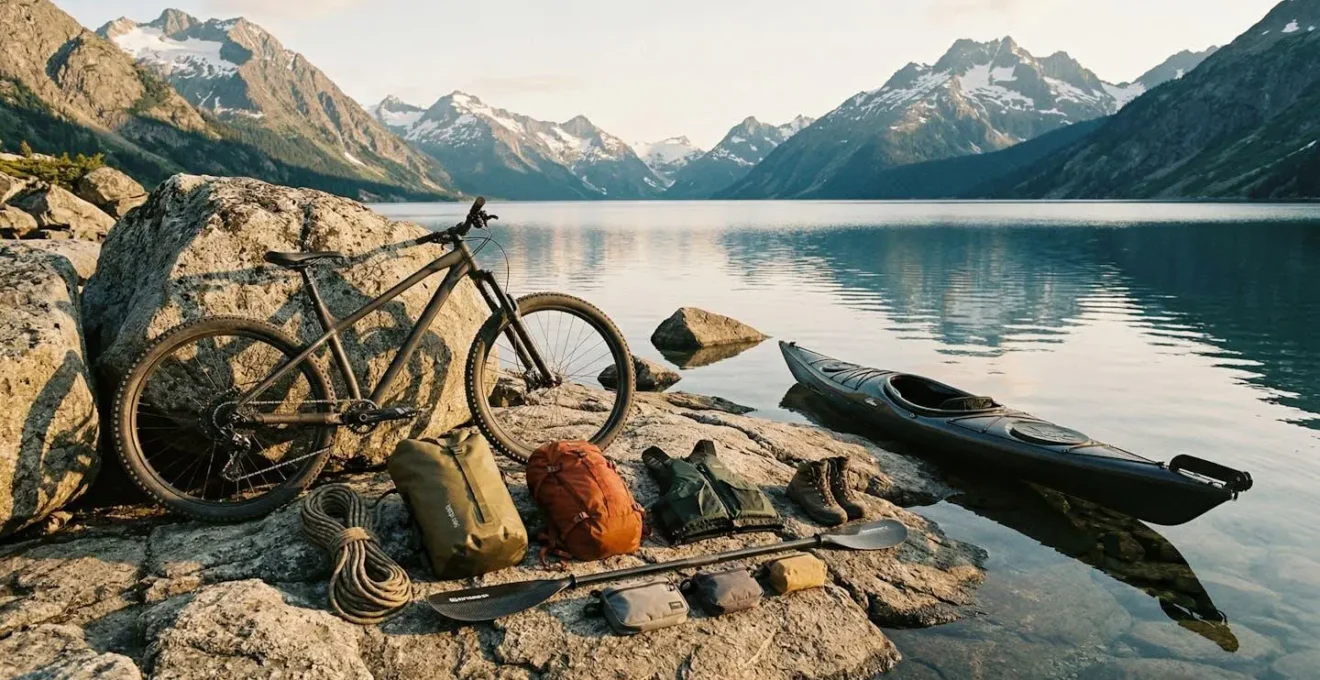
The key to a successful multi-sport trip isn’t peak fitness, but mastering the “transitional friction”—the hidden logistical, physical, and mental costs of switching sports.
- Effective transitions rely on a pre-planned system for gear, nutrition, and recovery, not just brute force.
- Strategic time buffers and data-driven gear management are non-negotiable for preventing cascading failures in the field.
Recommendation: Stop planning your sports in isolation. Start planning your transitions as a core part of the adventure itself.
The dream is epic: a grueling morning bike ride through a remote forest, followed by a serene afternoon kayaking across a pristine lake. The reality, for many, is a chaotic scramble of gear, plummeting energy levels, and wasted time. You’ve trained for the bike. You’ve trained for the kayak. But have you trained for the crucial, often-overlooked moment in between? Most advice for active travel focuses on packing light or general fitness, ignoring the real challenge that derails ambitious “biathlon-style” trips.
The common approach is to just push through, treating the switch from land to water as a simple pause. This overlooks the significant physiological and logistical shifts required. Your body’s engine has to switch from a lower-body-dominant aerobic effort to an upper-body and core-focused one. Your gear system must transform from trail-ready to water-worthy. This gap is where adventures falter.
But what if the transition itself was treated as a sport? The secret to a seamless multi-sport adventure lies not just in your athletic ability, but in your logistical strategy. It’s about minimizing what we’ll call transitional friction: the cumulative cost of every minute spent repacking, every calorie wasted, and every bit of mental energy burned figuring things out on the fly. This isn’t about simply being faster; it’s about being smarter to conserve energy for the adventure itself.
This guide provides a strategic framework to conquer that friction. We will break down how to engineer your packing for rapid sport-switching, choose the right dual-purpose gear, fuel your body for changing demands, and build a training plan that prepares you specifically for the shock of the transition. It’s time to stop just planning your activities and start engineering your transitions.
This article provides a comprehensive operational framework for your next multi-sport adventure. Below is a summary of the key strategic areas we will cover to help you master the art of the transition.
Summary: A Strategic Guide to Multi-Sport Wilderness Adventures
- The Transition Zone: How to Pack So You Can Switch Sports in Under 15 Minutes?
- Amphibious Shoes: Are They Good for Hiking or Just Bad for Everything?
- Eating on the Go: How to Fuel Differently for Upper vs Lower Body Exertion?
- Active Recovery: How to Flush Lactate When You Sleep in a Tent?
- The Buffer Day: Why You Need 20% More Time When Switching Activities?
- The Gear Matrix: How to Track Every Gram of Weight in Excel?
- Pitching in a Downpour: Which Shelter System Is Fastest to Set Up?
- Preparing for Active Travel: How to Train for a Hiking Trip 3 Months in Advance?
The Transition Zone: How to Pack So You Can Switch Sports in Under 15 Minutes?
Every minute you spend digging through a disorganized pack for your paddle gear after a long bike ride is a minute of wasted energy and mounting frustration. This is the first and most critical point of transitional friction. Elite endurance athletes don’t just dump gear in a bag; they engineer a system. Adopting this mindset transforms your pack from a storage unit into a high-speed transition zone. The goal is to make the switch from cyclist to kayaker a choreographed, sub-15-minute procedure, not an hour-long yard sale of equipment.
The core principle is compartmentalization and sequencing. Your gear shouldn’t be packed by category (e.g., all clothes together), but by activity and order of use. This means creating distinct “modules” for each sport. The kayaking gear you’ll need first—like your spray skirt or PFD—should be instantly accessible, not buried under your post-ride recovery snack. This systematic approach dramatically reduces cognitive load when you’re already physically taxed.
Case Study: Elite Triathlon Bag Organization
A study of professional triathlon packing systems revealed a powerful insight applicable to any multi-sport adventurer. Athletes using pre-organized, stage-specific compartments consistently reduce transition times by an average of 2-4 minutes compared to those with unstructured bags. The key is creating separate, often waterproof, modules for each discipline (swim/bike/run, or in our case, kayak/bike/hike) with items arranged in the exact order they’ll be used. Small items like nutrition and tools are grouped in transparent zip bags, creating a visual “grab-and-go” system that functions flawlessly even under the cognitive load of extreme exhaustion.
To implement this, you must think like a race pit crew. Every item has a place, and every action is rehearsed. Color-coded dry bags are not a luxury; they are a critical tool for instant visual identification. Your bike repair kit (blue bag) should never be confused with your primary first-aid kit (red bag). This system turns a chaotic moment into a calm, efficient process, preserving your physical and mental energy for the water.
Action Plan: The Triathlon-Inspired Transition Packing System
- Compartmentalize: Use dedicated packing cubes or dry bags to create separate gear zones for kayaking, biking, and hiking within your main pack.
- Pack in Reverse: Place the gear you’ll need last (e.g., evening camp clothes) at the bottom of the pack first. The gear for your next sport goes on top for sequential access.
- Color-Code Everything: Assign colors to key systems for instant identification under stress. For example: red for water sports gear, blue for bike repair, and yellow for nutrition.
- Prioritize Access: Isolate high-frequency items like snacks, maps, or a GPS device in external pockets or a top lid compartment for one-touch access without unpacking the main bag.
- Rehearse at Home: Time yourself switching from fully kitted for biking to fully kitted for kayaking in your backyard. This “dry run” will identify and eliminate bottlenecks before you’re in the field.
Amphibious Shoes: Are They Good for Hiking or Just Bad for Everything?
The amphibious shoe represents the ultimate gear paradox in multi-sport adventures: a promise of seamless transition that often results in compromise. It aims to be the one shoe for hiking to your launch point, wading in the water, and performing in the kayak. But in the quest to do everything, does it end up doing nothing well? The answer lies in understanding the inherent design trade-offs between drainage, support, and grip. There is no single “best” amphibious shoe; there is only the best shoe for a specific context.
This is where a strategic approach to gear selection becomes critical. Instead of asking “Is this a good shoe?”, you must ask “What performance characteristics am I willing to sacrifice?” A shoe with massive drainage ports will dry quickly but will almost certainly offer less ankle support on a rocky trail. A model with the sticky rubber grip of a top-tier approach shoe may have a denser sole that retains water for longer. Your choice must be a calculated one based on the specific demands of your trip: a long, rugged hike to the water’s edge requires a different tool than a short, muddy portage between two lakes.
The image above highlights the three competing priorities in amphibious shoe design: the aggressive sole for grip, the supportive upper for stability, and the mesh panels and ports for drainage. Excelling in one area often means a compromise in another. A heavy-duty, supportive shoe will be a burden in the water, while a minimalist water slipper offers zero protection on a technical trail. Your job is to pinpoint where on this spectrum your adventure lies and select your gear accordingly.
To make an informed decision, it’s helpful to analyze how different types of water-oriented footwear perform across these key metrics. The following data from extensive field tests by gear experts provides a clear framework for choosing the right tool for the job.
| Shoe Type | Drainage (Speed) | Ankle Support | Grip on Wet Rock | Hiking Comfort (3+ miles) | Best Use Case |
|---|---|---|---|---|---|
| Closed-toe Sandals (e.g., KEEN Newport H2) | Excellent (Instant) | Low | Good | Moderate | Sandy beaches, calm water crossings |
| Mesh Trail Runners (e.g., Salomon Tech Amphib 5) | Very Good (Under 2 min) | Moderate | Excellent | Excellent | Rocky portages, long approach hikes |
| Neoprene Booties with Rubber Sole | Poor (5+ min) | Low | Moderate | Poor | Cold water paddling only |
| Hybrid Amphibious (e.g., Astral Brewer 3.0) | Good (2-3 min) | Moderate-High | Very Good | Very Good | Muddy riverbanks, multi-day transitions |
Eating on the Go: How to Fuel Differently for Upper vs Lower Body Exertion?
Transitioning from a 3-hour bike ride to a 3-hour paddle isn’t just a gear change; it’s a profound metabolic shift. Your body’s primary engine switches from the large, powerful muscles of the legs to the smaller, endurance-focused muscles of the back, core, and shoulders. Fueling for these two activities as if they were the same is a recipe for a mid-afternoon bonk. The strategic athlete understands the need for metabolic bridging: a specific nutritional protocol designed to refuel the depleted system while pre-loading the one that’s about to engage.
The science is clear: upper and lower body exercises have different physiological demands. Research shows there’s a significant disparity in how our bodies process oxygen for these activities. For instance, metabolic research published in the Journal of Sports Sciences found that elite kayakers operate at a much lower maximal oxygen consumption (around 58 ml·kg-1·min-1) than cyclists (73-74 ml·kg-1·min-1). This means you’re not just using different muscles; you’re using a different energy system profile. Your nutrition strategy must reflect this.
During the biking phase, your focus is on a steady intake of easily digestible carbohydrates (30-60g per hour) to fuel your legs. The transition is your only window to address this deficit and prepare for the next challenge. This is not the time for a heavy, slow-digesting meal. Instead, you need a rapid infusion of fast-acting carbs to replenish glycogen, coupled with a small amount of protein or amino acids. This protein “pre-load” helps prime the upper-body muscles, signaling that they are about to become the primary engine and minimizing muscle breakdown.
Hydration also needs to adapt. While cycling, airflow provides significant evaporative cooling. Once you’re in a kayak, often wearing a PFD that traps heat, your core temperature and sweat rate can increase dramatically. This necessitates a switch from plain water to a beverage enhanced with electrolytes to maintain proper muscle function and prevent cramping. Finally, caffeine should be used as a strategic tool, not a morning ritual. Deploying it at the start of the second activity can be a powerful weapon against the mental and physical slump that often accompanies a major transition.
- During biking phase: Consume 30-60g carbohydrates per hour to fuel leg muscles, focusing on easily digestible sources like sports drinks or gels.
- 15-minute transition meal: Combine fast-acting carbs (banana, energy bar) with 10-15g protein to bridge the gap between biking’s lower-body demand and kayaking’s upper-body focus.
- Pre-kayak loading: Consume small amounts of protein/amino acids 10 minutes before paddling to ‘pre-load’ upper body and core muscles that will become the primary engine.
- Hydration adjustment: Switch from standard water to electrolyte-enhanced beverages when transitioning to kayaking, as lower airflow and PFD-trapped heat increases sweat rate.
- Caffeine timing strategy: Save caffeine intake (100-200mg) for the start of the second activity rather than morning consumption to combat the mental and physical slump during transitions.
Active Recovery: How to Flush Lactate When You Sleep in a Tent?
The end of a grueling day of biking and kayaking doesn’t mean the work is over. The most significant gains—or losses—in a multi-day trip happen while you sleep. Arriving at camp exhausted and collapsing into your sleeping bag is a guarantee for a stiff, sore, and underperforming body the next morning. The myth is that meaningful recovery requires foam rollers, massage guns, and ice baths. The reality is that you can execute highly effective recovery micro-cycles using only the gear you’re already carrying and the environment around you.
The goal is to facilitate the clearance of metabolic byproducts, like lactate, and reduce inflammation. Passive recovery (simply resting) is the least effective method. The science of recovery is definitive on this point. For example, a key study found that active recovery at 80% of lactate threshold had the highest rate of lactate clearance after maximal exercise, proving significantly faster than passive rest. While you won’t be doing sprints in your tent, the principle holds: gentle movement and targeted pressure are better than nothing.
This is where ingenuity comes in. Your 1-liter Nalgene bottle, when full, becomes a brutally effective IT band and calf roller. The handle of your trekking pole is a perfect tool for trigger point release on tight calf muscles. Even a bundle of spare rope can be used as a lumbar support to facilitate gentle spinal stretches. You don’t need a dedicated recovery toolkit; you need to see the recovery potential in your existing gear. A 5-minute mobility sequence inside your tent, focusing on counteracting the day’s posture—thoracic rotations for paddling, hip flexor stretches for cycling—can make a world of difference.
Furthermore, leveraging the natural environment is a pro-level move. If there’s a cold stream or lake nearby, a 10-15 minute immersion of your legs post-activity is a world-class anti-inflammatory treatment, far more effective than simply hoping the soreness subsides by morning. This proactive approach to recovery is a non-negotiable part of minimizing the physical component of transitional friction.
- Nalgene Bottle Foam Rolling: Use a full 1-liter water bottle as a makeshift foam roller for your IT band and calf muscles. Roll for 2-3 minutes per leg while lying in your sleeping bag.
- Trekking Pole Trigger Point Release: Apply the rubber handle of a trekking pole to trigger points in your calves, using your body weight for pressure while seated.
- Rope Bundle Lumbar Support: Create a firm lumbar support by bundling spare rope or stuff sacks, placing it behind your lower back during stretching sequences.
- 5-Minute Tent Mobility Sequence: Perform thoracic spine rotations (to counteract paddling posture) and hip flexor stretches (to counteract the cycling position) in the confined space of your tent.
- Cold Stream Immersion Protocol: If available, immerse your legs in a cold stream or lake for 10-15 minutes after the bike segment to dramatically reduce inflammation before sleep.
The Buffer Day: Why You Need 20% More Time When Switching Activities?
One of the most common and costly mistakes in planning a multi-sport expedition is underestimating time. You calculate your biking time based on your average speed and your kayaking time based on your paddling pace, but you forget to account for the single biggest time sink: the transition itself. This isn’t just the 15 minutes of changing gear; it’s the sum of a dozen hidden tasks that we’ll call the “Friction Tax.” A conservative rule of thumb, backed by real-world expedition data, is to budget a 20-25% time buffer specifically for transition-related activities. Ignoring this tax leads to rushed decisions, compromised safety, and a constant feeling of being behind schedule.
Case Study: The Patagonia Expedition Race
Nowhere is the Friction Tax more evident than in multi-sport expedition races. The Patagonia Expedition Race, where teams trek, climb, kayak, and mountain bike for hundreds of miles, provides hard data. According to a breakdown of logistics in Men’s Journal, race organizers consistently observe that successful teams are those who bake in a 20-25% buffer for transitions, gear changes, and navigation between disciplines. Teams that plan their timeline too tightly, without accounting for this friction, experience higher dropout rates as small delays compound into critical failures over the multi-day event.
So, what makes up this Friction Tax? It’s a series of small but crucial tasks that are invisible on a map. It’s the hour you spend drying your wet kayaking gear to avoid carrying water weight on the next day’s hike. It’s the 30 minutes of mental context-switching required to study a new map and shift from a cyclist’s mindset to a paddler’s. It’s the unexpected 90 minutes spent fixing a finicky bike derailleur that you only noticed during the switch. It’s the extra hour it takes to locate the obscure, unmarked trail leading to your water access point.
This buffer isn’t “wasted” time; it’s an investment in sustainability and performance. It allows for calm, deliberate gear maintenance, proper nutrition, and mental reset. Building this 20% buffer into your plan from the outset is the difference between a frantic, stressful dash and a challenging but controlled expedition.
- Gear drying and maintenance: Allocate a non-negotiable 45-60 minutes for drying wet gear and performing basic bike checks between activities.
- Mental context switching: Budget 30 minutes for a dedicated mental transition—reviewing maps, adjusting nutrition plans, and shifting focus.
- Transition point navigation: Add 1-2 hours of buffer time for the often-underestimated challenge of locating and accessing launch points in unfamiliar territory.
- Unexpected repairs: Reserve a 60-90 minute block in your buffer for equipment repairs that only become apparent during activity switches.
- Physical recovery window: Include a 2-3 hour window of low-intensity activity or complete rest between two demanding legs to prevent injury and maintain performance across a multi-day trip.
The Gear Matrix: How to Track Every Gram of Weight in Excel?
The “pack light” mantra is the most overused and least helpful advice in adventure travel. A strategic athlete doesn’t just pack light; they pack smart. This requires moving beyond a simple gear list and creating a Gear Matrix—a dynamic spreadsheet that tracks not just weight, but volume, frequency of use, and multi-functionality. This system allows you to make data-driven decisions, optimizing your entire load-out for maximum efficiency and minimal transitional friction. It’s about engineering your pack, not just filling it.
The core of the Gear Matrix is the Packability Score, a calculated metric that provides an objective measure of an item’s value on a specific trip. Weight is a major factor, but it’s not the only one. A very light item that takes up a huge amount of space (high volume) might be less desirable than a slightly heavier but more compact alternative. An item you use five times a day should be prioritized differently than one you might use once a week. And an item with multiple functions (e.g., a trekking pole that doubles as a tarp support) is inherently more valuable than a single-use tool.
By assigning a weighted value to each of these metrics, you can create a formula that scores every single item in your potential kit. This immediately highlights inefficiencies. You might discover that your “lightweight” cooking pot has a terrible packability score because of its awkward shape, or that carrying a small, dedicated tool is more efficient than a bulky multi-tool whose other functions you’ll never use on this particular trip.
| Metric | Measurement Unit | Weight in Formula | Why It Matters |
|---|---|---|---|
| Item Weight | Grams | 40% | Direct impact on energy expenditure during multi-day trips |
| Pack Volume | Liters | 30% | Determines spatial efficiency and bag organization potential |
| Frequency of Use | Times per day (1-5 scale) | 20% | High-use items should be lightweight and easily accessible |
| Dual-Use Multiplier | Number of functions (1-3 scale) | 10% | Multi-function items reduce overall gear count and weight |
Setting up this matrix is a one-time investment that pays dividends on every trip. Using pivot tables, you can instantly see the total weight and volume for each sport-specific module (bike vs. kayak), allowing for precise balancing. By adding columns for different weather scenarios, you can model how your pack weight changes if you need to add rain gear or cold-weather layers, turning guesswork into a calculated plan.
- Create separate columns: Item Name, Category (Kayak/Bike/Shared/Camp), Weight (g), Volume (L), Frequency of Use (1-5), and Number of Functions (1-3).
- Build a Packability Score formula: Create a custom formula to score each item. A simple example might be `=(Weight*0.4) + (Volume*0.3) – (Frequency*0.2) – (Functions*0.1)`. Lower scores indicate more efficient items.
- Use pivot tables: Create dynamic views that filter by Category, allowing you to see the total weight and volume for your “Bike” module versus your “Kayak” module.
- Add a ‘Worn Weight’ tab: Track the weight of the clothes, shoes, and watch you’re wearing. This weight isn’t in your pack, but it’s part of your total metabolic load and should be considered.
- Model scenarios: Add boolean (Yes/No) columns like ‘Rain Gear’ or ‘Cold Weather’. Then use `SUMIF` formulas to model your total pack weight under different weather conditions before you even start packing.
Pitching in a Downpour: Which Shelter System Is Fastest to Set Up?
There is no moment where transitional friction is more punishing than arriving at your campsite after a long day, exhausted, only for the sky to open up. A downpour turns a routine task into a high-stakes race against hypothermia and misery. In this scenario, the speed and efficiency of your shelter system are paramount. The difference between a tent that goes up in three minutes and one that takes eight is the difference between a dry sleeping bag and a disastrous night. Your choice of shelter shouldn’t just be based on weight, but on its performance under pressure.
Different shelter systems behave dramatically differently in the rain. A standard “all-in-one” tent where the inner mesh body is pitched first is a recipe for a soaked interior. Conversely, a “fly-first” system, where the waterproof outer fly is erected first, creates a dry workspace underneath to set up the inner tent. A minimalist tarp and bivy combo can be the absolute fastest, but requires a high degree of skill to pitch effectively in wind and rain. Understanding these trade-offs is crucial.
| Shelter System | Setup Time (Dry) | Setup Time (Rain) | Inner Tent Stays Dry? | Skill Level Required |
|---|---|---|---|---|
| Fly-First Tent (External Poles) | 4-5 min | 5-6 min | Yes | Moderate |
| All-in-One Tent (Internal Poles) | 3-4 min | 6-8 min | No | Easy |
| Tarp + Bivy Combo | 2-3 min | Under 60 sec | N/A | High |
| Freestanding Hub System | 2 min | 2-3 min | Yes (if fly-first) | Easy |
However, the most effective tool is not just the gear, but the technique. The “Tarp-as-Dry-Dock” method is a pro-level skill that nullifies the threat of rain regardless of your main shelter type. It involves immediately deploying a lightweight secondary tarp to create an overhead shelter. This takes less than 90 seconds with practice and creates a dry staging area where you can calmly unpack and assemble your main tent, completely protected from the elements. This turns a frantic, stressful situation into a controlled, tactical operation.
- Step 1: Upon arrival, immediately deploy a lightweight tarp (8x10ft minimum) using quick-clip corner attachments to create an overhead shelter.
- Step 2: Pitch the tarp at a 45-degree angle using trekking poles or nearby trees as anchor points. This should take 60-90 seconds once practiced.
- Step 3: Under this “dry dock,” calmly unpack your pack and organize your main tent components without exposing them to rain.
- Step 4: Assemble your main tent structure under the protection of the tarp, ensuring the inner tent fabric remains completely dry.
- Step 5: Once the main tent is fully erected, you can either remove the staging tarp or leave it up as an extended, dry vestibule for gear storage.
Key Takeaways
- Mastering “transitional friction” is more critical than peak fitness; focus on the logistics between sports.
- Adopt a systems-based approach for packing, nutrition, and recovery, inspired by elite endurance athletes.
- Build a 20% time buffer into your plan to account for hidden tasks like gear drying, maintenance, and navigation.
Preparing for Active Travel: How to Train for a Hiking Trip 3 Months in Advance?
Training for a multi-sport trip requires a more sophisticated approach than simply logging miles on a bike and in a kayak. You must train for the specific, unique stressor of the adventure: the transition itself. A 12-week preparation cycle should be designed not just to build an aerobic base, but to forge durability and resilience against the shock of switching between starkly different physical demands. Your program must prepare your body for the cumulative fatigue and varied muscle recruitment patterns that define a “biathlon-style” journey.
The first month should focus on building a solid aerobic foundation in each discipline separately. This means consistent Zone 2 efforts—long, easy bike rides, steady paddles, and hikes with a weighted pack—to improve your body’s efficiency at using fat for fuel. This base is the bedrock upon which you’ll build your transition-specific strength.
The second month is where the real work begins. This is the phase for transition workouts. These “back-to-back” sessions are critical for simulating the shock of the real event. For example, a 90-minute hard bike ride is immediately followed by a 30-minute strength routine focused on the core and back muscles essential for kayaking. This teaches your body to function under fatigue and recruit a new set of muscles when it’s already depleted. It trains the nervous system as much as the muscular system.
The final month shifts focus to durability and pre-habilitation. This means strengthening the vulnerable areas prone to injury in each sport: knee stabilizers and IT bands for cycling, rotator cuffs and rhomboids for kayaking. This is also the time to practice sport-specific strength, like loaded carries to simulate portaging a bike or kayak, and grip strength drills to prepare for hours of handling a paddle and managing gear. A final taper in the last two weeks reduces volume while maintaining intensity, ensuring you arrive at day one fully recovered but perfectly primed for the challenge ahead.
- Weeks 1-4 (Base Building): Establish your aerobic base with 3x weekly sessions. Aim for 90-minute bike rides in Zone 2, 60-minute easy paddles, and 2-hour hikes carrying a 15lb pack.
- Weeks 5-8 (Transition Workouts): Introduce back-to-back sessions to simulate the transition shock. A prime example is a 90-minute hard bike ride immediately followed by a 30-minute core and back strength routine.
- Weeks 9-10 (Durability & Pre-hab): Focus on injury prevention. Strengthen cycling-prone areas (knee stabilizers, IT band) and kayaking vulnerabilities (rotator cuff, rhomboids) with targeted exercises twice a week.
- Weeks 11-12 (Sport-Specific Taper): Reduce your total training volume by 30-40% but maintain intensity with short, sharp efforts. Practice loaded carries and grip strength drills to prepare for the specific physical demands of the trip.
- Throughout: Dedicate one session per week to sustained Zone 2 effort (keeping your heart rate strictly controlled) to practice fueling efficiency and pacing for multi-day endurance.
By shifting your focus from the individual sports to the strategic management of the transitions between them, you transform a potentially chaotic ordeal into a controlled, high-performance expedition. Mastering this framework is the final step in your preparation.