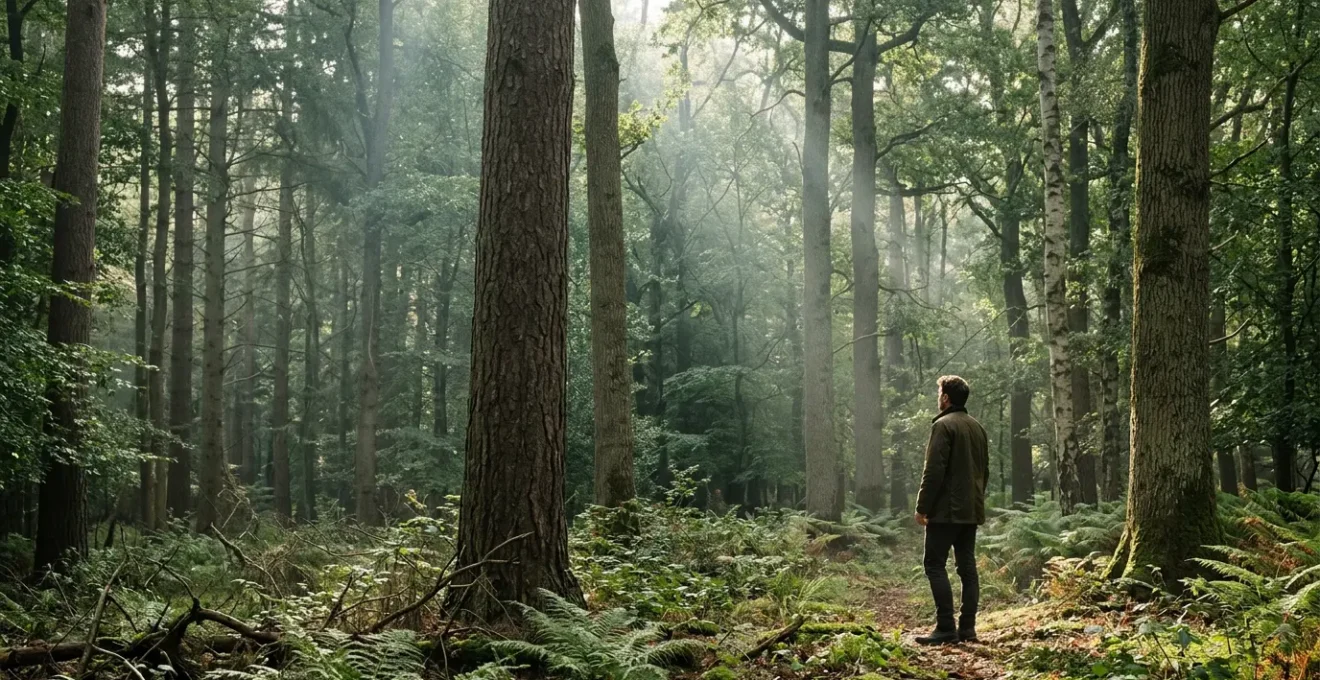
Shinrin-yoku, or forest bathing, is an evidence-based protocol that can lower cortisol in just 20 minutes by actively engaging in a physiological exchange with nature.
- Leaving your phone behind is non-negotiable to free up cognitive resources and enable true immersion.
- Specific breathing techniques in the right type of forest maximize the inhalation of immune-boosting compounds called phytoncides.
Recommendation: Begin with a focused 20-minute session, using sensory anchoring techniques to quiet the mind and unlock the forest’s measurable biochemical benefits.
In the constant hum of urban life, the search for tranquility can feel like a full-time job. You’ve likely heard the advice: “Just take a walk in the park,” or “unplug for a while.” For a stressed professional, this can sound simplistic, another item on an endless to-do list. You’re right to be skeptical. Is Shinrin-yoku, the Japanese practice of “forest bathing,” just a trendy new name for a simple walk, or is there a measurable, scientific basis for its calming effects?
The common understanding of forest bathing often misses the most crucial element. It’s not about passively walking through the forest, but about actively engaging in a physiological transaction with it. The difference between a simple stroll and a therapeutic session lies in a specific, evidence-backed protocol designed to shift your body from a state of high-alert stress to one of restorative calm. The key isn’t just being in nature; it’s about knowing how to receive its biochemical benefits.
This guide moves beyond the platitudes. We will deconstruct the science behind Shinrin-yoku, providing a practical, step-by-step protocol for the analytical mind. You’ll learn how to engage your senses to stop rumination, why your phone is a cognitive liability even when off, and how to literally breathe in the forest’s immune-boosting compounds. This is not just a walk; it’s a targeted wellness intervention, and it starts with just 20 minutes.
To help you navigate this journey from skepticism to practice, this article breaks down the core components of an effective forest bathing session. The following sections will guide you through the science and techniques needed to turn your next walk in the woods into a powerful tool for stress reduction.
Summary: Your Guide to a Scientific Forest Bathing Practice
- The 5-4-3-2-1 Technique: How to Engage Senses to Stop Rumination?
- Digital Detox: Why Your Phone Must Stay in the Car for Forest Bathing to Work?
- Guide vs Solitude: Do You Need an Instructor to Walk in the Woods?
- Phytoncides and Breath: How to Inhale Tree Compounds for Immune Boosting?
- Pine vs Oak: Which Forest Type is Best for Respiratory Health?
- Why You Feel Panic After 48 Hours of Silence and How to Overcome It?
- Soft Fascination: How Does Nature Restore Attention Span?
- Practicing Shinrin-yoku: How Do Phytoncides Boost Your Natural Killer Cells?
The 5-4-3-2-1 Technique: How to Engage Senses to Stop Rumination?
The stressed, analytical mind is a powerful engine for rumination—endlessly replaying worries and what-if scenarios. To begin lowering cortisol, the first step is to gently disengage this engine. A simple walk doesn’t achieve this; the mind continues to churn. The key is to shift from internal thought loops to external sensory input. This is where a structured technique becomes an essential part of the biochemical protocol.
The 5-4-3-2-1 method is a powerful tool for sensory anchoring. It’s a simple, guided meditation that forces your brain to focus on the present moment. You start by deliberately and slowly identifying: five things you can see (the texture of bark, the shape of a leaf), four things you can feel (the breeze on your skin, the earth under your feet), three things you can hear (a distant bird, the rustle of leaves), two things you can smell (damp earth, pine), and one thing you can taste (the clean air, or a sip of water).
This isn’t just a mindfulness exercise; it’s a neurological intervention. By systematically engaging each sense, you activate different parts of your brain, pulling cognitive resources away from the default mode network responsible for self-referential thought and rumination. As noted by researchers, simply viewing natural environments may induce changes in the autonomic nervous system, calming your fight-or-flight response. The 5-4-3-2-1 technique provides the structure to ensure this viewing is intentional and effective.
Your Sensory Anchoring Checklist
- Sight (5): Actively look for details you’d normally miss. A spiderweb, a unique pattern on a rock, the gradient of green in a patch of moss.
- Touch (4): Intentionally feel different textures. The rough bark of a tree, the smooth surface of a stone, the coolness of a fern.
- Sound (3): Close your eyes for a moment to isolate your hearing. Separate the layers of sound from the closest rustle to the most distant hum.
- Smell (2): Get closer to the source. Crush a pine needle between your fingers, smell the air after a light rain, notice the scent of the soil.
- Taste (1): Be aware of the taste of the air itself. Is it clean, metallic, sweet? This final step grounds you completely in the present moment’s physical experience.
By transforming a passive walk into an active sensory scan, you give your brain a specific, non-stressful task that effectively crowds out anxiety. This creates the necessary mental quiet for the deeper physiological benefits of the forest to take hold. It is the foundational step in managing the mind to heal the body.
Digital Detox: Why Your Phone Must Stay in the Car for Forest Bathing to Work?
The most common piece of advice for any “unplugged” activity is to put your phone away. But for the practice of forest bathing, this instruction is not a gentle suggestion—it is a non-negotiable prerequisite for success. The reason is not just about avoiding the distraction of notifications; it’s about a documented cognitive phenomenon known as “brain drain.”
Your smartphone, even when silent, even when face-down, even when powered off, is a voracious consumer of your finite cognitive resources. A landmark 2017 study demonstrated that cognitive capacity is significantly reduced when a smartphone is merely within reach. Your brain is actively working to *not* pick it up, to *not* check it. This background process of resisting temptation occupies a portion of your working memory and attention that is essential for the immersive experience of forest bathing.
This is why “airplane mode” is not enough. The goal of Shinrin-yoku is to allow your directed attention, the kind you use for work and focus, to rest and recover. If your phone is in your pocket, a part of your brain remains on guard duty. To truly begin the restorative process, a complete physical separation is necessary. Leaving it in the car creates a clear, psychological boundary. It’s a ritual that signals to your brain: “You are off duty. You do not need to monitor that device. You are free to engage fully with the environment.”
The act of placing your phone in the glove compartment is the first concrete step of your forest bathing protocol. It is an intentional act of releasing the cognitive load associated with constant connectivity. Only by offloading this mental weight can you create the space for nature’s restorative effects, like “soft fascination,” to work their magic on your overtaxed brain. Without this step, you’re merely walking in the woods with a mental ball and chain.
Guide vs Solitude: Do You Need an Instructor to Walk in the Woods?
Once you’ve committed to the practice, a natural question arises: can I do this on my own, or do I need a certified guide? For the self-sufficient professional, the idea of needing an instructor to simply walk in the woods might seem superfluous. The answer, however, is nuanced. You absolutely do not *need* a guide, but understanding their role reveals a deeper layer of the practice you can learn to apply yourself.
A trained forest therapy guide is not a hiking leader or a naturalist who points out plant species. Their role is to be a facilitator of connection. They are skilled at creating a safe space and offering a series of “invitations”—simple, open-ended prompts designed to help you slow down and engage your senses in ways you might not think of on your own. The goal is to move you from your thinking brain (the prefrontal cortex) to your sensing, feeling body.
As the Association of Nature and Forest Therapy explains, guides help people forge a partnership with nature. They are experts in crafting a sequence that encourages deep presence. They might invite you to spend 15 minutes observing the “world of a single leaf” or to find a “listening spot” and notice the full symphony of the forest. These structured prompts are designed to break the patterns of a goal-oriented mind that just wants to “get to the end of the trail.”
So, should you go solo or with a guide? For your first few sessions, a guide can be invaluable. They teach you the *pace* and the *mindset* of Shinrin-yoku. They model a way of being in nature that is about presence, not performance. Once you have internalized these principles—the art of slowing down, of sensory engagement, of aimless wandering—you are fully equipped to guide yourself. Solitude then becomes a powerful space for personal reflection and deepening your own unique connection with the natural world, using the tools the guide has taught you.
Phytoncides and Breath: How to Inhale Tree Compounds for Immune Boosting?
Here we arrive at the heart of the “physiological transaction” between you and the forest. The air in a forest is not just “fresh air”; it is a complex, airborne cocktail of chemical compounds, and inhaling them is a primary mechanism of Shinrin-yoku. The most important of these are phytoncides, volatile organic compounds released by trees to protect themselves from bacteria, fungi, and insects.
When you breathe in forest air, you are breathing in these phytoncides. These molecules enter your bloodstream through your lungs, and the scientific evidence for their effect on the human body is astounding. The leading researcher in this field, Dr. Qing Li, has conducted numerous studies showing their direct impact on our immune system. Specifically, phytoncides have been shown to significantly increase the number and activity of our Natural Killer (NK) cells. These are a type of white blood cell that plays a vital role in fighting off tumors and virus-infected cells.
This isn’t a fleeting benefit. The research by Dr. Qing Li shows that the increase in NK cell activity from a multi-day forest bathing trip can last for more than 30 days. To maximize this benefit, your breathing must be intentional. Instead of the shallow breathing typical of a stressed state, practice deep, diaphragmatic breathing. Inhale slowly through your nose for a count of four, hold for a moment, and exhale slowly through your mouth. This technique increases the volume of air—and phytoncides—that you take in and allows for better absorption in the lungs.
Imagine each deep breath as a deliberate act of taking the forest’s defense system into your own body to bolster your immunity. This is the most tangible aspect of the biochemical exchange of forest bathing. You are not just calming your mind; you are actively absorbing a natural immunobooster. This is the science that elevates a simple walk into a profound act of preventative medicine.
Pine vs Oak: Which Forest Type is Best for Respiratory Health?
If the key to boosting immunity is inhaling phytoncides, the logical next question for an analytical mind is: are all forests created equal? The answer is no. While any time spent in a natural green space is beneficial, certain types of forests are more potent phytoncide factories than others, making them a more efficient choice for a targeted forest bathing session.
The primary phytoncides with proven health benefits include alpha-pinene and beta-pinene, which are also the compounds responsible for the characteristic “pine” scent. As their names suggest, these are most abundant in coniferous trees like pines, spruces, firs, and cedars. These evergreen trees release phytoncides year-round, with concentrations often peaking in warmer months. Deciduous, broad-leaf forests, like those dominated by oak or maple, also release phytoncides, but generally in lower concentrations and different varieties.
Scientific studies measuring air composition found that alpha-pinene and beta-pinene phytoncides were readily detected in forest air, but almost none were found in city air. This confirms that to get this specific benefit, you must go to the source. As National Geographic highlights, native evergreens are particularly aromatic and release a high concentration of these airborne essential oils, providing a natural immunity boost that can last for weeks.
Therefore, for maximizing respiratory and immune benefits, a coniferous forest is the superior choice. If you have the option, seek out a pine or fir forest for your Shinrin-yoku practice. The rich, resinous scent is not just pleasant; it is a direct indicator of a dense phytoncide “shower.” When you breathe in that aroma, you can be confident that you are engaging in the most potent form of this natural therapy. Choosing your location strategically is another way to transform a casual walk into a deliberate, effective health protocol.
Why You Feel Panic After 48 Hours of Silence and How to Overcome It?
For individuals accustomed to a constant stream of external stimuli—emails, meetings, podcasts, city noise—the sudden absence of it can be profoundly unsettling. You may commit to a weekend of digital detox or a silent retreat, only to find yourself feeling not calm, but a rising sense of panic, anxiety, or intense boredom. This experience is not a sign of failure; it is a predictable and normal neurological response.
Your brain has been trained to be in a reactive state. It constantly scans the environment for the next thing to process, the next problem to solve, the next notification to address. When you remove all external input, the brain’s “threat detection” system can go into overdrive. The silence isn’t empty; it’s filled with the sudden, loud volume of your own internal thoughts, emotions, and unresolved anxieties that were previously drowned out by the noise. This is often referred to as the “withdrawal” phase from our addiction to stimulation.
A study highlighted in a meta-analysis on forest bathing found that while sessions improved mental wellbeing, the experience of initial discomfort is a known part of the process. The brain is adjusting from its frantic pace of processing external data to the much more challenging task of processing internal data—your own feelings and thoughts. The “panic” is the resistance of a mind that is unfamiliar and uncomfortable with looking inward.
The key to overcoming this is to not fight it. Acknowledge the feeling of anxiety or panic as a sign that the process is working. Your brain is detoxing. Instead of fleeing back to distraction, gently redirect your attention to the sensory world around you using the 5-4-3-2-1 technique. Focus on your breath. Walk slowly. The goal is to ride out this initial wave of neurological protest. The calm you are seeking is on the other side of this discomfort. By understanding it as a temporary and necessary phase of re-calibration, you can move through it with compassion and patience rather than fear.
Soft Fascination: How Does Nature Restore Attention Span?
In our professional lives, we rely heavily on “directed attention”—the ability to focus intensely on a task, like writing a report or analyzing data, while filtering out distractions. This type of focus is a finite resource, and in our modern world, it is constantly depleted, leading to mental fatigue and an inability to concentrate. Forest bathing offers a powerful antidote through a psychological concept known as soft fascination.
Coined by environmental psychologists Rachel and Stephen Kaplan in their Attention Restoration Theory, soft fascination describes the effortless, almost meditative state of attention that natural environments evoke. Unlike the “hard fascination” of a thrilling movie or a video game, which captures your attention completely, soft fascination involves stimuli that are interesting but not demanding. Think of watching clouds drift, leaves rustling in the wind, or water flowing in a stream. These patterns are engaging enough to hold your attention gently, but leave plenty of room for reflection and mind-wandering.
This state is profoundly restorative because it allows your directed attention to rest and replenish. While your mind is lightly held by the softly fascinating details of the forest, the neural circuits for intense focus get a much-needed break. It’s the mental equivalent of letting a tired muscle relax. As the Kaplans state, “Natural environments often evoke a state known as soft fascination that allows the mind to rest and reflect, supporting later task performance.” This is not an empty claim; systematic research reviews consistently find evidence for restored attention and improvements in working memory after nature exposure.
During your forest bathing practice, actively seek out these sources of soft fascination. Don’t just walk past the creek; stop and watch the light play on the water’s surface. Don’t just notice the trees; watch how the breeze moves through their branches. By doing so, you are not “doing nothing.” You are engaging in a scientifically validated process of cognitive restoration, recharging your brain’s capacity for focus far more effectively than pushing through fatigue.
Key Takeaways
- Forest bathing is an active protocol designed for cortisol reduction, not just a passive walk.
- A complete digital detox is crucial; the mere presence of a phone depletes the cognitive resources needed for restoration.
- Inhaling phytoncides, especially from coniferous trees, directly boosts immune function by increasing Natural Killer (NK) cells.
Practicing Shinrin-yoku: How Do Phytoncides Boost Your Natural Killer Cells?
We’ve established that Shinrin-yoku is a physiological transaction, with the inhalation of phytoncides as a key mechanism. Now, let’s connect the dots: how does this process directly impact the stress hormone cortisol and your frontline immune defenders, the Natural Killer (NK) cells?
The relationship is elegantly intertwined. High levels of chronic stress, marked by elevated cortisol, are known to suppress the immune system. Specifically, cortisol can inhibit the effectiveness and reduce the number of NK cells, leaving you more vulnerable to infections and illness. Forest bathing attacks this problem from two directions simultaneously. First, the practice itself—the quiet, the soft fascination, the sensory anchoring—reduces psychological stress, which in turn lowers cortisol production. In fact, research has documented an average 12-18% decrease in cortisol levels after short-term forest exposure.
Secondly, and more directly, the phytoncides you inhale actively stimulate your immune system, independent of the psychological calming effect. They act as a direct signal to your body to ramp up its defenses. This was proven in a remarkable study that isolated the chemical from the experience, demonstrating the pure power of the forest’s chemistry.
Case Study: Dr. Qing Li’s Phytoncide Exposure Study
To prove that phytoncides alone were responsible for the immune boost, Dr. Qing Li conducted an experiment where male subjects stayed in a hotel room while a hinoki cypress oil (rich in phytoncides) was vaporized into the air. The results were conclusive: even without the visual and psychological aspects of being in a forest, the participants showed a significant increase in NK cell activity and a decrease in stress hormones. This study powerfully demonstrates that phytoncides are not just a pleasant smell; they are a potent, absorbable, and effective immunomodulator.
This dual-action mechanism is what makes Shinrin-yoku such a powerful wellness protocol. It simultaneously dials down the stress that suppresses your immune system while also directly dialing up the activity of the very cells that protect you. It’s a comprehensive tune-up for your body’s defense and stress-response systems, delivered by the simple, profound act of breathing in the forest.
Begin your practice today by scheduling your first 20-minute forest bathing session. Find a local coniferous forest, leave your phone in the car, and walk slowly, breathing deeply. Focus on this simple, repeatable protocol and experience the measurable benefits for yourself.