True treehouse safety goes beyond a simple checklist; it requires an engineer’s mindset to understand and assess the forces at play.
- Structural integrity depends on managing dynamic loads (movement and wind) and respecting strict occupancy limits, not just the static weight of your family.
- Child and pet safety relies on measurable standards, like the “4-inch sphere rule” for railings, and recognizing that normal behaviors change at height.
Recommendation: Before your stay, use this guide to ask the owner specific questions about load capacity, railing dimensions, and the emergency escape plan. A confident host can answer these questions easily.
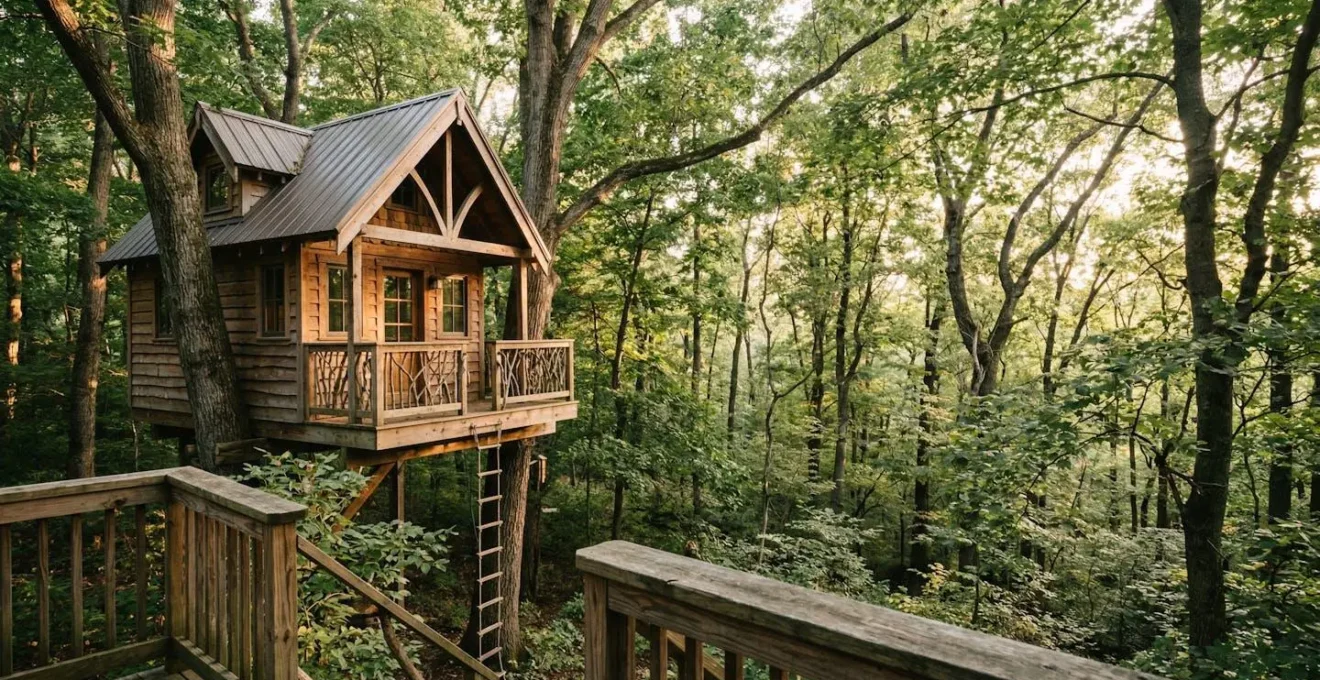
The pictures are captivating: a rustic cabin nestled in the forest canopy, sunlight filtering through the leaves, the promise of a magical escape from the everyday. You envision your children’s wonder and the unique family memories you’ll create. But as a parent, another thought inevitably creeps in, a quiet but persistent whisper: the 20-foot drop. The what-ifs begin to multiply. Is the structure truly sound? What about the wind? Is it safe for the dog, or a curious toddler?
Most travel advice offers generic tips: “supervise your children,” “check for sturdy railings,” or “pack a first-aid kit.” While sensible, this advice fails to address the core anxiety because it doesn’t explain the underlying principles of safety at height. It offers suggestions, but not true understanding or peace of mind. As both a parent and a structural engineer, I know that genuine confidence comes not from a generic checklist, but from knowing what to look for and understanding *why* it matters.
This guide is designed to give you that confidence. We will go beyond the surface-level checks and apply an engineer’s perspective to your treehouse rental. We will analyze the physics of safety, from the forces acting on the structure to the environmental challenges of living in the canopy. You’ll learn how to assess critical safety features, understand the risks, and implement practical protocols that will allow your family to relax and fully embrace the magic of your elevated adventure.
This article breaks down the essential safety considerations for your treehouse stay, providing an engineering and parental perspective on everything from structural loads to emergency preparedness. The following sections will equip you with the knowledge to vet your rental and ensure a secure experience for your entire family.
Summary: Renting Treehouse Cabins: A Guide to Safety at Height
- The Pulley System: How to Get 50lbs of Gear Up 20 Feet Without Injury?
- Motion Sickness on Land: Why Treehouses Move in the Wind and How to Cope?
- Ants and Spiders: How to Seal Your Food When You Live in Their Habitat?
- Fire in the Canopy: What is the Escape Plan if the Stairs are Blocked?
- Occupancy Loads: Why You Can’t Invite 10 Friends to Your 4-Person Treehouse?
- Railings and Lofts: Is This Converted Barn Safe for Toddlers?
- Dynamic vs Static Belay: Why Gym Habits Can Be Dangerous on Real Rock?
- Booking Unusual Lodging: What Insurance Covers a Stay in a Converted Silo or Cave?
The Pulley System: How to Get 50lbs of Gear Up 20 Feet Without Injury?
Hauling luggage and coolers up a narrow ladder or spiral staircase is not just inconvenient; it’s a significant safety risk. It compromises your balance and increases the chance of a fall. A well-designed treehouse often includes a pulley system, a simple machine that provides a huge mechanical advantage. However, its safety depends entirely on its construction and, more importantly, its anchor points. A pulley’s effectiveness is nullified if what it’s attached to—a branch or a structural beam—is a point of failure.
When you arrive, treat the pulley system as a critical piece of safety equipment. Look at where the pulley is mounted. Is it attached to a robust, load-bearing beam of the treehouse itself or a thick, healthy tree limb? Avoid systems attached to thin branches or showing signs of stress on the bark. The rope should be thick, without fraying, and the bucket or basket should be solid. A quick tug on the rope with your feet firmly on the ground can give you a feel for its stability before you entrust it with your heavy gear.
The detail in the mechanism matters. Look for sturdy metal components rather than plastic, and ensure the rope moves smoothly without catching. This isn’t just about convenience; it’s about preventing injury from falling objects or a system failure. Taking a moment to inspect this simple machine is a core part of an engineer’s approach to safety: verify, then trust.
Your Pulley System Inspection Checklist
- Inspect Anchor Points: Check where the pulley is attached to both the treehouse and the tree. Look for any cracks, rust, or signs of bark stress that indicate a weak point.
- Assess Components: Ensure the system uses solid wooden or metal components. Avoid rope-only systems, which are less stable and can pose strangulation risks for children.
- Verify Load Capacity: Before hauling heavy items, give the rope a firm pull from the ground to test its weight-bearing capacity and ensure the attachments can handle dynamic loads.
- Check Rope Condition: Examine the entire length of the rope for fraying, thinning, or sun damage. A compromised rope is a primary point of failure.
- Confirm Attachment Strength: The pulley must be attached to a strong branch or structural support, not a decorative element. It needs to handle the force of lifting and potential swinging.
Motion Sickness on Land: Why Treehouses Move in the Wind and How to Cope?
One of the most surprising aspects of a treehouse stay can be the subtle, yet constant, movement. A well-built treehouse is not rigid; it’s designed to move with the tree, swaying gently in the wind. This flexibility prevents the structure from putting excessive stress on the host tree. However, for some individuals, especially children, this gentle motion can trigger a very real phenomenon: motion sickness. This isn’t a sign of a faulty structure but a biological response to a sensory mismatch.
This feeling of dizziness or nausea occurs when your brain receives conflicting information. As the Vestibular Disorders Association explains, the issue arises “when the central nervous system receives conflicting messages from the visual system and the vestibular system in the inner ears.” Your inner ear feels the motion of the sway, but your eyes, looking at the fixed interior of the cabin, tell your brain you are stationary. This sensory conflict is the root cause of motion sickness, whether on a boat or 20 feet up in a tree.
Coping with this involves helping your brain reconcile these signals.
Adapting to the Motion: A Practical Approach
Principles from vestibular therapy, which uses repeated movements to help patients build tolerance, can be applied here. Upon arrival, don’t just stay inside. Spend time on the deck or near a window, focusing your gaze on a fixed point on the distant horizon, like a mountain or another tree. This helps your brain sync the motion it feels with the visual evidence of your elevated, moving position. Gradual exposure is key; spending short, repeated periods of time in the treehouse can help your family, especially those with sensitive vestibular systems, acclimatize and reduce symptoms. In most cases, the brain adapts within a few hours or a day.
If symptoms persist, over-the-counter motion sickness remedies can be effective. But for most, the key is to acknowledge the movement, understand its source, and give your body time to adapt to its new, gently swaying environment.
Ants and Spiders: How to Seal Your Food When You Live in Their Habitat?
When you stay in a treehouse, you are not just a guest of the host; you are a temporary resident in a complex, vertical ecosystem. You are in the habitat of ants, spiders, and other creatures that have been navigating this space long before the cabin was built. Their primary goal is survival, and an unsealed bag of chips is an open invitation. Preventing pests is not about cleanliness alone; it’s about understanding their world and creating impenetrable barriers.
Ants, for instance, are master foragers that leave behind invisible pheromone trails for others to follow. A single crumb can create a superhighway to your pantry. The key is a zero-tolerance policy for food exposure. Upon arrival, all food should be transferred from its original, often permeable packaging (like cardboard boxes or plastic bags) into completely sealed containers. This is non-negotiable. Opt for heavy-duty glass jars or thick acrylic canisters with silicone gaskets and locking clamps. If air can’t get in or out, neither can insects.
For ultimate protection, think like a backcountry camper and adopt a “bear canister” mentality. Use hard plastic or metal containers that are not just insect-resistant but also rodent-proof. Wiping down all kitchen surfaces with a simple vinegar and water solution is also highly effective, as the acid in the vinegar destroys those scent trails, confusing the pests’ communication system. Finally, remember that some pests don’t need to crawl in; their eggs are already in your food. Items like whole wheat flour, nuts, and spices should be stored in the refrigerator if possible, as the cold temperatures will kill any microscopic eggs before they can hatch. This proactive strategy ensures your food remains yours and respects the natural environment you’ve come to enjoy.
Fire in the Canopy: What is the Escape Plan if the Stairs are Blocked?
The single staircase or ladder leading to your treetop cabin offers a charming, rustic entrance. However, from a safety engineering perspective, a single point of entry is also a single point of failure in an emergency. In the event of a fire, that charming staircase could become blocked by smoke or flames. Fire safety experts warn that in a home fire, you may have as little as two minutes to escape safely. In an elevated structure, that time is even more critical, and a clear, practiced escape plan is not a suggestion—it’s a necessity.
Within the first hour of your arrival, your family’s number one priority should be to conduct a fire safety drill. This involves three crucial steps. First, identify two escape routes: the primary stairs and a secondary exit. This might be a rope ladder stowed in a box, a window that opens onto a lower roof, or a designated emergency descent system. If a second route isn’t obvious, ask the host immediately. Second, establish a safe meeting point on the ground, a specific landmark like a large tree or clearing far away from the structure. Third, practice. Everyone, including children old enough to understand, should physically practice using both escape routes.
Assign specific roles: one adult is responsible for younger children, another for pets. Practice at night or with eyes closed to simulate the disorienting conditions of a real fire. Test that windows open easily and any escape ladders deploy correctly. The rule must be absolute: once you are out, you stay out. No one ever re-enters a burning structure. This isn’t about creating fear; it’s about building muscle memory so that in a high-stress situation, your family can act decisively and automatically. A few minutes of preparation provides an invaluable layer of protection.
Occupancy Loads: Why You Can’t Invite 10 Friends to Your 4-Person Treehouse?
The occupancy limit posted for your treehouse rental—”Maximum 4 people”—is not an arbitrary suggestion; it’s a critical structural calculation. From an engineering standpoint, the most significant risk to a treehouse is not the dead weight of the structure itself, but the unpredictable forces placed upon it. Exceeding the occupancy limit isn’t just about being a little crowded; it’s about introducing forces the structure was not designed to withstand.
Engineers design for two types of forces: static load and dynamic load. The static load is the constant, unmoving weight of the treehouse, its furniture, and its occupants standing still. The dynamic load, however, is the force exerted by movement—people walking, children jumping, or even the structure swaying in the wind. A dynamic load can exert forces many times greater than the static weight of the object creating it. Ten friends invited for a party don’t just add the weight of six extra people; they add the dynamic load of their movement, which could concentrate stress on critical connection points and lead to a catastrophic failure.
Professionally built treehouses incorporate a significant safety margin to account for these forces.
Engineering Safety Margins in Elevated Structures
According to construction standards for elevated play structures, even a small treehouse intended for children should be built to support substantial weight—often 300 pounds or more—using reinforced supports. This safety factor ensures the structure can handle unexpected dynamic loads and remains secure as the host tree grows and shifts. The 4-person limit on your rental is based on a conservative calculation of the total dynamic load the structure and its anchor points can safely bear over time. Respecting it is the single most important thing you can do to ensure structural integrity during your stay.
This limit is the fundamental promise of safety between the builder and your family.
Railings and Lofts: Is This Converted Barn Safe for Toddlers?
Whether in a converted barn, a loft, or a treehouse, ensuring the safety of a toddler at height requires a level of scrutiny that goes far beyond a casual glance. For a small child, a gap that seems insignificant to an adult can present a serious fall hazard. Safety in these environments is not subjective; it is measurable. Professional safety guidelines provide clear, quantifiable standards that serve as your best tool for assessment.
The two most critical numbers to know relate to railings. First, the height. According to professional treehouse safety guidelines, railings should be at least 36 inches tall, high enough to prevent a child from easily climbing or tumbling over. Second, and arguably more important for toddlers, is the spacing between the vertical balusters. This gap should be no more than 4 inches apart. This is known as the “4-inch sphere rule”—if a 4-inch sphere (roughly the size of a soda can or an infant’s head) cannot pass through the opening, it is considered safe. Upon arrival, perform this test yourself. Use your fist or a can to physically check the gaps in all railings, including on decks, lofts, and staircases.
Your inspection should be done from a toddler’s perspective. Get down on your hands and knees. Look for furniture or objects placed near railings that could be used as impromptu climbing aids. Check for any horizontal railing elements that could act like a ladder. For lofts, a removable safety gate at the top and bottom of the ladder or stairs is essential to prevent unsupervised climbing adventures. For children under six, solid barrier walls are always safer than railings with balusters. These objective measurements, not just a feeling of security, are what truly make a space toddler-safe.
Dynamic vs Static Belay: Why Gym Habits Can Be Dangerous on Real Rock?
In rock climbing, a “static belay” works perfectly in the controlled environment of a gym, but it can be dangerous on real rock where a fall requires a “dynamic belay” to absorb the unpredictable forces. This principle of “context misapplication”—where a behavior that’s safe in one environment becomes risky in another—is critically important for parents in a treehouse. Your child or pet’s perfect behavior at home on the ground floor does not automatically transfer to an exciting, elevated, and unfamiliar environment.
Your pet’s perfect behavior at home may change when faced with squirrels and strange noises 20 feet up.
– The Mohicans Treehouse Resort, Treehouse and Cabin Pet Policies and Safety Guidelines
A dog that never leaves your side at home may bolt after a squirrel on a 20-foot-high deck. A child who knows not to climb on furniture may see the loft ladder as an irresistible challenge. The new environment, with its strange noises, new sights, and thrilling heights, can override learned behaviors. You cannot rely on “gym habits.” You must actively plan for the “real rock” scenario. This means keeping pets on a leash at all times when on decks or balconies and establishing firm, clear rules for children from the moment you arrive, with zero exceptions.
The Reality of Falls from Height
The danger is not theoretical. Research from the Center for Injury Research and Policy shows that falls are a leading cause of unintentional injury among children, with the most severe injuries resulting from falls from great heights. The most common treehouse-related injuries are broken bones in the upper body, typically occurring when a child falls or jumps from the structure. This data confirms that skills and behaviors from a controlled home environment do not reliably transfer to dynamic, elevated structures, making constant supervision and proactive rules paramount.
This is where parental supervision becomes a dynamic, active process. It’s not just about being present; it’s about anticipating how the unique context of the treehouse will influence behavior and setting up physical and verbal boundaries to manage that risk.
Key Takeaways
- Think in Dynamic Loads: The safety of a treehouse depends on its ability to handle movement (dynamic loads) from people and wind, not just the static weight of your family. Always respect occupancy limits.
- The 4-Inch Rule is Absolute: For child safety, railings are only secure if the gap between balusters is no more than 4 inches. Physically test this measurement upon arrival.
- Practice a Two-Route Escape: Within the first hour, identify a primary and secondary fire escape route. Practice using them with your family to build muscle memory for a real emergency.
Booking Unusual Lodging: What Insurance Covers a Stay in a Converted Silo or Cave?
After you’ve assessed the physical structure and established safety protocols, one final layer of security remains: your travel insurance. Renting a non-traditional lodging like a treehouse, converted silo, or cave home falls into a gray area for many standard insurance policies. An accident or medical issue in a remote, unconventional setting can introduce complexities that a typical hotel stay would not. Assuming your policy covers you is a risk you shouldn’t take.
Before your trip, you must contact your insurance provider and ask specific, pointed questions. Start by clearly stating the nature of your lodging: “We are renting a professionally-built treehouse cabin that is 20 feet off the ground.” Then, ask the following: Does my policy have any exclusions for accidents occurring in “non-standard,” “unusual,” or “self-built” accommodations? Is there a height limitation for coverage? In the event of an injury, does the policy cover medical evacuation from a remote or difficult-to-access location? This last point is crucial, as an ambulance may not be able to reach the base of a treehouse easily.
Furthermore, inquire about liability. If a member of your party is injured due to a perceived structural issue, what does your policy cover? Understanding these details beforehand provides your final and most important safety net. A good travel insurance policy is designed to protect you from the unexpected, but it can only do so if it is properly aligned with the specific risks of your adventure. Verifying your coverage is the final step in an engineer’s approach to safety—mitigating risk on all fronts.
Armed with this engineering mindset, your next step is to confidently vet your booking. Use these points to communicate with the host about their specific safety features, ensuring your magical trip is built on a solid foundation of knowledge and peace of mind.