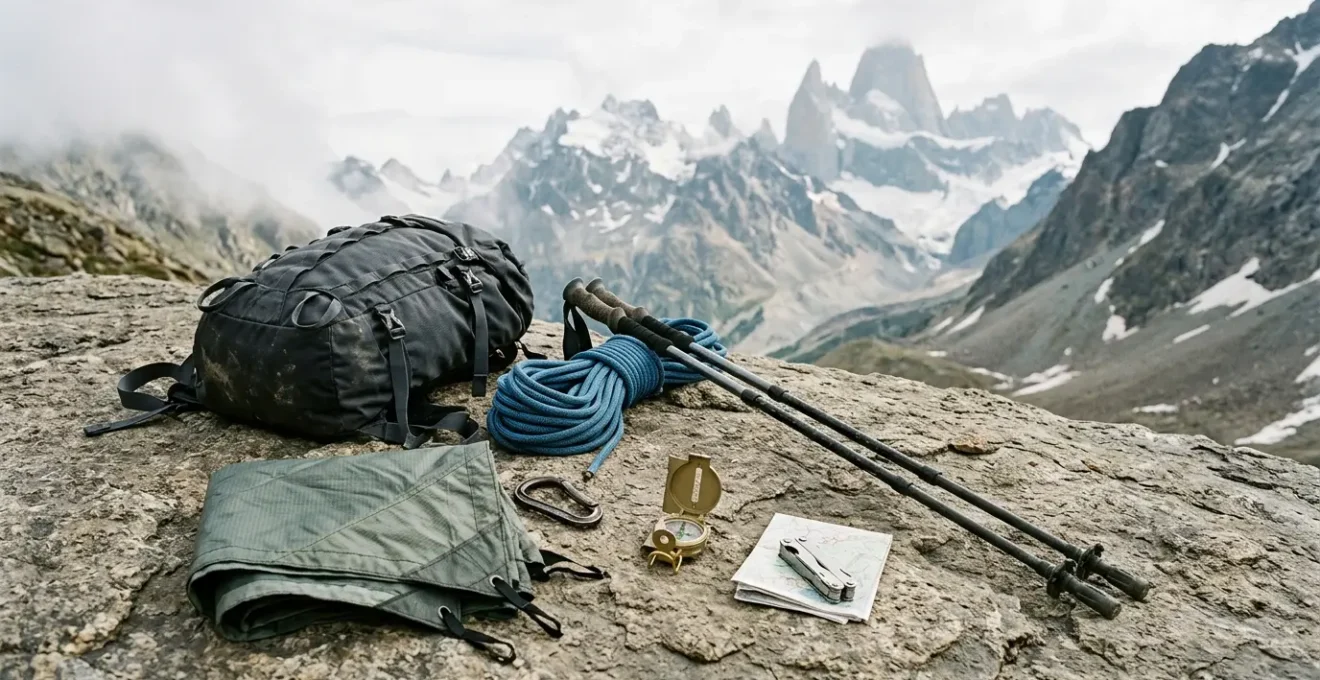
Forget brand loyalty; your expedition gear’s survival depends on your ability to think like a saboteur and perform rigorous failure analysis *before* you leave.
- Most gear failures are predictable and stem from specific weak points in materials, design, and construction that can be identified at home.
- A successful field repair is not about luck, but about having the correct, material-specific adhesives and components for your exact equipment.
- Ultralight gear is not a universal solution; it’s a direct trade-off where you sacrifice durability and increase failure risk to save weight.
Recommendation: Adopt a “pre-mortem testing” mindset. Actively try to break your gear in controlled, worst-case simulations at home to expose its weaknesses before they become catastrophic liabilities in the field.
The terror is a familiar one for any serious adventurer. You’re days from civilization, the weather turns, and a critical piece of equipment gives out. A zipper separates, a tent pole snaps, a seam leaks. The success, and even safety, of the entire expedition hinges on these small points of mechanical integrity. The common advice is to buy from reputable brands and read reviews, but this is a passive approach that outsources your survival to strangers and marketing departments. It assumes a level of quality that is never guaranteed. This is a dangerously flawed strategy.
The real problem isn’t that gear fails; it’s that we fail to anticipate *how* it will fail. We trust the hang-tag and the denier count without understanding the complex interplay of fabric weave, coating chemistry, and stress concentration points. We pack a generic repair kit, hoping a single tube of glue and some duct tape will solve any problem, ignoring the reality of material mismatch where the wrong adhesive is worse than none at all. This guide rejects passive trust. It champions an aggressive, critical mindset of a gear torture-tester.
If you truly want to build a bombproof expedition kit, you must stop being a consumer and become an inspector—a saboteur conducting your own failure forensics. This is not about brand names; it’s about material science, structural analysis, and systemic redundancy. We will dissect the common myths, from fabric strength to zipper function, and provide a systematic framework for identifying and mitigating the inevitable points of failure. This is how you transform fear of the unknown into the cold confidence of the prepared.
This article provides a complete methodology for analyzing your equipment’s weak points. You’ll learn to conduct meaningful pre-trip tests, build a truly effective repair kit, understand the science behind fabric durability, and make strategic decisions about backups and ultralight gear trade-offs.
Summary: A Torture-Tester’s Manual for Expedition Gear Reliability
- The Backyard Test: Why You Must Set Up Your Tent in a Storm Before the Trip?
- Needles and Adhesives: What Must Be in Your Field Repair Kit?
- Slider Failure: How to Fix a Separated Zipper in the Field?
- Denier vs Weave: Why Higher Denier Doesn’t Always Mean Stronger?
- Two is One, One is None: Which Items Require a Backup?
- Seasoning the Canvas: Why Your New Tent Leaks and How to Fix It?
- Tenacious Tape: How to Patch a Gore-Tex Jacket in the Rain?
- Using Ultralight Gear: How to Reduce Knee Pain by Cutting Base Weight?
The Backyard Test: Why You Must Set Up Your Tent in a Storm Before the Trip?
Reading a tent’s hydrostatic head rating is meaningless. Believing a “factory sealed” seam will hold under load is naive. The only truth is performance under stress. A “backyard test” is not a casual setup on a sunny day; it’s a pre-mortem simulation of the worst conditions you might face. Your goal is to make the tent fail now, in the safety of your home, so you can diagnose and fix its inherent weaknesses before they become a hypothermic emergency. This means setting it up and subjecting it to a prolonged, multi-angle soaking that mimics driving rain. This is where you will discover if the seam tape lifts, if the DWR coating has gaps, or if a design flaw channels water directly into a vulnerable area.
A proper test reveals the difference between condensation and a true mechanical leak. Many adventurers mistake interior moisture for a failing fabric, when it’s often just their own respiration. By systematically stressing the exterior while monitoring the interior, you can pinpoint the exact failure point. Is it the seam at a high-tension guy-out point? Is it the fabric itself wetting out under sustained pressure? The US military won’t certify a tent fabric as waterproof unless it meets a minimum of 1500mm hydrostatic head pressure, but this rating degrades with abrasion and UV exposure. Your test is the only way to know your shelter’s current, real-world capability.
Your Tent Waterproofing Audit Protocol
- Set Up: Pitch the tent in an open area. Ensure the fabric is taut and all stakes are under proper tension to simulate wind load.
- Simulate Rain: Use a garden hose with a spray nozzle on a “shower” or “mist” setting. Avoid high-pressure jets which can damage coatings.
- Saturate: Spray the entire tent exterior for at least 15 minutes, focusing on all seams, zippers, and high-stress areas like pole attachments and guy-out points.
- Diagnose Leaks: Perform a “Wet Paper Test.” Tape dry paper towels to the inside of the tent along seams and walls. Spray the outside again for 15 minutes. The paper will instantly show a true leak, differentiating it from slow-forming condensation.
- Identify Failure Mode: Inspect any wet spots to determine the cause. Is it a seam tape failure (peeling), hydrostatic head failure (water seeping through the fabric), or wicking (water traveling along stitching or guylines)?
Needles and Adhesives: What Must Be in Your Field Repair Kit?
A generic repair kit is a useless gesture. Your field repair kit must be a purpose-built, material-specific arsenal designed for the exact equipment you carry. The most common point of failure in repairs is not the patch, but material mismatch—using an adhesive that is chemically incompatible with the fabric’s coating. A silicone-based sealant on a polyurethane (PU) coated fabric will not bond. It will peel off, leaving you with a sticky, compromised mess and a still-leaking shelter. You must know what your gear is made of and pack the precise chemistry to fix it.
This means your kit isn’t just “glue”; it’s a tiny material science lab. It should contain a small tube of silicone-based sealant for silnylon, a urethane-based adhesive for PU coatings, and specialized patches for laminates like Gore-Tex. The needle you pack shouldn’t be a flimsy sewing needle; it must be a heavy-duty sailmaker’s needle capable of punching through thick webbing and multiple layers of fabric. The thread should be heavy-duty polyester or even dental floss, which is incredibly strong and wax-coated for water resistance. Every item in the kit must be a direct answer to a predicted failure. As the following case study shows, this level of preparation is not academic; it is the result of hard-won experience.
Case Study: Andrew Skurka’s Evolved Repair System
Long-distance hiker Andrew Skurka’s field repair kit is a masterclass in material-specific preparation. After experiencing catastrophic failures like torn rain gear and abraded Dyneema tarps on major expeditions, he developed a system that directly addresses the chemical nature of his gear. As detailed in his analysis, his kit isn’t one-size-fits-all; it contains Aquaseal specifically for urethane-coated items and Sil-Net for silicone-treated fabrics. He learned that these adhesives are not interchangeable, a lesson that prevents trip-ending gear failures. This demonstrates that a truly effective kit is built on a foundation of material science, not guesswork.
The technical specifications from manufacturers are not marketing fluff; they are critical operational parameters. Ignoring them leads to guaranteed failure.
Seam Grip WP will not work on silicone-treated fabrics or sil-nylon.
– Gear Aid Technical Documentation, Seam Grip WP Field Repair Kit Product Specifications
Slider Failure: How to Fix a Separated Zipper in the Field?
Of all the potential mechanical failures, a separated zipper on a tent door or jacket is one of the most insidious. It renders your shelter or insulation system useless. The common assumption is that the teeth are broken, but in most cases, the culprit is the slider itself. Over time, the small gaps on the top and bottom of the slider that hold the two sides of the zipper coil together slowly widen from use. Once they open beyond a critical tolerance, they no longer have the force to properly mesh the teeth, causing the zipper to separate behind the slider.
Fixing this in the field is a delicate but often possible operation. It requires one tool: a pair of pliers or a multi-tool. The goal is to gently squeeze the slider to narrow those gaps back to their original specification. First, move the slider all the way to the start of the zipper. If the zipper has separated, you may need to work it back and re-feed one side. Then, using your pliers, apply very gentle, incremental pressure to the sides of the slider (not the top and bottom where the pull-tab is). Squeeze, test the zipper. If it still separates, squeeze a tiny bit more. The danger is over-tightening; if you apply too much force, you will jam the slider permanently. This is a last-resort fix, but it can save a trip.
Of course, preventative maintenance is key. As experts note, the primary cause of slider wear is often contamination.
In my experience, sliders very rarely just ‘get stuck.’ There is usually something caught in the teeth (like dirt, grit, sticky stuff, etc.)
– Lindsey Stone, Rainy Pass Repair Operations Director
Keeping your zippers clean with a brush and occasionally lubricating them with a silicone-based zipper lube will dramatically reduce wear on the slider and prevent the grit that accelerates its demise. Assume your zippers will be exposed to sand, dirt, and resin, and treat them accordingly.
Denier vs Weave: Why Higher Denier Doesn’t Always Mean Stronger?
One of the most pervasive and dangerous myths in outdoor gear is that a higher denier (D) number automatically means a stronger, more durable fabric. Denier is simply a measure of a fiber’s weight and thickness; it says nothing about the fabric’s structural integrity. True strength, particularly tear strength, comes from the weave. A low-denier fabric with a superior weave can vastly outperform a high-denier fabric with a simple, weak weave. The most obvious example of this is the difference between a plain weave and a ripstop weave.
A ripstop fabric incorporates a grid of thicker, stronger reinforcement threads into the main weave. When a tear starts, it runs until it hits one of these threads, which contains the damage and prevents it from propagating across the entire fabric panel. This is a form of engineered structural redundancy at the microscopic level. A plain weave fabric lacks this grid, so a small puncture can easily become a catastrophic, trip-ending tear under load. The difference in performance is not subtle; it is dramatic. According to technical tests, the tear strength can be more than doubled by the weave alone, even with identical fiber denier.
For example, data from ASTM D2261 testing protocols shows that a 70D Nylon Ripstop can have a tear strength of 15-20 lbs/inch, whereas a 70D Nylon Plain Weave might only withstand 5-8 lbs/inch. When selecting gear, you must look beyond the marketing-friendly denier number and inspect the fabric itself. Look for the tell-tale grid pattern of a ripstop weave. Understand that durability is a synergy between fiber material (Nylon vs. Polyester), denier, weave structure, and any coatings applied. To ignore the weave is to be blind to one of the most critical factors in fabric failure.
Two is One, One is None: Which Items Require a Backup?
The mantra “two is one, one is none” is the core principle of systemic redundancy. It’s not about carrying two of everything; that’s just dead weight. It’s about identifying single points of failure within your critical survival systems (shelter, water, fire, navigation) and ensuring you have a backup for those specific components. A broken tent pole doesn’t just mean your tent is broken; it means your entire shelter system has failed. A lost water filter means your hydration system is compromised. Your failure analysis must extend from individual items to the systems they support.
Some redundancies are obvious: carry a backup fire starter (a lighter and a ferro rod) and a backup navigation tool (GPS and a physical map/compass). But others are less intuitive. A critical, often-overlooked single point of failure is a tent pole. A single cracked segment can cause the entire structure to collapse in high wind. The backup? A simple, lightweight aluminum pole splint or sleeve that can be slid over the break and taped in place. According to analysis by gear manufacturers like NEMO, this single item is one of the most crucial and most frequently forgotten pieces of a repair kit.
Another critical area is buckles. As Gear Patrol notes, the hip belt buckle on a heavy pack is not an accessory; it is a crucial component for load transfer. Its failure means you will be carrying the entire weight of your pack on your shoulders, which can be debilitating. Carrying a spare, field-replaceable buckle for your specific hip belt width is a tiny weight penalty for massive insurance. Smart redundancy can also be achieved through multi-use items. A multi-tool with pliers, a knife, and a driver serves as a backup for multiple individual tools and repair functions, embodying the principle of efficient redundancy.
Seasoning the Canvas: Why Your New Tent Leaks and How to Fix It?
A brand new canvas or poly-cotton tent will almost certainly leak during its first rainstorm. This is not a defect; it is a fundamental property of the material that must be addressed through a process called “seasoning.” Canvas fabric is made of woven cotton fibers. When new and dry, there are microscopic gaps in the weave and around the stitch holes. When the canvas gets wet for the first time, the cotton fibers swell up, closing these gaps and making the fabric naturally waterproof. The stitching thread also swells, sealing the needle holes.
To season a new canvas tent, you must intentionally soak it and let it dry completely. Set it up in your backyard and saturate it with a garden hose. Let it get thoroughly soaked, paying special attention to the seams. Then, let it dry completely in the sun. You may need to repeat this wet/dry cycle two or three times. Each cycle will cause the fibers to swell and shrink, progressively tightening the weave and sealing the stitch holes until the tent is fully waterproofed by its own structure. Skipping this process is a guarantee for a wet, miserable first trip.
This principle of proactive maintenance extends to modern synthetic tents as well. While they don’t “season” in the same way, their waterproof coatings (DWR and PU) degrade over time due to UV exposure, abrasion, and dirt. A tent that was once bombproof can begin to “wet out,” with water saturating the outer fabric instead of beading up. Following manufacturer guidelines, which often suggest re-applying waterproofing treatments every 2-3 years of use, is critical. In fact, a well-maintained older tent can be far more reliable than a cheap new one. As gear analysts point out, the performance is in the maintenance, not the age, a fact proven by how a properly restored 10-year-old tent can outperform a budget model off the shelf.
Tenacious Tape: How to Patch a Gore-Tex Jacket in the Rain?
A tear in your hardshell jacket during a downpour is a critical emergency. It’s a breach in your primary defense against hypothermia. Field repair in these conditions is the ultimate test of preparation, where success hinges on technique and understanding adhesive limitations. Tenacious Tape is an excellent tool for this, but simply slapping it on a wet, cold jacket will fail. The adhesive needs a clean, dry, and preferably warm surface to bond correctly. In a storm, you have to create these conditions.
There is a clear hierarchy for emergency surface preparation. Your ability to execute these steps determines whether your patch holds or peels off in minutes.
- Achieve Dryness: This is your absolute first priority. Use a dry, absorbent cloth (a bandana or even the inside of another dry layer of clothing) and press firmly on the area around the tear to absorb as much surface moisture as possible.
- Clean the Surface: Once mostly dry, you must degrease the area. Your first-aid kit should contain alcohol wipes; use one to aggressively clean the fabric. This removes body oils and dirt that will defeat any adhesive.
- Apply Body Heat: Cold temperatures inhibit adhesive curing. After cleaning, warm both the patch (by holding it in your hand) and the jacket fabric (by pressing it against your body) before application.
- Apply with Pressure: Apply the patch, which should overlap the tear by at least 1/4 to 1/2 inch on all sides. Press down firmly from the center outwards, using your thumbnail to smooth out any air bubbles.
If conditions are so severe that the tape absolutely will not stick, you must revert to a mechanical closure. Use a needle and dental floss to stitch the tear shut. This won’t be waterproof, but it restores the jacket’s structural integrity and wind resistance, which can then be covered by any other waterproof material to deflect the worst of the rain.
Different adhesives have different environmental needs. While Tenacious Tape needs a dry surface, other options like Aquaseal UV are designed for different scenarios. It cures in seconds when exposed to sunlight, making it ideal for sunny-day repairs but useless in a storm or at night. Know the operational parameters of every item in your repair kit.
Key Takeaways
- Gear failure is not a matter of ‘if’ but ‘when’. A proactive, destructive testing mindset is your best insurance.
- True fabric strength lies in the weave (e.g., ripstop) and coatings, not just the advertised denier number.
- A field repair kit is only effective if it contains material-specific adhesives and tools tailored to your exact gear.
Using Ultralight Gear: How to Reduce Knee Pain by Cutting Base Weight?
The siren song of ultralight (UL) gear is powerful. The promise of reducing base weight to alleviate stress on your knees and increase your daily mileage is tempting. However, this is not a free lunch. Ultralight is a conscious and critical trade-off: you are exchanging durability and resilience for lower weight. Every gram saved comes from using thinner fabrics, smaller buckles, and less robust components. This directly increases the probability of catastrophic gear failure. Choosing UL gear isn’t a simple upgrade; it’s a strategic decision that requires a higher level of user skill, care, and a deep understanding of its inherent weaknesses.
The failure points of UL gear are fundamentally different from those of traditional equipment. A traditional backpack might suffer a broken buckle, which is a replaceable component. An ultralight pack made from 70D fabric is more likely to suffer a structural failure, where the strap attachment point tears directly out of the pack’s main body—an unrepairable, trip-ending event. A traditional tent pole might bend and be fixed with a splint; a puncture in an ultralight single-wall tent can be a critical breach of the entire shelter system. Understanding this distinction is paramount.
This comparative table, based on data and analysis of gear construction, highlights the critical shift in failure points when moving from traditional to ultralight equipment. As outlined in a technical guide from Featherstone Outdoor, the materials used define these vulnerabilities.
| Gear Type | Traditional Failure Point | Ultralight Failure Point | Denier Range |
|---|---|---|---|
| Backpack | Broken buckle (replaceable) | Fabric tearing from strap attachment (structural) | Traditional: 500D+ / UL: 200D-70D |
| Tent | Bent aluminum pole (repairable with splint) | Puncture in single-wall fabric (catastrophic leak) | Traditional: 40D+ / UL: 20D-7D |
| Rain Gear | Worn DWR coating (re-treatable) | Abrasion through thin laminate (requires patch) | Traditional: 40D+ / UL: 15D-7D |
| Sleeping Pad | Slow valve leak (field-repairable) | Puncture from ground debris (critical warmth loss) | Traditional: 75D / UL: 30D-20D |
By adopting this critical, forensic approach to gear selection and preparation, you shift from being a potential victim of circumstance to being the master of your own equipment. Your survival is not a function of a brand’s reputation, but of your own diligence. Assume everything will fail, find out how, and prepare for it. That is the only path to true confidence in the wild.