The exorbitant price of a Nordic glass dome is only justified when the engineering, location, and timing align perfectly; otherwise, you’re paying for a gimmick, not a superior aurora experience.
- The dome’s thermal technology is surprisingly effective, but its optical quality for photography presents significant challenges like glare and reflection.
- True value comes from a resort’s verified dark sky rating (Bortle Scale) and strategic timing with the solar cycle, not just the glass roof itself.
Recommendation: Before booking, use light pollution maps to independently verify a resort’s “dark sky” claims and prioritize travel between late 2024 and early 2026 to capitalize on the current solar maximum.
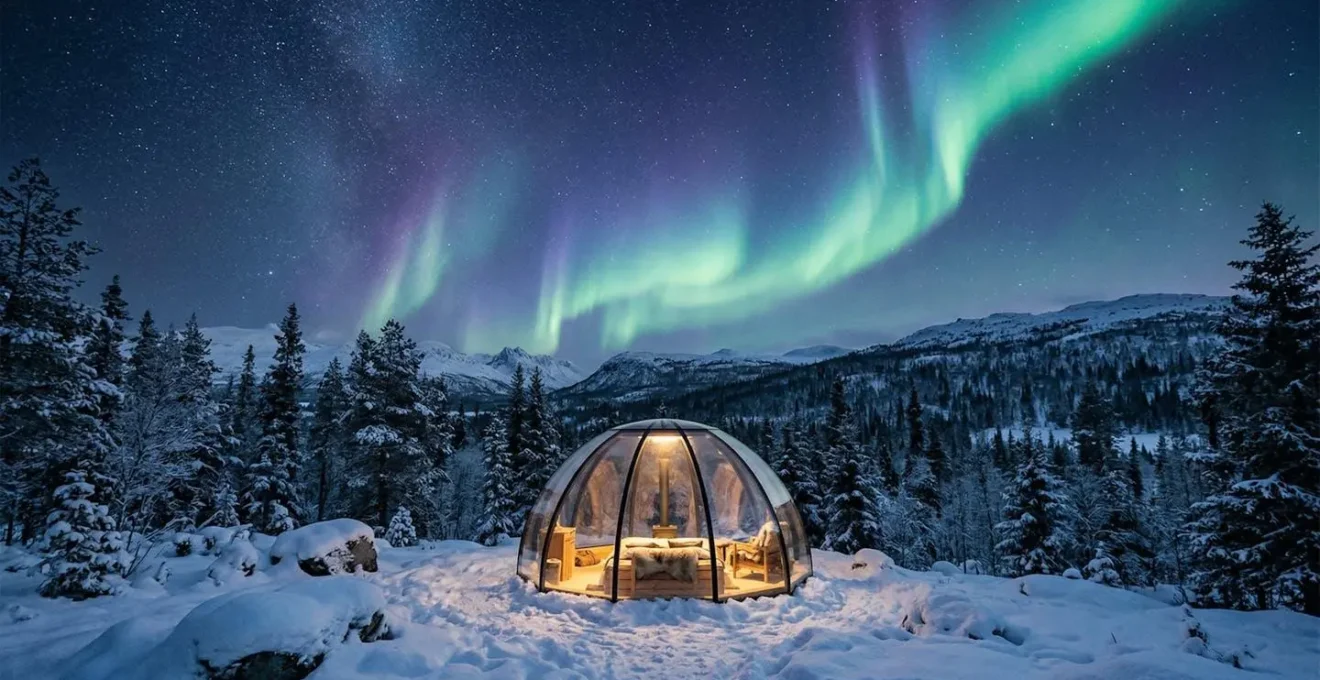
The image is an archetype of modern bucket-list travel: a luxurious glass dome, glowing softly amidst a snow-covered Arctic forest, with the ethereal green ribbons of the Aurora Borealis dancing overhead. It’s a fantasy sold on a million Instagram feeds, promising the ultimate union of comfort and cosmic wonder. But this fantasy comes with a staggering price tag, often running into thousands of dollars per night. For the discerning traveler, this raises a critical question: are you paying for a genuinely unparalleled viewing experience, or are you funding a brilliantly marketed gimmick?
Most travel guides wax poetic about the “magic” and advise you to “book in advance.” This analysis, however, goes deeper. We’re not here to talk about feelings; we’re here to talk about value. As a travel critic, my focus is on the return on your investment. We will dissect the engineering that keeps you warm at -30°C, the logistical challenges of privacy in a transparent room, and the astronomical realities that determine whether you see a faint green smudge or a sky on fire. This isn’t just about finding a room with a view; it’s about understanding the complex interplay of technology, location, and timing that separates a life-changing experience from an expensive disappointment.
This guide deconstructs the glass dome phenomenon piece by piece. We will analyze the thermal science, privacy solutions, optimal timing based on solar cycles, and the practicalities of photography. By understanding these critical factors, you will be equipped to judge for yourself whether the price is truly worth the view.
Summary: A Critical Look at Glass Domes and the Northern Lights
- Glass vs Cold: Can These Domes Actually Maintain 20°C When It’s -30°C Outside?
- The Fishbowl Effect: How to Maintain Privacy in a Transparent Room?
- Solar Cycles: Why Booking in 2025 Might Be Better Than 2028?
- Reflections and Glare: How to Shoot the Aurora From Inside the Dome?
- The Midnight Sun Problem: Can You Sleep in a Glass Dome in Summer?
- Bortle Scale 1 vs 3:Navigating Ancient Boreal Forests: How to Find Your Way When GPS Fails?
- Aperture Matters: Why f/2.8 is the Minimum for Night Sky Clarity?
- Escaping Invasive Light Pollution: Where to Find True Dark Skies for Astrophotography?
Glass vs Cold: Can These Domes Actually Maintain 20°C When It’s -30°C Outside?
The primary technical marvel of a glass dome is not the view itself, but its ability to provide that view without freezing its occupants. The claim of maintaining a comfortable indoor temperature of 20°C when the Arctic winter rages at -30°C seems almost unbelievable. However, the technology is both sound and highly sophisticated, borrowing from advanced architectural science. The key lies in multi-layered, insulated glass units (IGUs), typically triple-glazed, which create sealed cavities between the panes.
These cavities are the secret weapon against the cold. Instead of regular air, they are filled with an inert gas, most commonly argon. This is not just a minor upgrade; research shows that argon-filled cavity systems offer 31% more efficiency than standard air-filled ones at preventing heat transfer. This gas acts as a powerful thermal barrier. Furthermore, the glass panes are treated with a microscopic, transparent metal layer known as a Low-Emissivity (Low-E) coating. This coating reflects long-wave infrared energy (heat) back into the room, preventing it from escaping through the glass. It’s a one-way mirror for heat, keeping the warmth generated inside from leaking out into the polar night.
So, can they actually stay warm? Yes. The combination of triple-glazing, inert gas insulation, and Low-E coatings creates a high-performance thermal envelope. When paired with efficient underfloor heating, these structures are more than capable of providing a cozy sanctuary. From a value perspective, this is a legitimate feat of engineering that you are paying for—it’s the foundational technology that makes the entire experience possible.
The Fishbowl Effect: How to Maintain Privacy in a Transparent Room?
A room made of glass inherently creates a paradox: it offers total immersion in nature while simultaneously threatening total exposure. This is the “fishbowl effect,” and how a resort manages it is a key differentiator between a luxury retreat and an awkward, overpriced campsite. The marketing often highlights the seamless connection with the outdoors, as a statement from one popular resort notes.
The transparent dome design creates a 360-degree viewing experience that effectively eliminates the boundary between indoors and outdoors.
– Aurora Queen Resort, Glass igloo getaway: Reconnect with nature in comfort
While this sounds idyllic, it raises immediate privacy concerns. Low-end operators might simply place domes side-by-side, relying on curtains and the goodwill of neighbors. High-end resorts, however, integrate privacy into the very fabric of their design and location. They understand that true luxury is not just about what you see, but also about not being seen. This is where site planning becomes a critical component of the value proposition.
Case Study: Lyngen North’s Strategic Seclusion
The Lyngen North Glass Igloo Hotel in Norway exemplifies an intelligent solution to the privacy dilemma. Instead of relying on curtains, their strategy is based on geography and orientation. Each dome is meticulously positioned on the secluded Spåkenes Peninsula, with the floor-to-ceiling glass walls facing directly towards the Lyngen Alps and Lyngenfjord. The opaque rear sections of the domes face the access paths, ensuring that no unit has a direct line of sight into another. This thoughtful layout leverages the vast, empty landscape as a natural privacy screen, creating an intimate and personal viewing theater for each guest without visual intrusion.
When evaluating a glass dome resort, look beyond the room itself. Examine the site map. Are the domes staggered? Are they oriented away from each other? Are they using natural features like forests or hills to create visual barriers? A resort that has invested in strategic site planning is offering a tangible upgrade in experience and privacy, which helps justify its premium price.
Solar Cycles: Why Booking in 2025 Might Be Better Than 2028?
The Northern Lights are not a constant phenomenon; their intensity and frequency are governed by the Sun’s 11-year cycle of activity. Paying thousands for a glass dome is a gamble, but you can significantly improve your odds by timing your trip with the “solar maximum”—the peak of this cycle. During this period, the sun emits more solar flares and coronal mass ejections, sending a greater volume of charged particles toward Earth, resulting in more frequent and spectacular auroral displays.
For travelers planning a trip, this is not an abstract scientific concept; it is the single most important factor for maximizing the return on their investment. Fortunately, we are entering a prime window. After years of a quiet “solar minimum,” NASA and NOAA confirmed that the solar maximum arrived in late 2024. This peak isn’t a single event but a plateau of heightened activity that will gradually wane over the next few years. This makes the immediate future a gold rush for aurora hunters.
Experts in the region are highlighting this unique opportunity. As a guide from Hurtigruten Norway explains, the effects of this peak will extend for some time:
The two upcoming aurora-chasing seasons, between September and March of 2025-26 and 2026-27, will benefit from elevated activity, even as the solar cycle progresses steadily towards the next minimum around 2031.
– Hurtigruten Norway, What is the Solar Maximum? Northern Lights guide
From a critic’s standpoint, this is a crucial piece of advice. Booking a trip in 2025 or 2026 offers a statistically higher chance of a spectacular show than booking in 2028 or 2029, when solar activity will be significantly lower. While a glass dome is a fixed asset, the quality of the sky’s performance is variable. Paying the same high price for a low-activity year is a poor investment. Therefore, strategic timing is not just a recommendation; it’s a financial imperative.
Reflections and Glare: How to Shoot the Aurora From Inside the Dome?
While the dome offers unparalleled comfort for viewing the aurora, it presents a significant challenge for photographers: you are shooting through multiple layers of thick, curved glass. The same Low-E coatings that keep you warm can create internal reflections and glare, potentially ruining a long-exposure shot. The dream of capturing a perfect aurora photo from your bed is possible, but it requires specific techniques to overcome the optical limitations of your five-star bubble.
Simply pointing your camera at the sky will result in disappointment. You’ll capture reflections of yourself, the room’s interior, and any ambient light. To get a clean shot, you must treat the glass as a technical obstacle to be managed. Autofocus will almost certainly fail in the dark, and any slight movement will blur the image. Success depends on a methodical approach that minimizes reflection and maximizes stability. The following steps are not just tips; they are essential procedures for anyone serious about astrophotography from within a dome.
- Use Manual Settings: Set your aperture to f/2.8 or as wide as your lens allows. Use manual focus and set it to infinity by focusing on a distant, bright star before the aurora appears.
- Eliminate Reflections at the Source: The most critical step is to create a light-tight seal between your lens and the glass. Press your lens hood flush against the dome’s interior surface.
- Block Light Leaks: Drape a dark piece of clothing (like a black jacket or hoodie) over both your camera and the area where the lens meets the glass. This creates a mini darkroom, blocking any stray light from inside the room from reflecting into your lens.
- Shoot Perpendicularly: Position your camera to shoot as straight-on (perpendicular) to the glass as possible. Shooting at an angle increases distortion and refraction caused by the triple-glazing.
- Total Darkness is Mandatory: Turn off every single light inside your dome. This includes your phone screen, the bathroom light, and even the tiny standby light on a TV. Any light source will be visible in a long exposure.
- Ensure Stability: Use a sturdy tripod. To avoid camera shake when you press the shutter, use a 2-second exposure delay mode or a remote shutter release.
Mastering these techniques is part of the experience. While it requires more effort than shooting in an open field, successfully capturing the aurora through the glass is a rewarding technical achievement. It proves that the dome can be more than just a viewing platform—it can also be a functional, albeit challenging, photographic studio.
The Midnight Sun Problem: Can You Sleep in a Glass Dome in Summer?
While glass domes are synonymous with winter and the Northern Lights, many of these resorts are open year-round. This presents a completely different challenge during the Arctic summer: the Midnight Sun. From late May to late July in the far north, the sun doesn’t set, bathing the landscape in 24-hour daylight. For a traveler in a transparent room, this raises a very practical question: how is it possible to sleep?
The experience of the Midnight Sun is a natural wonder in itself—a perpetual, golden-hued twilight that disorients the body clock and creates a surreal, dreamlike atmosphere. A glass dome offers an immersive way to experience this phenomenon, allowing you to watch the sun dip to the horizon and then begin to rise again without ever disappearing. However, the human body is conditioned to associate darkness with sleep, and the constant daylight can disrupt sleep patterns.
Fortunately, resorts have a simple and effective solution. While the main viewing panels are permanently transparent, the domes are almost always equipped with heavy, blackout curtains for the sections of the dome not intended for primary viewing or for when guests desire darkness. As The Aurora Zone points out, functionality is not sacrificed for form: “The curtains can be closed if you’d like privacy, and you can enjoy the room’s beautiful interior.” Most properties also provide high-quality sleep masks as a standard amenity.
From a value perspective, this confirms that the domes are designed as versatile, all-season accommodations. You are not just paying for a winter-only aurora gimmick. The ability to enjoy the unique spectacle of the Midnight Sun in summer adds another layer to the investment, though it transforms the dome’s purpose from a celestial observatory to a unique, light-filled wilderness retreat. It’s a different kind of magic, but one that requires a good sleep mask.
Bortle Scale 1 vs 3:Navigating Ancient Boreal Forests: How to Find Your Way When GPS Fails?
The single most critical factor for a successful aurora viewing is not the quality of your accommodation, but the quality of the darkness. Not all dark skies are created equal. The scientific measure for this is the Bortle Scale, a nine-level numeric scale that quantifies the darkness of a night sky. It’s the definitive metric for any serious astrophotographer or aurora hunter. As the Bortle dark-sky scale defines, it ranges from Class 1, representing the darkest skies available on Earth, to Class 9, which is the skyglow of an inner-city center. For aurora viewing, anything above a Class 3 is a significant compromise.
A true Class 1 sky is so dark that the Milky Way can cast a faint shadow. These pristine locations are often found deep within vast, ancient boreal forests or remote tundras, far from any human settlement. It is in these profoundly isolated places—where one might indeed worry about navigating if a GPS were to fail—that the aurora appears at its most brilliant and detailed. The fainter, more subtle colors and structures of the display become visible only in the absence of any competing light pollution.
Discerning resorts know this and leverage their location as a primary selling point. A property boasting about its location is making a direct claim about its Bortle Scale rating, as one Finnish operator highlights: “This area of Finland is affected by only very limited light pollution and has an impressive Aurora Borealis-viewing record.” When you pay a premium, you should be paying for a location that is, at a minimum, a Bortle Class 3, and ideally a Class 2 or 1. A glass dome located in a Bortle Class 4 area (e.g., on the outskirts of a town) is a poor value proposition, as you are paying for a view that is already compromised.
Aperture Matters: Why f/2.8 is the Minimum for Night Sky Clarity?
For photographers aiming to capture the aurora, the technical specifications of their equipment are as important as the location. Among the most critical of these is the lens aperture. The aperture is the opening in the lens through which light travels to the camera sensor. Its size is measured in f-stops (e.g., f/1.8, f/2.8, f/4), and in the low-light world of aurora photography, a “wide” or “fast” aperture (a lower f-stop number) is non-negotiable.
Professional aurora photographers and guides consistently recommend using a lens with an aperture of at least f/2.8. Why is this specific number so important? The aurora is often fainter to the camera sensor than it appears to the human eye and is constantly moving. A wide aperture allows the sensor to gather as much light as possible in the shortest amount of time. This is a crucial advantage for several reasons.
As photographer Dave Morrow explains, it’s about balancing the exposure triangle to maintain image quality. In his definitive guide, he notes:
The wide lens opening allows your camera’s sensor to collect a lot of light from the scene while keeping your ISO and image noise, low.
– Dave Morrow, Northern Lights Photography – The Definitive Guide
Using a wider aperture like f/2.8 means you can use a shorter shutter speed to freeze the movement of the aurora’s “dancing” curtains and a lower ISO to minimize the grainy “noise” that plagues high-ISO images. If you try to shoot at f/4 or f/5.6, you would need to compensate with a much longer shutter speed (turning the aurora into a blurry smear) or a much higher ISO (degrading the image with noise). Therefore, f/2.8 isn’t an arbitrary suggestion; it’s the minimum threshold for capturing a sharp, clean, and vibrant image of the night sky.
Key Takeaways
- The dome’s thermal performance is a genuine feat of engineering, but its optical quality for photography is a significant, manageable challenge.
- A resort’s true value is determined less by the glass itself and more by its verified dark sky location (Bortle Scale) and strategic guest privacy planning.
- Maximizing your investment requires timing your visit with the solar maximum, making 2025-2026 a prime window for superior aurora activity.
Escaping Invasive Light Pollution: Where to Find True Dark Skies for Astrophotography?
You can be in the most expensive glass dome in the world, but if it’s near a town, a ski resort, or even a brightly lit access road, your aurora experience will be compromised. Light pollution is the nemesis of astrophotography. It washes out faint details, reduces contrast, and turns the sky from a deep black to a hazy orange or gray. Therefore, the final and most important act of a discerning traveler is to independently verify a resort’s dark sky claims before committing thousands of dollars.
Do not take marketing phrases like “secluded location” or “zero light pollution” at face value. A truly dark site is a measurable attribute, and you have the tools to check it yourself. The secluded location of a resort like Lyngen North is often cited as a key benefit, with reviews noting, “The secluded location means zero light pollution and unbeatable stargazing—ideal for aurora hunters looking for the ultimate glass igloo experience in Norway.” Your job is to verify such claims for any property you consider. This due diligence is the final step in ensuring your investment pays off with a genuinely dark sky.
Your 5-Step Dark Sky Audit Plan
- Map the Pollution: Use a tool like lightpollutionmap.info to check the resort’s exact location. Look for areas in the blue, gray, or black zones (Bortle 1-3). Reject any location in a green, yellow, or orange zone.
- Scout via Satellite: Use Google Earth’s satellite view to inspect the resort’s layout and its proximity to nearby towns, roads, and other potential light sources. Check for brightly lit pathways or central buildings within the resort itself.
- Analyze Resort Lighting: Investigate the resort’s own lighting policy. Do they use shielded, downward-facing fixtures? Are the lights a warm color temperature (amber or red) to preserve night vision? A premium resort will openly advertise its dark-sky-friendly lighting design.
- Check the Lunar Calendar: The moon is the brightest object in the night sky. Plan your trip for the week surrounding the new moon. A full moon can be bright enough to wash out all but the most intense auroral displays.
- Assess the Hybrid Strategy: If your dream dome is in a less-than-perfect (e.g., Bortle 4) location, consider a hybrid approach. Stay in a more affordable cabin and book a separate, professionally guided “aurora chase” that takes you to a certified Bortle 1 location.
Ultimately, a glass dome is just a lens. Its value is entirely dependent on the quality of the spectacle it’s pointed at. By acting as your own critical auditor and prioritizing a pristine dark sky above all else, you shift the odds dramatically in your favor. This ensures you are paying for the celestial show itself, not just a comfortable seat in a compromised theater.
By applying this critical framework—evaluating the technology, verifying the location, and timing your visit with the cosmos—you can confidently determine if a Nordic glass dome is the right investment for your bucket list. It’s about moving beyond the hype and making an informed decision based on tangible value.