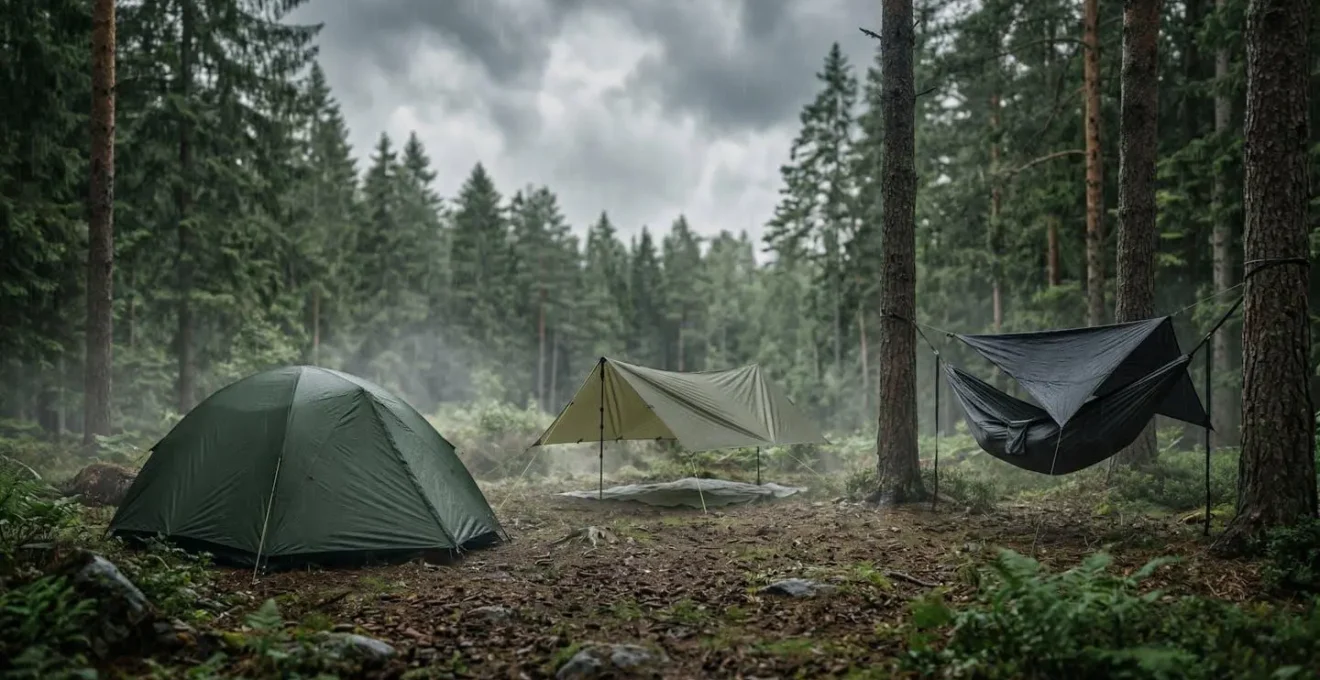
True dryness in wet weather is not about buying the ‘most waterproof’ shelter, but about mastering the entire moisture management system.
- Internal condensation from your own breath is often a greater threat than rain, soaking your gear from the inside out.
- Your sleeping pad’s insulation (R-value) is more critical than your sleeping bag for preventing heat loss to the cold, wet ground.
- A shelter’s setup speed in a downpour directly impacts how dry your gear stays; a slow pitch can render a waterproof tent useless.
Recommendation: Shift your focus from a single waterproof rating to evaluating a shelter’s complete system: its ventilation design, its compatibility with high R-value pads, and its ability to be pitched quickly without soaking the interior.
Every camper who’s spent time in a rainy climate knows the feeling: the disheartening discovery of a damp sleeping bag, even inside a supposedly bombproof, waterproof tent. The initial assumption is a leak, a failure of the fabric. But more often than not, the enemy isn’t the rain getting in, but the moisture you’ve created from within. The common advice is to simply “buy a good tent” or “check the waterproof rating,” but this oversimplifies a complex problem. Choosing the right shelter for wet environments—whether it’s a tent, a bivy, or a hammock—goes far beyond a simple hydrostatic head number.
The decision involves a series of critical trade-offs between breathability, ground insulation, setup efficiency, and durability. True expertise lies not in finding a single perfect shelter, but in understanding this interconnected moisture system. This guide abandons the simplistic feature comparison. Instead, we will dissect the underlying physics and practical realities of staying dry. We will explore why condensation forms, how heat is lost to the ground, and why the time it takes to pitch your shelter in a storm can be the most critical factor of all.
This article breaks down the essential technical considerations for selecting a shelter system truly built for wet conditions. By understanding these principles, you can move beyond marketing specs and make an informed choice based on how a shelter performs as a complete system.
Summary: Which Shelter System Actually Keeps You Dry in the Rain?
- Why Condensation Soaks Your Sleeping Bag Even in a Waterproof Tent?
- R-Value Explained: Why Your Pad Matters More Than Your Bag in the Cold?
- Pitching in a Downpour: Which Shelter System Is Fastest to Set Up?
- The Ultralight Trap: When Saving 500g Costs You a Good Night’s Sleep?
- No-See-Ums and Mosquitoes: Which Mesh Size Actually Stops Them?
- The Backyard Test: Why You Must Set Up Your Tent in a Storm Before the Trip?
- Poncho-Tarp: Can One Item Really Serve as Rain Gear and Shelter?
- Living in Canvas Bell Tents: How to Prevent Mold During Humid Seasons?
Why Condensation Soaks Your Sleeping Bag Even in a Waterproof Tent?
The primary culprit behind a wet sleeping bag is often not a leak, but a fundamental principle of physics: condensation. Even at rest, the human body is a constant source of moisture. Field measurements show a single person can produce nearly a pint of water vapor overnight through breathing and perspiration. This warm, moist air fills your tent. When it makes contact with the inner surface of the tent fly, which has been cooled by the outside rain and air, the temperature drops below the dew point. The water vapor then converts back into liquid water, forming droplets on the inside of your shelter.
This process is the core of the moisture system inside your tent. A completely sealed, “waterproof” environment becomes its own worst enemy by trapping this moisture. Without adequate ventilation to exchange the humid interior air with drier outside air, this condensation will accumulate, run down the tent walls, and pool on the floor, eventually soaking your gear. As camping condensation research shows, humans produce about 120 mL of water in an 8-hour sleep period, which has to go somewhere. This is why double-wall tents are designed with a breathable inner tent and a waterproof outer fly, creating an air gap to manage this effect.
As the image above illustrates, these droplets coalesce and can become a significant source of water. If your sleeping bag presses against the tent wall, it will act like a sponge, wicking this moisture directly into its insulation. Effective microclimate management, therefore, relies less on absolute waterproofness and more on strategic ventilation. Features like high and low vents, leaving a vestibule door partially unzipped, and proper guy-out points to maximize airflow between the inner and outer walls are critical for staying dry from the inside out.
R-Value Explained: Why Your Pad Matters More Than Your Bag in the Cold?
In wet, cool climates, a significant battle for warmth is lost not to the air, but to the ground. This occurs through a process called conductive heat transfer. The cold, damp earth acts as a massive heat sink, constantly pulling warmth from your body when you lie on it. Your sleeping bag’s loft, which traps warm air, is rendered useless where your body weight compresses it against the floor. This is where your sleeping pad becomes the most critical piece of insulation in your entire sleep system.
A sleeping pad’s ability to resist this heat flow is measured by its R-value. A higher R-value means more insulation and less heat loss to the ground. What most campers don’t realize is that sleeping bag temperature ratings are not determined in a vacuum. In fact, industry testing standards reveal that manufacturers assume you’re using a pad with an R-value of 5.38 when assigning an EN/ISO temperature rating to a sleeping bag. If you pair a 20°F bag with a summer pad (R-value of 2), you will be cold at 40°F because you are losing massive amounts of heat through convective heat loss into the ground.
Choosing the right R-value for the conditions is non-negotiable for a warm, dry-feeling night. A well-insulated pad prevents your body from having to work overtime to stay warm, which in turn reduces the risk of cold-induced discomfort that can feel like dampness. For three-season use in rainy regions like the Pacific Northwest or the UK, a pad with an R-value between 3.5 and 5.0 is essential.
- R-value 1.0-2.5: Summer camping only, for temperatures reliably above 50°F (10°C).
- R-value 2.5-4.0: Three-season use, suitable for temperatures down to freezing 32°F (0°C).
- R-value 4.5+: All-season and winter use, necessary for frozen ground and sub-freezing temperatures.
Remember that R-values are additive. In an emergency, or for added winter protection, stacking a closed-cell foam pad (e.g., R-2.0) under your inflatable pad (e.g., R-3.5) will give you a total system R-value of 5.5, significantly boosting your insulation from the cold, wet ground.
Pitching in a Downpour: Which Shelter System Is Fastest to Set Up?
When the sky opens up, the theoretical waterproofness of your shelter becomes secondary to one critical factor: the deployment penalty. This is the amount of water that gets inside your shelter *during* setup. A tent that takes 10 minutes to pitch with an exposed inner body can be completely soaked before you even get inside, negating its weather-proof design. Therefore, evaluating a shelter for rainy climates must include a rigorous assessment of its setup speed and method.
Different shelter systems have vastly different advantages and disadvantages in a downpour. Traditional double-wall tents that require setting up the inner mesh body first are the most vulnerable. Hammock systems and certain tent designs that allow the rainfly to be pitched first create a dry workspace, protecting you and your gear from the moment you start. Bivy sacks offer the fastest deployment but provide no transitional space to get out of wet gear before entering your sleeping bag.
The following comparison, based on data from wet-condition shelter analysis, breaks down the typical performance of each system when setup speed is paramount.
| Shelter Type | Setup Time | Dry Interior Success Rate | Key Advantage in Rain |
|---|---|---|---|
| Fly-First Double-Wall Tent | 5-7 minutes | High | Rainfly protects inner tent during setup |
| Hammock with Tarp | 3-5 minutes | Very High | Tarp-first method creates dry workspace |
| Bivy Sack | 1-2 minutes | Low | Fastest deployment but no transition space |
| Traditional Inner-First Tent | 7-10 minutes | Low | Interior gets soaked during pitch |
As the data shows, a hammock with a tarp offers the best combination of speed and protection, allowing an experienced user to establish a dry shelter in under five minutes. For ground dwellers, a “fly-first” or “all-in-one” pitch tent is vastly superior to an “inner-first” design in the rain. This single design choice can make the difference between a dry refuge and a miserable, waterlogged night.
The Ultralight Trap: When Saving 500g Costs You a Good Night’s Sleep?
The quest for an ultralight pack is seductive, but in wet and challenging climates, it can lead you into the “ultralight trap.” This is the point where shedding grams comes at the expense of durability, weather resistance, and ultimately, safety. The most significant trade-offs are often made in fabric thickness, which is measured in Denier (D). A lower Denier number means a lighter thread and a lighter fabric, but it also means less abrasion and puncture resistance.
For shelters intended for harsh, rainy conditions, the durability-to-weight ratio is a more important metric than absolute weight. A tent floor made of 10D or 15D fabric may be incredibly light, but it’s far more susceptible to punctures from sharp rocks or roots—a critical failure when the ground is saturated. Similarly, a 7D or 10D rainfly may not withstand the stress of being buffeted by wind-driven rain. As tent fabric testing shows, durability drops substantially below 30 Denier, while the weight savings become less significant. For a workhorse shelter in wet terrain, a floor of 30-40D and a fly of 20-30D often provide a much better balance of longevity and manageable weight.
Field studies on ultralight materials confirm this vulnerability. Fabrics like 10D nylon, while technologically impressive, require meticulous site selection to avoid damage. A small, unnoticed tear can quickly become a major leak in a persistent downpour. This doesn’t mean ultralight shelters have no place; it means the user must accept a higher level of responsibility for careful handling and be prepared for field repairs. For a camper upgrading for reliability in wet conditions, sacrificing a few hundred grams for a more robust fabric is often a wise investment in a good night’s sleep.
No-See-Ums and Mosquitoes: Which Mesh Size Actually Stops Them?
A shelter in a wet climate must protect you not only from rain but also from the swarms of biting insects that thrive in damp environments. Mosquitoes are a nuisance, but the truly maddening pests are tiny biting midges, often called “no-see-ums.” Their minuscule size allows them to pass through standard mosquito netting, turning your shelter into an inescapable trap rather than a refuge. This is why the specification of your shelter’s mesh is a critical detail, not a minor feature.
The effectiveness of insect netting is determined by its hole density, typically measured in holes per square inch. Standard mosquito netting might have a density of around 200-250 holes per square inch, which is perfectly adequate for stopping mosquitoes, black flies, and ticks. However, it is completely ineffective against no-see-ums, which are common in coastal, boggy, or forested areas like Scotland, Scandinavia, and the Pacific Northwest.
To create a true barrier against these pests, you need a much finer weave. According to tent ventilation specifications, a “No-See-Um” grade mesh is required. This type of netting features a density of 450 or more holes per square inch. While this ultra-fine weave offers superior bug protection, it does come with a trade-off: reduced airflow. This can slightly increase the potential for condensation, reinforcing the idea that every element of shelter design is part of an interconnected system. When choosing a tent, bivy, or hammock inner, look for the specific “no-see-um mesh” designation to ensure you’re protected from the smallest of invaders.
The Backyard Test: Why You Must Set Up Your Tent in a Storm Before the Trip?
Reading specifications and watching reviews can only tell you so much. The single most important step in mastering your shelter system is to pressure-test it in controlled but challenging conditions before you’re miles from civilization. A backyard, a local park, or any accessible outdoor space can become your laboratory. Waiting to learn your tent’s quirks in a real-life downpour at dusk is a recipe for failure. A proactive backyard test turns theory into invaluable muscle memory.
The goal is not just to see if it leaks. It’s to simulate the entire experience of setting up, living in, and packing down the shelter under stress. This includes practicing the pitch with thick gloves on to mimic cold, numb fingers, or even with your eyes closed to build a tactile familiarity with the poles and clips. This practice is what separates experienced outdoorspeople from those who rely solely on their gear’s marketing. It allows you to identify potential failure points—a guyline that’s difficult to tension, a spot where water pools on the fly, or how much bulk a soaking wet tent adds to your pack.
By discovering these issues at home, you can develop solutions and strategies, ensuring that when you face a real storm, your actions are confident and efficient. This hands-on experience is the final and most crucial part of choosing and owning a reliable shelter.
Your Pre-Trip Shelter Pressure-Test Protocol
- Practice with gloves: Set up the shelter while wearing thick gloves to simulate pitching with cold, numb hands and build muscle memory.
- Simulate rain: Use a garden hose or sprinklers to douse the tent for at least 30 minutes, then get inside to inspect for leaks, paying close attention to the seams.
- Test wind-loading: Use a large fan to simulate wind pressure against the tent, checking how the guylines hold tension and if the fabric makes excessive contact with the inner tent.
- Identify pooling spots: During the sprinkler test, look for areas on the rainfly where water collects instead of shedding. Practice re-tensioning the fly to eliminate these spots.
- Practice a wet pack-down: Pack up the soaking wet shelter to understand how much water it retains, how heavy it becomes, and the best technique for stuffing it without getting everything else wet.
Poncho-Tarp: Can One Item Really Serve as Rain Gear and Shelter?
For the dedicated minimalist, the poncho-tarp represents the pinnacle of multi-functionality. This single piece of gear serves as your rain jacket while hiking and converts into your primary shelter for sleeping. By eliminating the redundancy of carrying both a separate rain jacket and a tent fly or tarp, a poncho-tarp can save significant weight and bulk in a pack. It embodies the philosophy of doing more with less, but this efficiency comes with significant and often underestimated trade-offs.
The primary advantage is its ultralight, dual-use nature. On the trail, it provides ample ventilation as rainwear, reducing the “human-sauna” effect common with traditional rain jackets. At camp, it can be pitched in a variety of configurations, such as a simple A-frame or lean-to, using trekking poles or trees for support. The setup is incredibly fast, a major benefit in a sudden downpour. However, the compromises are substantial, especially in persistently wet and buggy climates.
First, coverage is minimal. Most poncho-tarps provide just enough space to keep a sleeping bag and a person out of direct rain, but offer very little protection from wind-blown spray or ground splash. There is no floor, requiring a separate groundsheet. More importantly, there is absolutely no bug protection. In areas with clouds of mosquitoes or no-see-ums, this is not just an inconvenience—it’s a deal-breaker. Finally, transitioning from “rain mode” to “shelter mode” means you are without rain protection while setting up, and the inside of your shelter is the same fabric that was just exposed to the elements. For the hardened ultralight backpacker in forgiving conditions, it’s a viable tool. For someone seeking reliable comfort in truly wet, buggy environments, it’s a significant gamble.
Key Takeaways
- Condensation is a primary internal threat; managing airflow is just as important as keeping rain out.
- Your sleeping pad’s R-value is your main defense against conductive heat loss to the cold, wet ground.
- A shelter’s setup speed in a downpour is a critical performance metric that directly impacts how dry you and your gear will stay.
Living in Canvas Bell Tents: How to Prevent Mold During Humid Seasons?
While most of our discussion has focused on lightweight, portable shelters for backpacking, a different set of challenges arises with long-term basecamps in humid climates, particularly when using canvas bell tents. Unlike synthetic nylon or polyester, canvas is an organic material made from cotton. This gives it a wonderful, breathable quality but also makes it highly susceptible to mold and mildew if not managed correctly. Preventing mold is not a one-time fix, but an ongoing process of moisture management.
The first step, known as “seasoning,” is crucial for new canvas. This involves thoroughly wetting the tent and letting it dry completely. The process causes the cotton fibers to swell and then shrink, tightening the weave and creating a naturally water-resistant barrier. Beyond this initial step, the key to mold prevention is constant and aggressive airflow. Canvas tents are designed with large doors and multiple vents for this purpose. Using low wall vents and a high apex vent or a stove jack creates a natural chimney effect, constantly pulling humid air up and out of the tent.
The most critical phase for mold growth is not during use, but during storage. A canvas tent must be bone dry before it is packed away. Even a small amount of residual dampness can lead to a catastrophic mold outbreak in a matter of weeks. Storing the tent in a dry, climate-controlled space and using a dehumidifier in the storage area is highly recommended. For those living in a canvas tent for extended periods, a small wood stove is an invaluable tool, providing a dry heat that helps vaporize condensation and keep the interior environment hostile to mold growth.
- “Season” new canvas by wetting and drying it to tighten the weave.
- Use low and high vents to create a “chimney effect” for constant airflow.
- Ensure the tent is 100% “bone dry” before storage, as this is when most mold grows.
- Utilize a tent wood stove to provide dry heat and burn off interior humidity.
- Regularly open doors and windows to fully exchange humid air, especially after rain or while cooking.
Now that you understand the core principles of moisture and thermal management, the final step is to apply this knowledge. The most effective way to validate any shelter system is to put it to a real-world test, identifying its strengths and weaknesses before you depend on it in the backcountry.