In summary:
- True self-sufficiency is a problem-solving system, not just a gear checklist.
- Mastering field-expedient repairs for chains, tires, and suspension is non-negotiable.
- Your nutrition and hydration directly impact your ability to perform complex mechanical tasks under stress.
- Learn to improvise first aid for common major injuries like collarbone fractures and be prepared to self-evacuate.
- The “Two is One, One is None” principle applies to critical systems: navigation, hydration, and repair kits.
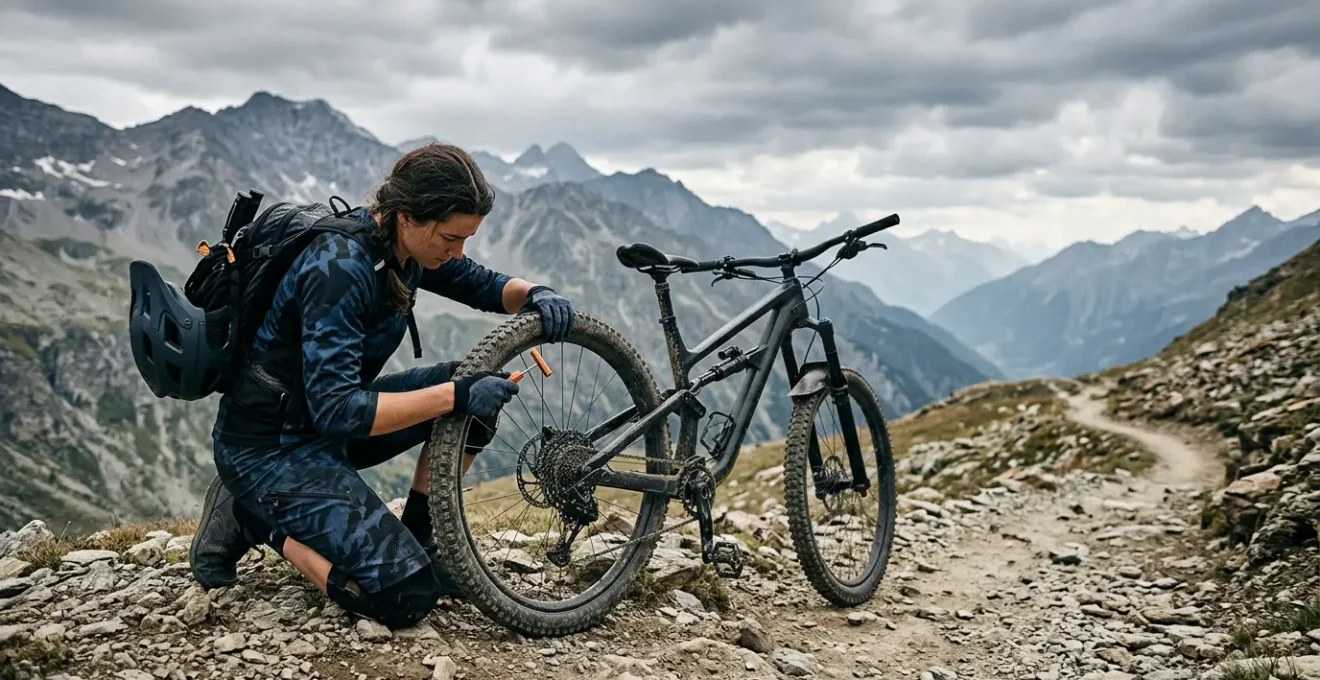
You’re miles from the trailhead. The sun is dipping, a chill is in the air, and you just heard that sickening sound—a snapped chain, a hissing tire, or the dull thud of your body hitting the ground. Panic is a luxury you can’t afford. In the backcountry, your most important tool isn’t in your pack; it’s the problem-solving system in your head. Many guides offer simple checklists of what to carry, but they fail to teach you what to do when the ideal tool is missing, the situation is complex, or you’re the one who is broken.
This is where the mindset of an endurance racer and mechanic becomes critical. It’s a shift from merely following instructions to actively diagnosing a failure, managing your physical and mental state, and making a calculated decision. This guide moves beyond the basics. We’re not just talking about fixing a flat; we’re talking about splinting a limb with your bike pump, understanding why your suspension is failing on a descent, and knowing when to eat to keep your brain sharp enough to fix a complex mechanical. It’s about a holistic approach to self-reliance.
But what if the problem isn’t the bike, but you? We’ll cover the harsh realities of immobilizing an injury to walk or even ride out. The ultimate goal is to replace fear with a calm, systematic process. You’ll learn to perform a failure triage, apply the principle of “resourcefulness over redundancy,” and identify your personal evacuation threshold. This knowledge is what separates a bad day from a true disaster, ensuring you have the skills to make it back on your own terms.
This comprehensive guide is structured to build your self-sufficiency layer by layer, from common mechanical failures and bike tuning to critical first aid and strategic planning. Follow along to develop the system mindset that will keep you safe and in control, no matter what the trail throws at you.
Summary: The Backcountry Rider’s Complete Self-Reliance Manual
- Why Your Chain Breaks on Climbs and How to Prevent It?
- Rebound Damping: How to Adjust Your Shock for Rocky Descents?
- Gel vs Solid Food: What to Eat During a 4-Hour Ride to Avoid Bonking?
- The Collarbone Crash: How to Immobilize an Arm to Ride (or Walk) Out?
- PSI for Grip: How Low Can You Go Before Risking Rim Damage?
- Two is One, One is None: Which Items Require a Backup?
- Crawling Out: How to Splint a Leg for Self-Rescue?
- Planning Multi-Sport Wilderness Adventures: How to Transition from Biking to Kayaking Smoothly?
Why Your Chain Breaks on Climbs and How to Prevent It?
A snapped chain under load is a classic backcountry failure. It almost always happens on a steep, punchy climb when you’re putting maximum power through the drivetrain. The primary cause isn’t a single massive force, but the accumulation of wear and poor shifting technique. A worn, or “stretched,” chain is significantly weaker. In fact, research demonstrates that a chain loses about 15% of its tensile strength for every 1% of wear. This gradual degradation creates the perfect vulnerability for a sudden, catastrophic break.
The other major factor is shifting under load. When you force a shift while grinding up a hill, you’re trying to derail the chain from a sprocket that is under immense tension. This forces the chain plates to bend and twist laterally, a direction they are not designed to handle. This action, combined with pre-existing wear, is the final straw that pops a pin or snaps a plate. Preventing this failure begins before the climb, with proactive maintenance and disciplined shifting habits. Regularly checking your chain for stretch with a simple tool and replacing it when it exceeds 0.75% wear is the most effective prevention.
On the trail, the key is to anticipate. Shift to an easier gear *before* the grade kicks up, not halfway through it. If you must shift on a climb, momentarily back off your pedaling pressure for the split second it takes the chain to move. This small habit dramatically reduces side-loading stress. A clean, properly lubricated chain is also less likely to bind and suffer damage. Treat your drivetrain with mechanical sympathy, and it will get you home.
Ultimately, a chain break is almost always a failure of maintenance, not a random defect. By understanding the forces at play, you can adopt habits that make it a non-issue.
Rebound Damping: How to Adjust Your Shock for Rocky Descents?
Your rear shock’s rebound damping controls the speed at which it extends after being compressed. This is arguably the most critical suspension setting for maintaining control on fast, rocky descents. If your rebound is too fast (fully open), the rear wheel will bounce off obstacles like a pogo stick, feeling “bucking” and uncontrolled. If it’s too slow (fully closed), the shock won’t have time to recover between hits. It will “pack down,” sinking deeper into its travel with each successive bump until you have no suspension left to absorb the next impact. This results in a harsh, jarring ride and a total loss of traction.
The goal is to find the sweet spot: a rebound setting that is fast enough to track the ground but slow enough to prevent bouncing. This allows the tire to stay in contact with the trail surface, providing consistent grip and control. Many riders are intimidated by suspension dials, but setting rebound is a simple, feel-based process you can do anywhere. You don’t need a pro tuner, just a curb and a few minutes to establish a baseline.
This process of bracketing—starting at one extreme and working your way in—is a fundamental skill for any rider looking to get the most out of their bike. Once you have a good baseline, you can make small, one-click adjustments on the trail to fine-tune for specific conditions. A little slower for big, slow compressions; a little faster for high-frequency chatter.
As you can see, the adjuster dial provides a tactile way to make these micro-adjustments. Mastering this setting transforms the bike’s behavior, turning a nervous, skittish ride into a planted and confidence-inspiring one. It’s the difference between surviving a rock garden and flowing through it.
Your Field Guide to Setting Rebound Damping
- Set rebound fully open (fastest setting, usually counter-clockwise) as your starting point.
- Find a small drop or curb and ride off it slowly in a neutral, standing “attack position.”
- Notice if the suspension bounces or oscillates more than once after landing. If it does, add one click of rebound damping (clockwise).
- Repeat the process, adding one click at a time, until you feel the shock compress and return to its sag point in a single, smooth cycle with no bounce. This is your baseline.
- Test this setting on a rough trail. If the bike feels harsh and seems to lose travel on successive hits, your suspension is “packing down.” Reduce damping (make it faster) by 1-2 clicks.
Don’t be afraid to experiment. Your ideal setting is personal and terrain-dependent. Learning to adjust it by feel is a massive step towards total bike control.
Gel vs Solid Food: What to Eat During a 4-Hour Ride to Avoid Bonking?
In the backcountry, nutrition isn’t just about performance; it’s a critical safety system. “Bonking,” or hitting the wall from glycogen depletion, doesn’t just make you slow. It impairs your judgment, ruins your motor skills, and turns a simple mechanical problem into an insurmountable one. For a ride of four hours, your body’s stored energy is not enough. You must actively refuel, and the key is consistent carbohydrate intake. For moderate-intensity cycling, studies show cyclists need to consume 30-60g of carbohydrates per hour to maintain performance and cognitive function.
The debate between energy gels and solid food is about more than just taste. It’s a strategic choice based on timing, intensity, and psychological needs. Gels are a highly efficient fuel source. They are composed of simple sugars that are absorbed rapidly, providing a quick energy spike within 10-20 minutes. They are perfect for high-intensity efforts or when you feel a bonk approaching and need energy *now*. However, relying solely on gels can lead to flavor fatigue and gastrointestinal distress for some riders.
Solid foods—like energy bars, jerky, or a handful of nuts—play a different role. They provide a slower, more sustained energy release and can offer a significant psychological boost. The act of chewing and tasting savory or complex food can be a huge morale lift on a long, arduous day. They are your “all-day” fuel, while gels are your “in-case-of-emergency” or “race-pace” fuel. A smart backcountry rider carries both, using a systematic approach to fueling that matches the food type to the situation.
This comparative table breaks down the strategic advantages of each fuel type for a long backcountry ride, helping you decide what to pack and when to eat it.
| Factor | Energy Gels | Solid Food (bars, nuts, jerky) |
|---|---|---|
| Absorption Speed | Fast (10-20 minutes) | Moderate (20-40 minutes) |
| Water Required | Low to Moderate | High (digestion demands more water) |
| Ease During Mechanical | Very Easy (stationary) | Easy (can chew while working) |
| Psychological Benefit | Functional only | High (savory comfort, morale boost) |
| Storage Stability | Heat sensitive | Very stable (jerky, nuts) |
Your strategy should be to start with solid foods early and consistently, then introduce gels later in the ride or for intense climbs to keep your energy levels stable. Never wait until you’re hungry; by then, it’s already too late.
The Collarbone Crash: How to Immobilize an Arm to Ride (or Walk) Out?
A broken clavicle (collarbone) is one of the most common and debilitating injuries in cycling. It’s a harsh reality of the sport; a 2016 study revealed that up to 13.5% of cyclists may experience a clavicle fracture during their riding career. When it happens deep in the backcountry, the priority shifts from medical treatment to safe self-evacuation. The intense pain and instability of the shoulder joint make any movement agonizing, but proper immobilization can make the difference between a painful walk out and a full-blown emergency rescue.
Before focusing on the shoulder, you must perform a quick but thorough full-body systems check. Did you hit your head? Are you bleeding significantly? Can you feel and move your other limbs? Only after confirming no more immediate life threats should you address the collarbone. The goal of immobilization is to support the weight of the arm and prevent the broken bone ends from moving. Any movement is not only excruciating but also risks further damage to the surrounding nerves and blood vessels.
The most effective field dressing is a makeshift sling. Your own cycling jersey, a base layer, or even a large hydration pack can be used. The key is to create a cradle that supports the elbow and holds the arm at a 90-degree angle, snug against your body. This transfers the arm’s weight to your neck and torso, taking the strain off the broken clavicle. Once immobilized, you face a critical decision: walk or ride? If the trail is smooth and your legs and core are strong, a slow, careful ride may be possible. If the trail is technical or you’re in shock, walking is the only safe option. Pain is your guide; if an action dramatically increases pain, stop immediately.
Action Plan: Emergency Collarbone Immobilization
- Perform a comprehensive body check: assess for head injury, significant bleeding, and function in other limbs before focusing on the shoulder.
- Create a makeshift sling using a cycling jersey or base layer. Wrap it under the injured arm’s elbow and tie the ends securely behind your neck.
- Position the arm close to your body at a 90-degree angle to minimize movement and prevent the broken bone ends from shifting.
- Assess your evacuation options. If your breathing is normal and legs are functional, decide if walking out or attempting to ride is the safer choice based on the trail difficulty and your condition.
- Call for emergency services if you are alone, far from the trailhead, or unable to self-evacuate. Do not risk worsening the injury or succumbing to shock or exposure.
The ability to stay calm, assess the situation, and effectively splint your own injury is a profound act of self-reliance. It turns a moment of crisis into a manageable problem.
PSI for Grip: How Low Can You Go Before Risking Rim Damage?
Tire pressure is the simplest and most powerful tuning adjustment you can make on a mountain bike. It dictates the trade-off between grip and support. Lower pressure allows the tire casing to deform and conform to the trail, dramatically increasing the contact patch and providing more traction. However, there’s a dangerous lower limit. Go too low, and you risk two major failures: the tire squirming and folding in corners, leading to a loss of control, and catastrophic rim damage from an impact that bottoms out the tire against the rim—a “rim strike.”
In the backcountry, especially after a flat repair where you’ve installed a tube with a small hand pump, getting the pressure right without a gauge is a critical skill. You must learn to use your hands and eyes as a pressure gauge. The goal is to find the pressure that is low enough for traction but firm enough to protect the rim. This “sweet spot” is not a single number; it varies with rider weight, tire volume, casing construction, and trail conditions.
The key is to develop a feel for the correct firmness. A properly inflated tire for trail riding should feel firm but not rock-hard. When you press your thumb hard into the sidewall, it should depress slightly but offer solid resistance. When you pinch the tire, the casing should feel supportive, not flimsy or easily collapsible. After a trailside tube installation, always err on the side of caution. It’s better to run a few PSI too high and have a slightly harsher ride than to run it too low and suffer a pinch flat or a destroyed rim, which is often a ride-ending failure.
This hands-on technique is your most reliable tool when a digital gauge is miles away. Trust your sense of touch. A few simple tests can tell you everything you need to know about your tire’s readiness for the trail ahead. After installing a tube, it’s wise to add 5-10 PSI more than your typical tubeless setting to provide an extra buffer against pinch flats, to which tubes are notoriously susceptible.
Your Gauge-Free Guide to Setting Tire Pressure
- Push hard on the tire’s sidewall with your thumb. It should compress slightly but feel supportive and resist squirming.
- Pinch the tire casing between your thumb and forefinger. It should feel firm, not mushy or on the verge of collapsing.
- Roll the bike forward slowly and watch the tire’s contact patch on the ground. An excessive bulge or wrinkle in the sidewall indicates the pressure is too low.
- Test ride cautiously on a short, rocky section. If you feel or hear harsh “clangs” of the rim hitting rocks, stop immediately. Your pressure is dangerously low.
- After installing a tube following a tubeless failure, always increase pressure 5-10 PSI above your normal tubeless setting to prevent pinch flats.
Developing this tactile sense for tire pressure is a mark of a truly experienced and self-sufficient rider. It’s a skill that will save you from long walks home.
Two is One, One is None: Which Items Require a Backup?
The mantra “Two is One, One is None” is a cornerstone of risk management in any serious endeavor, from military operations to backcountry travel. It means that for any truly critical piece of equipment, relying on a single item is equivalent to having none at all, because a single point of failure can leave you completely stranded. For a backcountry mountain biker, this philosophy doesn’t mean carrying two of everything. That would be absurdly heavy. It means identifying the systems whose failure would be catastrophic and building in smart, lightweight redundancy.
Your critical systems are: Navigation, Hydration, Flat Repair, and Illumination. If any one of these fails completely, you are in a survival situation. For navigation, relying solely on a dedicated GPS device is a mistake. A dead battery, broken screen, or software glitch can leave you lost. Your backup is your phone with offline maps downloaded and a small power bank. For flat repair, tubeless plugs are plan A, but what if you get a large sidewall tear? A spare tube is plan B. What if the tube’s valve stem tears? A tire boot (or an improvised one from a food wrapper) and a second tube or robust patch kit is plan C.
This “system mindset” extends to every part of your kit. Your primary light source should be backed up by a tiny, keychain-sized emergency light or at least spare batteries. Your hydration bladder could leak, so carrying a small water filter or purification tablets as a backup is essential. The key is not just redundant items, but redundant *methods*. This layered approach to preparedness is what allows you to handle not just one problem, but a cascade of them, which is often how real emergencies unfold.
Case Study: The Single Point of Failure in Tire Repair
Riders often believe carrying more of the same item is redundancy. However, this creates a single point of failure in methodology. For example, a comprehensive test of various tubeless plug systems highlighted a critical flaw in this thinking. Riders who carried only one type of plug tool, even with plenty of spare plugs, faced ride-ending failures when the tool itself broke or when the type of puncture was not suitable for that specific plug design. The study concluded that true resilience comes from redundancy in *methods*—carrying both bacon-style plugs for small holes AND a traditional tube and tire boot for large gashes or sidewall tears. This ensures you have a solution for different failure modes, not just more of the same solution for a single failure mode.
Think through what would happen if each piece of your kit failed. If the consequence is disastrous, you have found a gap in your system that needs a backup.
Crawling Out: How to Splint a Leg for Self-Rescue?
Of all the potential injuries in the backcountry, a significant leg injury is the most serious threat to your ability to self-rescue. While a broken collarbone or arm is painful and difficult, you can still walk. A broken or severely sprained lower leg, ankle, or knee can render you completely immobile. In this scenario, your priorities are stark: stabilize the injury to prevent further damage, manage pain, and prepare for a slow, arduous evacuation or signal for help. If you are alone and without a satellite communication device, knowing how to improvise a splint is a life-saving skill.
The principle of splinting is to immobilize the joints both above and below the injury. For an injury to the lower leg, this means securing the ankle and the knee to prevent any movement. Your bike and your pack are a treasure trove of splinting materials. A hand pump, a sturdy branch, or even your tire levers can serve as the rigid elements of the splint. Padding is crucial to prevent pressure sores and further injury; use a spare jacket, arm warmers, or foam from your pack’s back panel. The binding to hold it all together can be a spare inner tube stretched and wrapped, straps cut from your pack, or even strips of clothing.
Once the splint is applied and secure, you must test it. Can you put any weight on it at all? Can you move by crawling or scooting? The process will be slow and agonizing, but a well-made splint makes it possible. It’s crucial to understand the severity, however. Documented self-rescue cases underscore a critical difference: with an upper-body injury, a determined rider might walk or even ride out. With a serious leg injury, self-evacuation is an absolute last resort. The risk of shock, hypothermia, and worsening the injury is immense. If you have any means of communication, your first action should be to call for help. Splinting is what you do while you wait, or what you do when there is absolutely no other choice.
Your Guide to Improvised Leg Splinting
- Identify rigid elements for the splint. Your hand pump, tire levers, or sturdy, straight tree branches are excellent options.
- Secure the splint on either side of the injured lower leg. Use a spare inner tube stretched and wrapped tightly, or cut straps from your hydration pack.
- Pad the area between the rigid splint and your skin. Use extra clothing, foam from your pack, or any soft material to prevent pressure points and chafing.
- Ensure you immobilize the joints above and below the injury. For a lower leg injury, the splint must extend from above the knee to below the ankle.
- Carefully test the splint. It should provide firm support and prevent the joint from flexing. Only then should you attempt a slow, careful evacuation.
This is a skill you hope to never use, but one you must be prepared to execute flawlessly if the time comes. It is the ultimate act of taking responsibility for your own safety.
Key takeaways
- System over Stuff: A problem-solving mindset and a system of layered redundancy are more valuable than any single piece of gear.
- Anticipate and Act: The best way to fix a failure is to prevent it through disciplined maintenance (chains) and proactive technique (shifting, suspension tuning).
- Fuel for Function: Your brain is your most important repair tool. Consistent nutrition and hydration are non-negotiable for clear thinking under stress.
- Know Your Threshold: Learn to distinguish between a manageable problem and a true emergency. The bravest decision is sometimes to stop and call for help.
Planning Multi-Sport Wilderness Adventures: How to Transition from Biking to Kayaking Smoothly?
Expanding a backcountry trip from a single sport to a multi-sport adventure, like a bike-to-kayak traverse, introduces a new layer of logistical complexity. The challenge is no longer just about being self-sufficient in one discipline, but about managing the transition between two. Success hinges on a principle of “gear symbiosis,” where equipment choices are made based on their utility across both activities. This requires meticulous planning before you even leave the house.
Think about dual-purpose gear. Can your cycling helmet also serve as a whitewater-rated helmet? Can the waterproof dry bags you use for bikepacking be transferred directly into the kayak’s hatches? This minimizes redundant gear and streamlines the transition. A multi-sport GPS watch with separate activity profiles is invaluable for tracking both legs of the journey accurately. Security also becomes a major concern. You need a high-quality, reliable lock to secure your bike at the transition point while you are on the water, and you must share the exact GPS coordinates of your stashed bike with an emergency contact.
The metabolic demands of each sport must also be planned for. Cycling and kayaking use different muscle groups and have different caloric burn rates. The transition point is a critical opportunity to refuel and rehydrate specifically for the next activity. You might finish the bike leg with fast-acting carbs and then consume a mix of protein and complex carbs at the transition to prepare your body for the sustained upper-body effort of paddling.
Understanding the different energy and hydration needs is crucial for avoiding a bonk on the second leg of your adventure. This table illustrates how the demands shift between activities.
| Activity Phase | Caloric Burn Rate | Carb Timing Strategy | Hydration Priority |
|---|---|---|---|
| Backcountry Cycling | 425-650 cal/hr (moderate pace) | 30-60g carbs/hour, continuous | High (pedaling generates heat) |
| Transition Point | Minimal (stationary) | Complex carbs + protein for energy shift | Moderate (rehydrate fully) |
| Kayaking | 300-500 cal/hr (touring pace) | Slower-release carbs, less frequent | Very High (water immersion, cooling) |
A smooth transition is not an accident. It is the result of deliberate planning, smart gear selection, and a deep understanding of the unique demands of each sport.