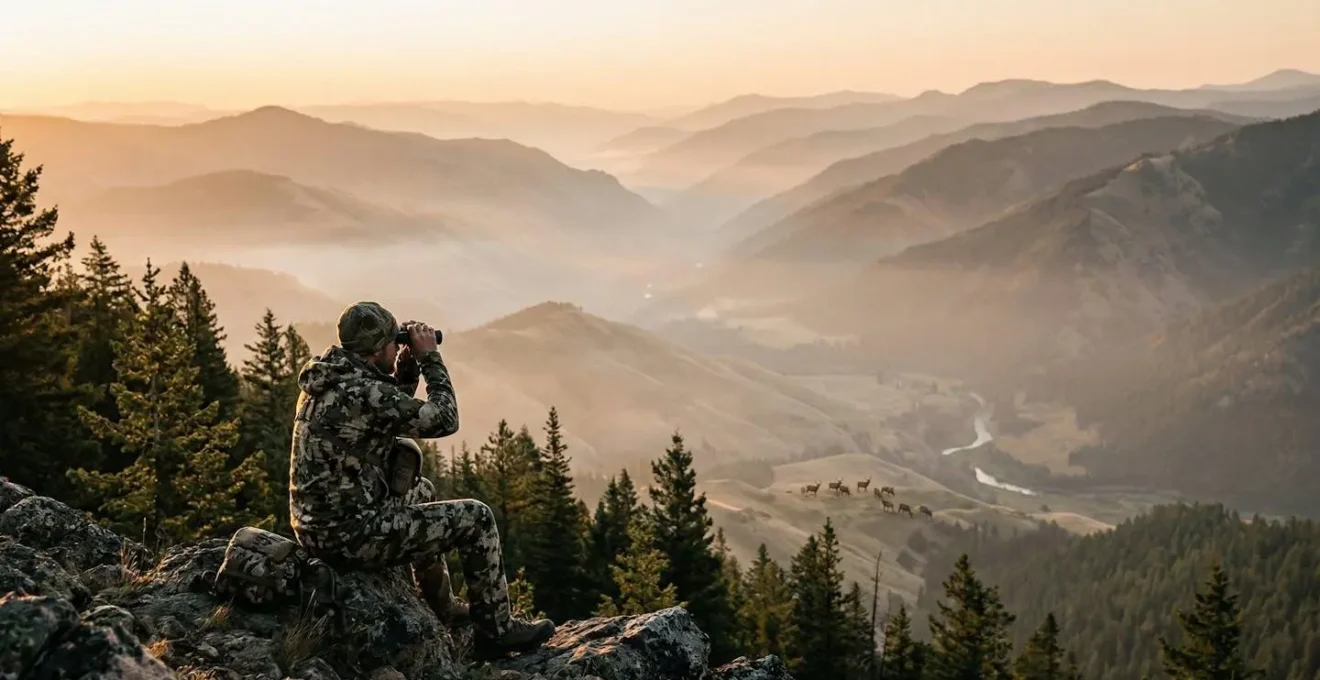
The greatest challenge for a wildlife enthusiast isn’t finding a rare animal, but observing it without causing the very disturbance that makes it disappear.
- Effective tracking is a discipline focused on silent movement and reading the environment, not just following tracks.
- Ethical observation relies on understanding an animal’s “zone of influence” and using optics as a bridge to see without stressing.
Recommendation: Shift your mindset from “finding the animal” to “becoming part of the landscape.” The most rewarding sightings happen when the animal never knows you were there.
The moment is electric. After hours of patient searching, you see it: the endemic species you traveled halfway across the world for. Your heart pounds. You raise your camera, but in the silent forest, the slightest rustle of your jacket, the snap of a twig underfoot, is a thunderclap. The animal’s head shoots up, and in a flash, it’s gone. This is the shared frustration of every wildlife enthusiast. Common advice tells us to “be quiet” or “look for tracks,” but these are superficial commands, not a methodology. They address the *what*, but ignore the crucial *how* and *why*.
The truth is, successful and ethical wildlife tracking is not a simple checklist. It is a profound discipline of sensory awareness and analytical thought. It involves mastering the art of silent movement, understanding how to read the landscape for subtle clues, and interpreting a behavioral timeline from the signs animals leave behind. This approach moves beyond simple identification to a deeper form of environmental reading, where you learn to anticipate an animal’s presence by understanding its world.
This guide abandons the platitudes. Instead, it offers a framework for developing the patience, observation, and respect of a professional naturalist. We will explore how to manage your own presence to minimize your “zone of influence”—the invisible bubble where your proximity causes physiological stress to wildlife. You will learn to use optics not just as viewing aids, but as ethical tools to bridge distances. This article will deconstruct the skills needed to transform you from a visitor in the wilderness into an invisible, respectful observer, capable of witnessing nature’s most private moments.
This comprehensive guide will walk you through the essential skills and strategic choices that separate a casual observer from a dedicated naturalist. We will cover everything from mastering silent movement to interpreting the subtle language of the wild, ensuring your encounters are both memorable and ethical.
Summary: The Art of Ethical Wildlife Tracking
- The Fox Walk: How to Move Silently to Avoid Spooking Skittish Animals?
- Scat Analysis: What Animal Droppings Tell You About Proximity and Diet?
- Spotting Scope vs Binoculars: Which Is Essential for Long-Distance Observation?
- Dawn or Dusk: When Are Endemic Predators Most Active in This Region?
- The 100-Yard Rule: How to Enjoy the Sighting Without Altering Behavior?
- Scratch Posts and Spray: How to Know if You Are in a Core Territory?
- Binoculars or Zoom Lens: How to Get ‘Close’ Without Stressing the Animal?
- Fauna Tracking Safaris: How to Interpret Predator Body Language for Safety?
The Fox Walk: How to Move Silently to Avoid Spooking Skittish Animals?
The foundation of all successful tracking is not what you see, but how you move. Most animals, especially skittish prey species, have evolved to detect the auditory rhythm of a bipedal walker. The typical “heel-toe” stride is a dead giveaway. To become invisible, you must unlearn this habit and adopt a practice of sensory discipline. The “Fox Walk” is a time-honored technique that breaks this rhythm and allows you to merge with the forest’s soundscape. It’s not just about being quiet; it’s about moving with intention and awareness.
This method transforms movement into a meditative practice. It involves lowering your center of gravity, testing the ground before committing your weight, and synchronizing your pace with the natural pauses of the environment. The goal is to eliminate the predictable cadence of human walking. This technique is paired with “Owl Eyes,” a method of using your peripheral vision to detect movement without the sharp, threatening turn of the head. By employing these skills, you’re not just sneaking; you’re actively becoming part of the environment.
As the illustration demonstrates, the key is the precise, rolling placement of the foot. This deliberate action allows you to feel for twigs or dry leaves that would snap under full weight, giving you a chance to adjust before making a sound. Mastering this requires practice, turning a simple walk in the woods into a training session for your senses and body control.
Action Plan: Mastering the Fox Walk
- Posture: Hold your body upright with knees slightly bent, as if a string pulls from the top of your head. Lower your center of gravity for better stability.
- Foot Placement: Place the outside ball of your foot (near the little toe) down first, testing the ground before transferring your full weight.
- Weight Transfer: Roll your foot laterally inward until both the inside and outside balls contact the earth, then slowly commit your weight.
- Pace Control: Move at approximately one step per minute when stalking close to animals. Use cycles of 25 steps followed by a 30-second pause to blend into the forest soundscape.
- Wide-Angle Vision: Employ the ‘Owl Eyes’ technique. Spread your arms wide and maintain peripheral vision at 180 degrees while keeping your head forward to detect movement without direct focus.
Scat Analysis: What Animal Droppings Tell You About Proximity and Diet?
While footprints tell you where an animal has been, its droppings—or scat—tell a much richer story. For a trained naturalist, scat is not just waste; it’s a biological postcard. It provides definitive information about species identification, diet, health, and, most importantly, proximity. The ability to “read” scat is what elevates a tracker from someone who finds signs to someone who can construct a behavioral timeline. This analysis helps you determine not just *if* an animal was here, but *when*, which is critical for predicting its current location.
The most crucial distinction is between fresh and old scat. Fresh droppings indicate the animal is likely nearby. As detailed by experts, fresh scat exhibits moisture, a strong scent, and clear coloration. In contrast, aged droppings become dry, crumbled, and faded as they are exposed to weather and insects. This simple observation can mean the difference between continuing on a cold trail and realizing you are closing in on your subject. Furthermore, the contents of the scat reveal the animal’s diet. The presence of fur and bone fragments points to a carnivore, while plant fibers, seeds, and berries indicate an herbivore or omnivore.
Identification can be further refined by shape. Wildlife tracking experts confirm that scat appears in 4 general shapes: plop, tubular, twisted, or pellet. Each shape is characteristic of certain animal families. For example, deer and rabbits produce pellets, canids like foxes and coyotes often have twisted scat with pointed ends, and bears typically leave large, amorphous plops. By combining these clues—freshness, content, and shape—a tracker can build a remarkably detailed picture of the unseen animal.
Expert Analysis: Aging Wildlife Scat
According to wildlife tracking guides, a key skill is determining the age of signs. Fresh animal tracks and scat indicate recent wildlife presence through tightly compressed soil with distinct outlines. As time passes, weather conditions, insects, and smaller animals cause track borders to collapse and secondary footprints to appear over original droppings. By examining consistency (moist vs. dry), scent intensity, and structural integrity, trackers can create a timeline. This estimation helps predict an animal’s current location and movement patterns, turning a simple discovery into a predictive tool.
Spotting Scope vs Binoculars: Which Is Essential for Long-Distance Observation?
Once you’ve honed your ability to move silently and read the signs, the next step is observing the animal without entering its zone of influence. This is where optics become an essential ethical tool, serving as an optical bridge between you and your subject. The two primary tools for this are binoculars and spotting scopes, and choosing the right one depends entirely on your objective. It’s not a question of which is better, but which is the right tool for the job. Binoculars are for scanning and locating; spotting scopes are for detailed, stationary observation.
As Wildlife Optics Experts from WildlifeCam state, “Spotting scopes are excellent for observing wildlife at long ranges. The magnification available with a spotting scope is much higher than with binoculars, often up to 60x.” This high magnification is their greatest strength and their primary weakness. While a scope allows you to count the feathers on a bird from a kilometer away, its narrow field of view makes it nearly impossible to track a moving animal or scan a wide landscape. It requires a tripod, adding weight and setup time.
Binoculars, on the other hand, are the workhorse of wildlife observation. They are lightweight, handheld, and offer a wide field of view, making them perfect for scanning a forest edge or following a herd on the move. Their lower magnification (typically 8x to 15x) is a trade-off for this versatility. For the serious enthusiast, the answer is often not one or the other, but both. Binoculars are used to find the animal, and the spotting scope is then set up for a prolonged, detailed, and respectful look from a safe distance.
The following table breaks down the key differences to help you decide which optical tool is essential for your specific needs, based on a comparative analysis of wildlife observation optics.
| Feature | Binoculars | Spotting Scope |
|---|---|---|
| Magnification Range | 8x-15x (typical) | 20x-60x or higher |
| Field of View | Wide (330+ feet at 1000 yards) | Narrow (51-100 feet at 1000 yards) |
| Portability | Lightweight (1.8-2.3 lbs), neck-strap ready | Heavy (3.3+ lbs scope + 2-4 lbs tripod) |
| Setup Time | Instant (handheld) | 30-60 seconds (requires tripod) |
| Best Use Case | Scanning wide areas, tracking moving wildlife, hiking | Stationary observation, long-distance detail, species ID at 800m+ |
| Eye Fatigue | Lower (binocular vision reduces strain) | Higher (monocular viewing over extended periods) |
| Optimal Distance | Close to medium range (up to 500m) | Long range (500m-2000m+) |
Dawn or Dusk: When Are Endemic Predators Most Active in This Region?
Timing is everything in wildlife tracking. While some animals are diurnal (active during the day) and others nocturnal (active at night), a vast number of species, particularly predators and their prey, are crepuscular. This term describes animals that are most active during the twilight hours of dawn and dusk. These periods offer a strategic advantage: there is enough light to see, but the low-angle light and long shadows provide excellent cover from predators and prey alike. For the wildlife enthusiast, these transitional hours are the “golden hours” of observation.
Understanding why these times are so active is key to planning your excursions. The cooler temperatures allow animals to conserve energy, and the changing light conditions create a window of opportunity for both hunting and foraging. According to research on crepuscular activity patterns, animals have approximately 1.5 hours before sunrise and after sunset to feed, find mates, and seek shelter. This is a finite and highly active window that you must be in position to observe before it begins.
Being present during these hours requires preparation. It means arriving at your observation point in the dark and waiting patiently for the world to awaken, or staying put as the light fades and the nocturnal shift begins. The challenge is to do so silently and respectfully. As wildlife ecology researchers have noted, crepuscular animals are especially sensitive to human presence, which can disrupt critical foraging or reproductive behaviors. Therefore, your mastery of silent movement and ethical distance is never more important than during these magical, but delicate, hours of the day.
The 100-Yard Rule: How to Enjoy the Sighting Without Altering Behavior?
The “100-Yard Rule”—maintaining a minimum distance of 100 yards (or about 91 meters) from most large wildlife—is a common guideline in national parks, but it’s more than just a rule. It’s a practical application of a deep ecological principle: minimizing your zone of influence. Every animal has a threshold for stress, and when a human crosses it, their behavior changes. They stop feeding, cease courtship, and switch from a relaxed state to one of high alert. The goal of ethical observation is to stay outside this zone, ensuring the animal’s behavior remains natural and unaltered by your presence.
The physiological impact of human proximity is well-documented. As wildlife ecology researchers point out, “Crepuscular animals are less likely to participate in typical foraging or reproductive behaviors and experience increased stress and mortality when humans are present.” This stress is not just a fleeting feeling; it has measurable biological consequences. When an animal perceives a threat, its body is flooded with stress hormones like cortisol, preparing it for a “fight or flight” response. This diverts energy away from essential functions like digestion, immune response, and reproduction.
A landmark study on this topic provides a clear illustration of the hidden costs of getting too close.
Case Study: Desert Bighorn Sheep Response to Human Recreation
A 2001 study by Papouchis et al., detailed in a report on wildlife activity and human impact, documented that hikers caused the most severe behavioral responses in desert bighorn sheep. The research found that human proximity elevates stress levels, disrupting essential behaviors. Even brief encounters had lasting physiological impacts, with cortisol levels remaining elevated long after humans had left the area. This research scientifically validates the need for maintaining ethical observation distances, showing that our presence leaves a biological trace even when we think we’ve gone unnoticed.
Scratch Posts and Spray: How to Know if You Are in a Core Territory?
As you move through a landscape, you are not just in a forest or a field; you are in a complex web of animal territories. Distinguishing between a simple travel corridor and an animal’s core territory is a critical tracking skill. A core territory is the heart of an animal’s world—where it sleeps, raises its young, and feels most secure. Intruding here causes the highest levels of stress. The landscape is filled with signs that communicate these boundaries, if you know how to look for them. These are not random marks, but deliberate messages left for other animals.
The most common territorial markers include scent markings from urine spray or glands, and visual markers like scratch posts (rubs) on trees or scrapes on the ground. The freshness of these signs is again the most important clue. A fresh rub on a tree will show bright, exposed sapwood and may even have a lingering scent. Old rubs will be weathered and grey. Similarly, fresh urine spray will have a potent odor, especially in humid conditions, and may still be visibly wet. A high density of *fresh* signs in a concentrated area is the clearest indicator that you are in a core territory.
Context is also crucial. Scat found in the middle of a trail or on a prominent rock is often a territorial statement, whereas scat found randomly in dense undergrowth is less likely to be. By mapping the density and freshness of these signs, you can practice effective environmental reading and make informed decisions about your route, choosing to go around a core area rather than through it. This not only respects the animal’s space but also increases your safety, as animals are most likely to be defensive near their den or young.
- Visual Inspection: Fresh territorial markers show wet spray residue, moist scent gland deposits, or fresh wood shavings at tree rubs with bright, exposed sapwood.
- Scent Detection: Use your sense of smell in humid or still air to detect active scent markings that are not visually obvious, a key tactic for elusive species.
- Contextual Analysis: Examine if scat is placed prominently on logs, rocks, or trail centers (territorial marking) versus randomly (travel route).
- Density Mapping: A high concentration of multiple fresh markers in one area indicates a core territory, while sparse, occasional signs suggest peripheral zones.
- Scrape Analysis: Look for accompanying ground scrapes or scratches near scat, which help differentiate active boundaries from transit areas.
Binoculars or Zoom Lens: How to Get ‘Close’ Without Stressing the Animal?
For the wildlife enthusiast who is also a photographer, the tension between getting a great shot and respecting the animal’s space is constant. A powerful zoom lens, like a spotting scope, can feel like a perfect solution—an optical bridge that allows for intimate-looking portraits from a safe distance. However, the ethics of wildlife photography go beyond just physical distance. The ultimate goal, as stated by GPS wildlife tracking experts, is for “the animal to never know you were there.” This philosophy should guide every decision you make, from your choice of lens to the click of your shutter.
A long zoom lens (400mm or more) is indispensable for this purpose. It allows you to fill the frame with your subject without having to physically approach and cross into its zone of influence. This is far more ethical than using a shorter lens and then heavily cropping the image, which often results in a lower-quality photo and may have tempted you to get too close in the first place. Using a tripod can further enhance your ethics, as it forces you to be stationary and patient, rather than actively pursuing an animal for a better angle.
Binoculars play a crucial supporting role. Before you even raise your camera, use your binoculars to scan the area and observe the animal’s behavior. Is it relaxed and feeding? Or is it watchful and tense? Only when you are certain the animal is undisturbed should you begin photography. This two-tool approach—binoculars for observation, zoom lens for documentation—is the hallmark of a responsible wildlife photographer. This respect for wildlife is a cornerstone of modern conservation, where technology is increasingly used to protect animals. For instance, data from GPS collars on elephants resulted in a 50% decrease in poaching in some protected areas, showing how technology can be a powerful force for good when used ethically.
Key Takeaways
- Movement is a Skill: Silent movement isn’t an instruction, it’s a learned discipline. Mastering the Fox Walk is the first step to becoming invisible.
- Signs Tell a Story: Animal tracks and scat are not just for identification. They are data points that allow you to build a behavioral timeline and predict an animal’s location.
- Distance is Respect: Your presence has a physiological impact on wildlife. Using optics as an “optical bridge” is the most ethical way to observe an animal’s natural behavior.
Fauna Tracking Safaris: How to Interpret Predator Body Language for Safety?
All the skills of a naturalist—silent movement, environmental reading, and patient observation—culminate in the most critical application: ensuring your safety, especially around predators. While attacks are extremely rare, understanding an animal’s body language is non-negotiable for anyone venturing into their habitat. Predators communicate their intentions clearly, but we need to learn their language. The key is distinguishing between curiosity, agitation, and aggression. Misinterpreting these signals can lead to a dangerous escalation.
A curious predator is not necessarily a threat. It may approach slowly, pause frequently, and cock its head. It is assessing you. In this scenario, the correct response is to remain calm, avoid sudden movements, and speak in a normal voice to identify yourself as human. Do not run, as this can trigger a chase instinct. An agitated predator, however, is giving you a clear warning to back off. It may huff, snort, or display “bluff charges”—short, stiff-legged bounces in your direction. This is not an attack; it is a communication to give it space. A fixed stare, raised hackles, and low growls are all definitive signs that you are too close.
Your response to agitation must be calm and deliberate. Avoid direct, prolonged eye contact, which is seen as a challenge. Make yourself appear larger by raising your arms (for bears) or stand your ground (for cougars, to avoid triggering a pounce). The goal is to de-escalate the situation by showing you are not a threat but are not easy prey either. Slowly backing away is the final step once the animal’s posture relaxes. The following table provides a guide to interpreting these crucial signals, based on information from wildlife identification resources.
| Body Language Signal | Curiosity (Safe Distance) | Agitation/Warning (Too Close) | Recommended Response |
|---|---|---|---|
| Head Position (Bear) | Head cocked, ears forward | Head low, ears back, huffing sounds | Freeze if curious; slowly back away if agitated |
| Vocalizations | Soft sounds, investigative sniffing | Huffs, coughs, low growls (communication: ‘give me space’) | Speak calmly, avoid sudden movements |
| Movement Pattern | Slow approach, pauses, indirect path | Stiff-legged bounce, direct approach, bluff charge | Stand ground for bluff; make yourself large (bear) or crouch (cougar) |
| Eye Contact | Brief glances, looks away | Fixed stare, pupils dilated | Avoid direct prolonged eye contact with predators |
| Body Posture | Relaxed, natural stance | Tense muscles, raised hackles, tail positioning (species-specific) | Assess species: make yourself big (bear) vs. avoid triggering chase (cougar) |
By embracing this deeper discipline of observation, you transform your relationship with the wild. Every trip becomes an opportunity to practice, to learn, and to witness the natural world with the quiet respect it deserves. Start applying these principles on your next journey and move from being a mere spectator to a true naturalist.