The “re-freeze” chill hikers feel isn’t a failure of their jacket, but a misunderstanding of the thermodynamic penalty paid for evaporating sweat from a saturated base layer.
- Synthetic fabrics don’t absorb moisture; they use capillary action to move it away from the skin, which is crucial for staying warm when you stop moving.
- Fabric performance is a system: the fiber’s properties (hydrophobic), the fabric’s structure (grid fleece), and the garment’s construction (flatlock seams) all work together.
Recommendation: Treat your base layer not as just a shirt, but as the primary engine of your personal micro-climate management system. Choose it based on activity level and an understanding of its material science.
Every hiker knows the feeling. You’ve been pushing hard uphill, your body a furnace, sweat pouring down your back. The moment you stop, a creeping, insidious chill begins. It feels like you’ve been plunged into an ice bath. This is the “re-freeze” effect, a dangerous thermodynamic reality that can lead to discomfort, rapid energy loss, and even hypothermia. The common advice is to “wear layers” or “avoid cotton,” but these are vast oversimplifications. They don’t address the core physics of the problem: your body is a heat engine, and the moisture trapped in your clothing is its greatest enemy during periods of rest.
The solution isn’t just about choosing a “synthetic” shirt; it’s about understanding how that synthetic fabric functions as part of a technical apparel system. Many believe any polyester shirt will do, but this ignores the nuances of fabric structure, seam construction, and even the unfortunate science of why synthetics can smell so bad. But what if the key wasn’t just to stay dry, but to manage moisture with the precision of an engineer? What if we could master the interplay between our body’s heat output and the fabric’s ability to move, not just absorb, water?
This guide moves beyond the platitudes. We will deconstruct the material science behind moisture-wicking fabrics from a thermodynamic perspective. We’ll explore why they work, their inherent tradeoffs, and how to leverage their properties to banish the re-freeze effect for good. From the microbiology of odor to the engineering of seams, you will learn to think like a fabric technologist and take control of your comfort and safety in the backcountry.
This article provides a detailed breakdown of the science and practical application of moisture-wicking fabrics. The following summary outlines the key topics we will cover to help you master your layering system.
Summary: Mastering Your Technical Apparel System to Beat the Chill
- Polyester Stink: Why Synthetics Smell Worse Than Natural Fibers?
- The Sink Test: Which Fabric Dries Fastest Overnight in a Tent?
- Water Repellency: Why Sweat Moves Away from Skin?
- Seam Placement: How to Avoid Rubbing Under Backpack Straps?
- Sun Protection: Does Wet Fabric Lose Its UV Blocking Ability?
- 150 vs 250 GSM: Which Wool Weight Fits Your Activity Level?
- RET and MVTR: What Do These Breathability Numbers Actually Mean?
- Planning Multi-Sport Wilderness Adventures: How to Transition from Biking to Kayaking Smoothly?
Polyester Stink: Why Synthetics Smell Worse Than Natural Fibers?
The most common complaint about synthetic base layers is their notorious tendency to develop a funky odor. This isn’t a flaw in your hygiene; it’s a direct consequence of the fabric’s material science. Unlike natural fibers like cotton or wool that absorb moisture, polyester is hydrophobic (water-hating) and oleophilic (oil-loving). This means that while it efficiently wicks away the watery part of your sweat, it readily absorbs the oily, nutrient-rich compounds, primarily sebum, that your skin produces.
This creates a perfect storm for odor-causing bacteria. A 2021 study on textile bacterial life cycles found that polyester’s surface acts like a selective buffet for specific microbes. In particular, a type of bacteria called Micrococcus thrives on these oil-rich synthetic fibers. According to a groundbreaking study published in Applied and Environmental Microbiology, Micrococci are almost exclusively found on synthetic shirts after a workout. These bacteria metabolize the sebum and sweat compounds, producing the volatile organic compounds (VOCs) that we perceive as body odor.
The smooth, non-absorbent nature of polyester fibers provides an ideal platform for these bacteria to colonize and proliferate. A sensory assessment confirms this, with a trained odor panel judging that polyester T-shirts smelled significantly less pleasant and more intense than cotton after incubation. So, while your synthetic shirt keeps you dry and warm, it’s also engineering a specialized, smelly microbiome right on your torso.
The Sink Test: Which Fabric Dries Fastest Overnight in a Tent?
The primary thermodynamic benefit of synthetics is their rapid drying time, which is critical for preventing the “re-freeze” effect. When you stop hiking, any moisture in your clothes will use your body’s precious thermal energy to evaporate, making you cold. Fabrics that release moisture quickly mitigate this thermal penalty. In this arena, synthetics are the undisputed champions. But why?
It’s not just about the fiber being hydrophobic; it’s about the structure of the fabric itself. Many high-performance synthetics, like grid fleece, are engineered with microscopic channels and a three-dimensional texture. This structure dramatically increases the fabric’s surface area, which is a key factor in accelerating evaporation. The grid pattern creates air channels that allow air to circulate close to the moisture, carrying it away more efficiently. This engineered approach is far more effective than a simple flat-faced fabric.
As the illustration shows, the raised grid sections wick moisture while the channels allow for airflow, creating a highly efficient moisture-moving system. The practical result is remarkably fast drying times. While merino wool is a great thermal regulator, synthetics’ raw drying speed is superior. In fact, field testing data shows that polyester clothing can dry completely in 2-4 hours indoors, and in as little as one hour in direct sun and open air. This means that after a strenuous, sweaty climb, a synthetic base layer has a much greater chance of being dry by the time you reach your next activity or make camp, directly contributing to your warmth and safety.
Water Repellency: Why Sweat Moves Away from Skin?
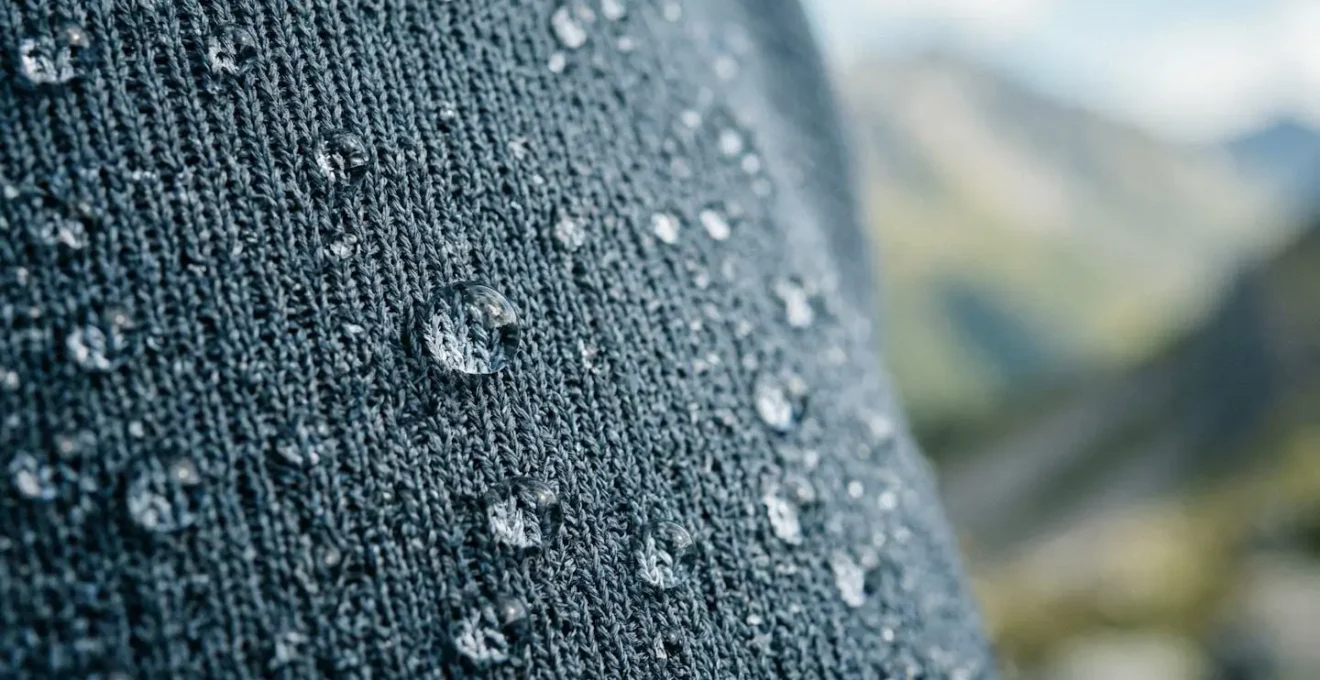
The term “moisture-wicking” is often used but rarely understood. It’s not magic; it’s a physical process called capillary action, driven by the fundamental properties of the synthetic fibers. As we’ve established, polyester is hydrophobic. This is not a surface treatment but an inherent property of its petroleum-based molecular structure. This is quantified by a metric called “moisture regain,” which measures how much moisture a fiber can hold. According to textile chemistry research from the American Chemical Society, polyester has a moisture regain of only 0.4%. For comparison, cotton’s is around 8.5%, and wool’s can be over 30%.
This extremely low absorption is the engine of wicking. Because the fibers themselves refuse to absorb water, sweat is forced into the tiny spaces *between* the fibers. This network of spaces acts like a series of microscopic straws. Capillary action, the same force that allows a paper towel to soak up a spill, pulls the liquid sweat along these channels, moving it from areas of high concentration (next to your skin) to areas of low concentration (the outer face of the fabric). The moisture spreads out across the exterior surface, which increases its exposure to air and dramatically speeds up evaporation, all without your body having to supply the heat to evaporate it directly from your skin.
Modern fabrics often enhance this effect with a bi-layer construction, as the American Chemical Society Textile Research Team explains:
Some types of sweat-wicking clothing have an inner layer next to the skin that is hydrophobic and an outer layer that is hydrophilic, creating a push/pull effect.
– American Chemical Society Textile Research Team, inChemistry – Don’t Sweat It
This “push-pull” system is the pinnacle of moisture management, actively pulling sweat away from your skin and pushing it to the outside to be evaporated, keeping your personal micro-climate dry and comfortable.
Seam Placement: How to Avoid Rubbing Under Backpack Straps?
Even the most advanced moisture-wicking fabric is useless if the garment’s construction creates pain points. For hikers, the most common culprit is seam chafing, especially under the high-pressure zones of backpack straps and hip belts. A poorly placed, bulky seam can create friction, lead to painful abrasions, and even compress the fabric, destroying its loft and wicking capabilities in that area.
The solution lies in the construction of the seam itself. Traditional seams, like those on a casual t-shirt, are typically overlocked, meaning the fabric edges are folded and stitched together, creating a raised, bulky ridge on the inside of the garment. Under the pressure of a 40-pound pack, this ridge becomes a point of intense friction. The gold standard in technical apparel is the flatlock seam. This construction method places the fabric edges side-by-side and stitches them together with a complex, flat stitch that results in a seam with virtually zero bulk.
The difference is not merely aesthetic; it’s a critical performance feature. As the visual comparison demonstrates, the flatlock seam lies flush against the skin, distributing pressure evenly and eliminating the friction points that cause chafing. A case study on hiking garment performance noted that flatlock seams are most critical for tight-fitting base layers. It also highlighted a key design choice in high-end apparel: offset seams. Instead of placing a seam directly on the top of the shoulder, where a backpack strap sits, designers will move it forward or backward, ensuring the strap rests on an unbroken panel of fabric. This combination of flatlock construction and intelligent seam placement is a hallmark of high-quality technical gear.
Sun Protection: Does Wet Fabric Lose Its UV Blocking Ability?
While managing moisture for thermal regulation is a base layer’s primary job, its role in sun protection is a critical secondary function, especially for adventurers in exposed, high-altitude environments. A common concern is how moisture affects a fabric’s Ultraviolet Protection Factor (UPF). The answer is complex and depends heavily on the fabric type and composition.
In general, for many fabrics, getting them wet can reduce their UPF rating. Water that fills the spaces between the fibers can act like a lens, potentially allowing more UV radiation to pass through to the skin. The swelling of fibers can also alter the weave structure, sometimes increasing and sometimes decreasing the protective-ness. A dry, tightly woven fabric typically offers the best protection because it presents a solid physical barrier to UV rays.
However, this is where material properties become nuanced. Some fabrics, particularly synthetics like polyester, are inherently quite resistant to UV radiation. Their chemical structure helps to absorb or reflect the rays. Furthermore, many technical garments are treated with specific UV-blocking agents or use fibers with UV-inhibiting particles (like titanium dioxide) embedded within them. In these cases, the UPF rating may be less affected by moisture. In contrast, a simple, untreated, light-colored cotton t-shirt, which might have a UPF of 5 when dry, can see its protection drop to as low as UPF 2 when wet—offering virtually no protection. This is another compelling reason to avoid cotton for serious outdoor pursuits.
150 vs 250 GSM: Which Wool Weight Fits Your Activity Level?
While synthetics excel at raw drying speed, merino wool offers a different, yet equally valid, approach to moisture management through the concept of “moisture buffering.” Unlike hydrophobic polyester, merino wool is hydrophilic and can absorb a significant amount of moisture within its fiber core. In fact, textile performance data demonstrates that wool fibers can absorb up to 35% of their own weight in water before feeling damp to the touch. This means wool can “buffer” a considerable amount of sweat, keeping your skin feeling dry even while the fabric is technically holding moisture.
The amount of wool available to perform this buffering is determined by its fabric weight, measured in grams per square meter (GSM). A lightweight 150 GSM base layer is ideal for high-output activities in mild conditions, offering good breathability. A heavyweight 250 GSM garment provides significantly more insulation and a larger moisture buffer, making it suitable for colder temperatures and more stop-start activities. However, this buffering capacity comes with a thermodynamic trade-off.
Case Study: The Trade-Off Between Moisture Buffering and Re-Freeze Risk
A comprehensive base layer evaluation detailed by a study on base layer drying times perfectly illustrates this dilemma. The study compared merino wool and polyester fabrics, noting that while merino showed superior moisture management during activity, it came at a cost. The report states that heavier merino fabrics, while providing excellent comfort by absorbing sweat, “require substantially longer drying periods during rest stops, directly increasing re-freeze risk in stop-start activities.” That larger moisture buffer, once saturated, becomes a significant thermal liability, taking much longer to dry than a synthetic counterpart.
Choosing the right GSM is therefore a calculated decision. For a strenuous, continuous effort where you’ll be sweating a lot, a lighter wool or a synthetic might be better. For a cold day with lots of stopping and starting (like backcountry skiing), a mid-weight wool can provide warmth and buffer moisture during exertion, but you must be prepared to manage the increased drying time and re-freeze risk during long breaks.
RET and MVTR: What Do These Breathability Numbers Actually Mean?
When evaluating technical shells and high-performance fabrics, you’ll often encounter arcane acronyms like MVTR and RET. These aren’t just marketing jargon; they are standardized lab measurements that attempt to quantify a fabric’s “breathability.” Understanding them empowers you to see past advertising claims and assess a garment’s true potential for managing your micro-climate.
MVTR (Moisture Vapor Transmission Rate) measures how much water vapor can pass through a square meter of fabric over a 24-hour period. It’s usually expressed in g/m²/24h. A higher number is better. For intense, high-output activities, you should look for fabrics where the MVTR exceeds 10,000 g/m²/24h to prevent condensation from building up inside your shell. This metric essentially tells you how quickly the fabric can vent the sweat that your wicking base layer is pushing outwards.
RET (Resistance to Evaporative Heat Transfer) measures the opposite: how much a fabric resists moisture transfer. For RET, a lower number is better, indicating less resistance and higher breathability. An RET score of 0-6 is considered very good, 6-13 is good, and anything over 20 is quite poor for active use. RET is often considered a more reliable, real-world metric by some experts because it accounts for the heat exchange component of comfort.
These numbers, however, must be put in the context of your body’s own output. As performance testing experts point out, it’s a simple equation of input versus output.
An MVTR of 20,000 g/m²/24h equals approximately 0.83 liters per hour. If you sweat 1 liter/hour, your jacket has a deficit, and moisture will build up.
– Outdoor Gear Performance Testing Experts, REI Expert Advice
This quote brilliantly highlights the thermodynamic reality. No matter how “breathable” your gear is, if your sweat rate exceeds the fabric’s transmission rate, you will get wet from the inside out. This reinforces the importance of not just choosing the right gear, but also managing your own physical output by pacing yourself and venting your layers proactively before you begin to sweat heavily.
Key Takeaways
- The “re-freeze” effect is a thermodynamic process where your body’s heat is used to evaporate moisture from clothing, causing a dangerous chill.
- Synthetic fabrics prevent this by using capillary action to move liquid sweat away from the skin to the fabric’s outer surface for evaporation, rather than absorbing it.
- A functional layering system is a holistic concept, where fabric choice (synthetics vs. wool), fabric weight (GSM), garment construction (flatlock seams), and proactive venting all play a role in managing your micro-climate.
Planning Multi-Sport Wilderness Adventures: How to Transition from Biking to Kayaking Smoothly?
Nowhere is the science of moisture management more critical than in a multi-sport adventure. Transitioning from a high-output activity like mountain biking to a more static, water-based one like kayaking presents a significant thermal challenge. You arrive at the transition point soaked in sweat, and now you must sit relatively still, exposed to potential wind and spray. This is a textbook scenario for the “re-freeze” effect. Successfully managing this transition is the hallmark of an experienced adventurer.
The key is to treat the transition as a deliberate, planned event aimed at resetting your thermal regulation system. The single most effective action you can take is to swap your saturated base layer for a completely dry one. This immediately removes the massive thermal liability of a wet shirt and gives your body a clean slate. Arriving with a “wet” layering system and simply throwing a splash jacket over it is a recipe for a cold, miserable, and potentially dangerous experience. A smooth transition relies on preparation and discipline.
This principle extends to your entire clothing strategy. For cold-weather adventures, outdoor clothing experts recommend a four-layer system: a wicking base layer, a fleece mid-layer for trapping air, an insulating layer for warmth, and a protective outer shell. The goal is to manage moisture and warmth across the entire system. Having a dedicated dry base layer ready is the ultimate tool for this.
Action Plan: Efficient Baselayer Change Protocol
- Pre-pack a dedicated dry baselayer in an easily accessible waterproof dry bag, separate from your main gear, before you start the first activity.
- During the transition, immediately use a small pack towel to dry the sweat from your skin’s surface. Removing the surface moisture is a critical first step.
- Remove the saturated baselayer and immediately put on the dry replacement to reset your thermal regulation system before you have a chance to get cold.
- Store the wet baselayer in a separate, isolated compartment or its own dry bag to prevent its moisture from contaminating your dry gear for the next leg of your journey.
Ultimately, preventing the post-activity chill is about thinking of your clothing not as individual items, but as an integrated system for managing heat and moisture. By understanding the thermodynamic principles and material science at play, you can move beyond simply buying gear and begin engineering your own comfort and safety in any environment.