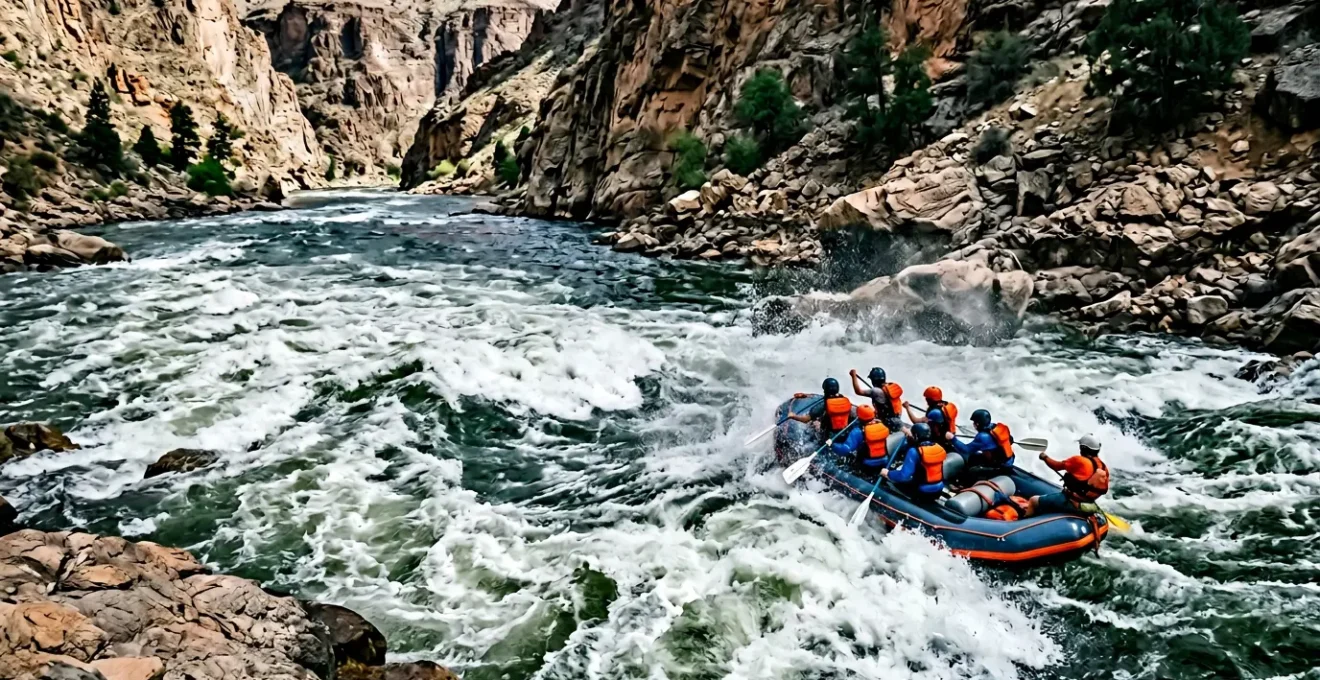
Most believe surviving a hydraulic is about swimming hard. The truth is it’s about understanding energy and hydrology to work with the water, not against it.
- Your survival depends more on the proactive decisions you make—like gear choice and scouting—than your reactive swimming ability.
- Advanced rescue PFDs (Type V) and specific wetsuit thicknesses are non-negotiable tools, not optional upgrades.
Recommendation: Shift your focus from fearing the swim to mastering the complete system of safety: reading water, using leverage, and managing your body’s energy.
The image is seared into the mind of every aspiring whitewater rafter: being trapped in the churning, recirculating maw of a hydraulic hole. It feels like a washing machine you can’t escape, and every instinct screams to fight your way to the surface. Most safety advice centers on generic platitudes like “stay calm” or “swim aggressively.” But for the rafter staring down the throat of a Class IV rapid, this advice is functionally useless. Fear isn’t conquered by willpower; it’s conquered by superior knowledge and a drilled, mechanical response.
The secret to surviving a hydraulic—and all advanced whitewater hazards—isn’t about being the strongest swimmer. It’s about understanding the physics of the river and the biomechanics of your own body. It’s a system of safety where your gear, your team, and your ability to read the water are just as critical as your actions during a swim. The common belief is that you must fight the river. The reality is you must learn to outsmart it by conserving energy, using leverage, and making critical decisions long before you find yourself underwater.
This guide moves beyond the platitudes. We will deconstruct the mechanics of whitewater safety, from the paddle strokes that keep you out of trouble to the gear that saves your life when you’re in it. This is not a list of tips; this is a system for transforming fear into a clear, executable plan of action.
This article provides an in-depth breakdown of the essential skills and knowledge required for advanced whitewater safety. Explore the table of contents below to navigate through the critical components of this safety system.
Contents: A System for Advanced Whitewater Safety
- Forward vs Draw: Which Stroke Turns the Raft Faster in an Emergency?
- Type III vs Type V: Which Life Jacket Do You Need for Big Water?
- The Horizon Line: How to Spot Hazards You Can’t See from the Boat?
- The T-Rescue: How to Get a Capsized Raft Back Upright in 30 Seconds?
- Wetsuit Thickness: How to Prevent Cold Shock on Spring Runoff Rivers?
- The Trap Point: Identifying Sections with No Higher Ground Before You Enter
- The Heel Hook: How to Get Back in a Canoe When Your Muscles Are Freezing?
- Planning Multi-Sport Wilderness Adventures: How to Transition from Biking to Kayaking Smoothly?
Forward vs Draw: Which Stroke Turns the Raft Faster in an Emergency?
In a critical moment, the ability to pivot a 1,000-pound raft instantly is paramount. The debate between a forward stroke and a draw stroke for turning speed misses the point. The most powerful turn isn’t about a single stroke type; it’s about the synchronized opposition of strokes. The fastest way to pivot a raft is to have one side paddle forward while the other side back paddles. This creates a powerful rotational force that spins the boat on its central axis.
The forward stroke provides thrust to break the pull of a hydraulic, while the draw stroke offers lateral movement to slip into an eddy. However, in aerated, “foamy” water where a paddle blade struggles to find purchase, a lateral draw stroke loses its effectiveness. In these conditions, the forward/backward pivot is superior. An even more powerful variation is the sweep stroke, particularly for paddlers in the rear. By extending the paddle blade as far out from the raft as possible and drawing a wide arc, you create a longer lever, generating maximum rotational torque.
Ultimately, the critical factor is not the stroke itself, but the team’s ability to execute commands in unison. An analysis of professional guide techniques on the Ocoee River shows that successful hole navigation depends entirely on synchronized paddle commands. A guide’s call of “RIGHT TURN!” must trigger an immediate, unified response: right side backs up, left side digs in forward. This is a drilled, mechanical action, not an individual choice.
This coordinated effort is the first layer in the system of safety, preventing incidents before they require a rescue.
Type III vs Type V: Which Life Jacket Do You Need for Big Water?
Not all Personal Flotation Devices (PFDs) are created equal. For calm water, a standard Type III PFD, providing a minimum of 15.5 pounds of buoyancy, is sufficient. It is designed for comfort and mobility. However, in Class III-IV whitewater, the risks escalate from simply needing to float to potentially needing to be rescued. This is where a Type V Rescue PFD becomes a non-negotiable piece of equipment.
The defining feature of a Type V PFD is its integrated quick-release rescue harness. This is a belt system with a high-visibility pull cord and a metal O-ring on the back. In a live-bait rescue scenario, a rescuer on shore can clip a rope to this O-ring. If the swimmer becomes entangled or the situation becomes unsafe, pulling the cord releases the entire harness, freeing the swimmer from the rope. A standard Type III PFD has no such feature, meaning a rope attachment could become a deadly anchor.
Beyond the harness, Type V PFDs often offer more buoyancy (up to 22 pounds), extensive storage for rescue gear, and reinforced shoulder straps for extraction. The trade-off is slightly reduced mobility compared to the streamlined design of a Type III. However, this is a small price to pay for the immense increase in safety and rescue capability.
The choice is dictated by the environment. The following table breaks down the critical differences, based on an expert comparison for whitewater paddlers.
| Feature | Type III PFD | Type V Rescue PFD |
|---|---|---|
| Minimum Buoyancy | 15.5 pounds | 15.5-22 pounds |
| Quick-Release Harness | No (convertible with accessory) | Yes (integrated rescue belt with quick-release buckle and O-ring) |
| Primary Use | Recreational paddling, active swimming, self-rescue mobility | Swiftwater rescue, live-bait rescue, advanced technical scenarios |
| Training Required | No | Yes (formal swiftwater rescue certification) |
| Swimming Mobility | High (streamlined design prioritizes freedom of movement) | Moderate (additional rescue features may reduce active swim efficiency) |
| Storage/Pockets | Moderate | Extensive (radio pockets, MOLLE attachments, gear integration) |
Choosing a Type V PFD for big water is a proactive decision that prepares you not just to survive a swim, but to be an active and safe participant in a potential rescue.
The Horizon Line: How to Spot Hazards You Can’t See from the Boat?
The most dangerous feature on a river is the one you don’t see coming. A horizon line—where the river drops away from view—is the river’s ultimate warning sign. It signals a significant drop, which could be a clean waterfall or a deadly, inescapable hydraulic. Reacting to a horizon line as you arrive at it is too late. The key is a proactive scouting protocol.
The moment a horizon line is detected, either visually or by its tell-tale roar, the command must be to pull over immediately and scout from the shore. A designated scout team must assess three critical factors: the type of hydraulic, its aeration level, and the available exit routes. As expert rescuer Matt Cuccaro explains, some features are far more dangerous than others.
Be especially wary of frowning holes—those with edges that curve upstream, feeding back into the center—and quiet, or relatively unaerated, hydraulics.
– Matt Cuccaro, Rescue Canada, Paddling Magazine – How To Escape A Hydraulic
A “frowning” hydraulic is more retentive than a “smiling” one (where the edges curve downstream, directing water out). A quiet, glassy hydraulic is often more powerful and harder to escape than a chaotic, foamy one because its recirculating current is more uniform. Based on this scouted information, the team makes a Go/Portage/No-Go decision. If the decision is to run the rapid, the scout communicates the precise line: the entry point, the required strokes, and where to position body weight for high-siding.
This is not an optional procedure; it is a rigid, professional protocol. Scouting transforms a blind gamble into a calculated execution. It is the single most important proactive safety skill in whitewater.
Ignoring a horizon line is the most common path to catastrophe. Respecting it is the hallmark of an expert rafter.
The T-Rescue: How to Get a Capsized Raft Back Upright in 30 Seconds?
A capsized raft in moving water is a crisis defined by chaos and limited time. An effective T-Rescue—the standard procedure for righting a raft—is not about brute strength; it’s about a clear, drilled protocol that prioritizes people over equipment. The first 10 seconds are the most critical, and they have nothing to do with the boat.
The immediate priority is a headcount. The guide must confirm all paddlers are accounted for. The next step is to assign roles. Swimmers in the water are not liabilities; they are assets. An upstream swimmer becomes a lookout for new hazards, while others are directed to grab the perimeter line of the overturned raft. The guide then directs one or two people to climb onto the bottom of the raft. By grabbing the perimeter line on the far side and leaning back, they use their body weight as a lever to flip the boat upright. Simultaneously, other swimmers can be “weaponized” to assist, pushing on the raft to help it roll or clearing tangled ropes.
This “people-first” approach ensures that panicked swimmers are given clear, purposeful instructions, transforming chaos into a coordinated effort. The entire sequence, from capsize to recovery, can be practiced on calm water or even on land to build the muscle memory required for a high-stress environment. According to professional rescue protocols, the focus is on turning victims into active participants in their own rescue.
Action Plan: People-First T-Rescue Protocol (First 30 Seconds)
- Seconds 0-3: Immediate Headcount: Guide calls out ‘COUNT OFF!’ starting from position one.
- Seconds 3-5: Assign Lookout Roles: Upstream swimmer becomes lookout for incoming hazards.
- Seconds 5-10: Secure Swimmers: Swimmers grab perimeter line (chicken line) and await instructions; do NOT attempt unsupervised re-entry.
- Seconds 10-20: Execute Flip: Guide directs one or two swimmers onto the hull to use their weight as a lever, while others push from the water.
- Seconds 20-30: Recover Swimmers: Once raft is upright, execute assisted rescue, pulling swimmers in by their PFD shoulder straps.
By focusing on a clear, human-centric sequence, a potentially disastrous capsize becomes a manageable, albeit intense, 30-second drill.
Wetsuit Thickness: How to Prevent Cold Shock on Spring Runoff Rivers?
In whitewater, especially during spring runoff when rivers are fed by snowmelt, the greatest threat is not drowning, but hypothermia. Cold water immersion triggers an involuntary gasp reflex (cold shock) that can cause you to inhale water. It also rapidly saps muscle strength, making self-rescue nearly impossible. The right thermal protection is your primary defense, and the choice between a wetsuit and a drysuit is a critical one.
A wetsuit works by trapping a thin layer of water against your skin, which your body then heats. Its effectiveness is determined by its neoprene thickness, measured in millimeters (e.g., 4/3mm). A drysuit, conversely, keeps you completely dry with waterproof seals at the neck and wrists; you wear insulating layers underneath. The choice depends on a combination of water temperature, air temperature, and the likelihood of a long swim.
According to the American Canoe Association’s cold water safety guidelines, thermal protection is mandatory when the combined air and water temperature is below 120°F (48°C), or when water temperature alone is below 60°F (15°C). For the extreme cold of early spring runoff, a drysuit is superior. For moderate spring conditions, a thick wetsuit (4/3mm or 5/4mm) is adequate. This decision matrix is not about comfort; it’s about survival.
This table provides a clear decision-making framework for trip leaders based on environmental conditions.
| Condition | Water Temp | Air Temp | Anticipated Swim Time | Recommended Protection | Rationale |
|---|---|---|---|---|---|
| Early Spring Runoff | <50°F | <60°F | High (Class IV+ technical difficulty) | Drysuit + Thermal Layers | Extended swim time likely; drysuit keeps you completely dry for superior heat retention |
| Late Spring | 50-60°F | 60-70°F | Moderate (Class III rapids) | 5/4mm or 4/3mm Wetsuit (Farmer John + Jacket) | Wetsuit adequate for shorter swims; easier mobility than drysuit |
| Summer Low Water | >60°F | >70°F | Low (Class II-III) | 3/2mm Wetsuit or Splash Jacket | Minimal thermal protection needed; prioritize freedom of movement |
| Combined Temp Rule | Water + Air < 120°F | Any | Thermal Protection Mandatory | American Canoe Association cold water threshold guideline |
Underestimating the cold is a fatal mistake. Dressing for the swim, not for the paddle, is a core tenet of whitewater safety.
The Trap Point: Identifying Sections with No Higher Ground Before You Enter
Some sections of a river are a commitment. Once you enter a steep-walled gorge or canyon, there may be no way out except at the other end. An equipment failure, an injury, or an unrunnable rapid in one of these “trap points” can turn an incident into a life-threatening epic. Identifying these commitment zones *before* you launch is a macro-level safety skill that relies on one of the oldest tools of navigation: the topographic map.
Before the trip, a thorough analysis of 1:24,000 scale topographic maps is essential. Gorge sections are easily identified by looking at the contour lines. Where the lines are tightly packed on both sides of the river, it indicates steep canyon walls with no escape routes to higher ground. The distance of these committed sections must be measured to calculate the “commitment time” based on the river’s flow.
During this pre-trip analysis, you must also identify potential emergency camps—any small beaches or ledges within the gorge—and mark all tributary junctions, which can serve as emergency exit routes. This map study creates a mental model of the entire river run, highlighting high-consequence zones. It allows the team to establish an external communication plan, programming a satellite messenger with pre-designated waypoints for potential extraction if an emergency occurs within a committed canyon.
This “proactive read” of the landscape is a fundamental part of expedition planning. It shifts safety from a boat-level concern to a trip-level strategy, ensuring that you are aware of every point of no return long before you reach it.
The choices you make with a map at your kitchen table are often more critical to your safety than the ones you make in the middle of a rapid.
The Heel Hook: How to Get Back in a Canoe When Your Muscles Are Freezing?
After a long swim in cold water, your muscles are screaming, your grip is failing, and your energy is gone. Trying to haul yourself back into a raft or canoe with pure upper-body strength is a losing battle. This is where a biomechanical technique that prioritizes leverage over power becomes a lifesaver: the heel hook. It is a core self-rescue skill that allows you to re-enter a boat when your muscles have already given up.
The technique works by using your body’s center of gravity and skeletal structure, not exhausted muscles. The sequence is a fluid application of physics. First, position yourself perpendicular to the side of the boat, with one hand on the near side and one on the far side for stability. The critical phase is momentum: kick hard to get your hips as close to the surface as possible. As your body rises, you “hook” one heel over the far edge (gunwale) of the boat. Your leg is now a rigid lever.
By rolling your body weight onto this hooked heel, you pivot your center of gravity over the gunwale and into the boat, swinging your other leg in behind you. It is a graceful, energy-efficient roll, not a muscular pull-up.
The heel hook utilizes your body’s center of gravity and skeletal structure to succeed when your muscles have failed due to cold and fatigue.
– Professional River Guide Training Manual
This technique must be practiced in a controlled environment until it is second nature. In a real-world scenario, you will be cold, tired, and possibly panicking. Having this mechanical sequence burned into your muscle memory allows you to execute it without conscious thought, conserving the last of your precious energy.
It is a perfect example of the safety system at work: when physical strength fails, superior technique and an understanding of leverage take over.
Key Takeaways
- Proactive safety (scouting, gear choice, map reading) is more effective than reactive skill.
- Advanced whitewater demands specialized gear; a Type V PFD and appropriate thermal wear are not optional.
- Team synchronization and clear communication are the foundation of raft control and rescue.
Planning Multi-Sport Wilderness Adventures: How to Transition from Biking to Kayaking Smoothly?
In a multi-sport adventure, the transition from a land-based activity like mountain biking to a water-based one like kayaking is a point of high risk. It requires more than just changing gear; it demands a complete physiological and cognitive reset. The physical demands shift from lower-body endurance to upper-body anaerobic power, and the risk profile changes dramatically. A fall on a trail is not the same as a swim in a Class IV rapid.
The physiological transition must be managed to prevent cramping and energy crashes. This involves a pre-transition protocol: hydrating with electrolytes, performing lower-body static stretches, fueling with complex carbohydrates, and finally, activating the upper-body muscle groups with dynamic stretches right before launching. Starting with a few minutes of low-intensity paddling allows the cardiovascular system to adapt to the new demands.
Even more critical is the cognitive reset. Competence on the trail does not translate to competence on the river. Professional guides treat the water leg as an entirely new trip, conducting a full safety briefing at the staging area. This includes checking PFD fit, reviewing paddle signals, and assigning rescue roles, even if the team is experienced. This practice prevents the dangerous assumption that a team that works well on land will automatically work well on water. The consequences are different, the communication is different, and the environment is far less forgiving.
Case Study: The Risk Mindset Reset
Expert multi-sport guides emphasize that a fall from a bike might lead to an abrasion with easy rescue access, while a swim in a remote canyon introduces risks of drowning and hypothermia. They enforce a full safety briefing at the water’s edge, recalibrating the team’s risk awareness. This psychological reset prevents the dangerous complacency that can follow success in the first leg of an expedition.
By consciously managing both the physical and mental transition, you ensure that your safety system remains robust and that your team is prepared for the unique challenges of the water.